Tryouts · All sports
How to evaluate players at tryouts: basketball, volleyball, soccer and hockey
By the CourtClok team · Updated October 2026 · 10 min read · 15 sources
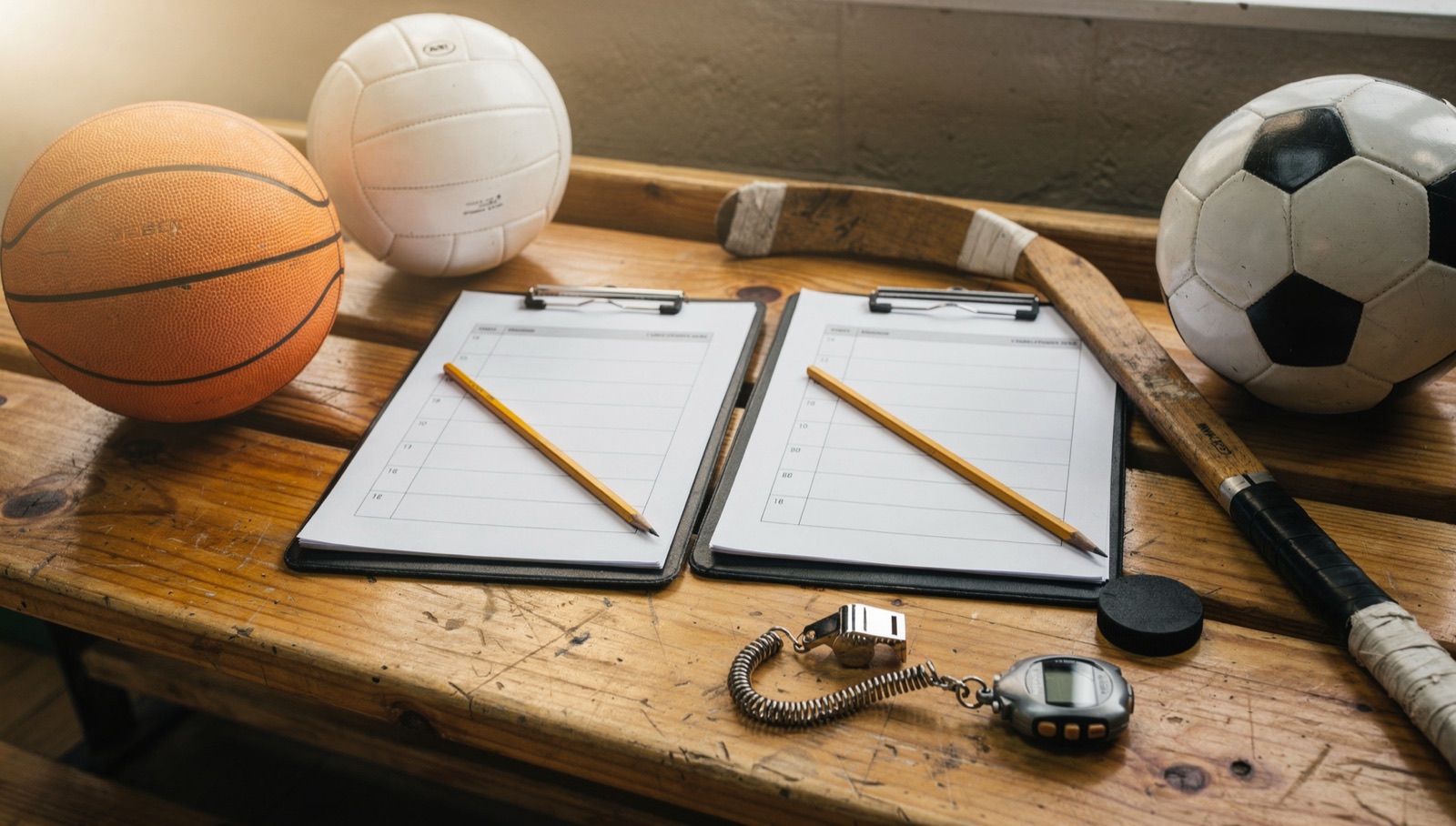
In every sport, the fairest tryouts share six habits: more than one session, a number on every player, evaluators with no connection to the kids, a 1–5 scale with each level defined, a check on birth months, and private, prompt conversations about results. What changes by sport is what you test and how.
Six rules that hold in every sport
- More than one session. Every governing body and coaching source we read prefers two or three sessions to one. In basketball, "two 60-minute tryouts are far better than one 120-minute tryout" (Basketball for Coaches). Hockey Canada wants at least two sessions before anyone is released (Hockey Canada).
- A number on every player. Rate numbers, not names (Positive Coaching Alliance). Keep the same number for every session.
- Independent evaluators who do nothing else. No relatives rating family (Basketball BC), no coaches rating their own division (Hockey Regina), and evaluators who don't also run drills (AYSO; Art of Coaching Volleyball).
- A defined scale. Use 1–5 (or 1–4) and write what each number means (NFHS). Whole numbers only, using the full range (Hockey Canada).
- Check birth months. The relative age effect shows up in all four sports, see the next section.
- Private, prompt, specific results. Tell players soon after the last session, individually, with reasons and somewhere else to play, and set expectations in writing beforehand (Sport for Life).
The relative age effect, sport by sport
Grouping by birth year means some players are nearly a year older than others at the same tryout. Older, more mature kids get picked more often, and the research shows the same pattern in all four sports:
| Sport | Finding | Source |
|---|---|---|
| Basketball | "Too often it is the early maturing athlete who gets to make the elite teams"; late maturers often become the better athletes | Canada Basketball LTAD |
| Volleyball | Only 6.03% of selected boys and 11.42% of selected girls were born in Oct–Dec; height and jump predicted selection | Frontiers in Psychology, 2020 |
| Soccer | Coaches rated specific skills fairly, but their overall ratings leaned toward early-born players (16,138 players) | Leyhr et al., 2021 |
| Hockey | Canadian minor hockey: 30.4% born Jan–Mar vs 19.8% Oct–Dec; major junior: 41.6% vs 11.2% | Lemoyne et al., 2021 |
The fix that works on paper: score each skill row first and total them, rather than starting from an overall impression. That's where the soccer study found coaches were fairest. Write birth year on every card, so you can see whether your roster skews old.
What changes from sport to sport
| Basketball | Volleyball | Soccer | Hockey | |
|---|---|---|---|---|
| Best game format to watch | 3v3 half court, short 5v5 | Wash games, Queen of the Court, 6v6 | 4v4 to 7v7 small-sided games | Small-area games, then scrimmage |
| Measurable test | Timed spot-up shooting | 0–3 pass rating, 0–4 serve rating | None standard; rate in games | Skating and pivots both ways |
| Specialists | — | Setters and liberos, rated in role | Goalkeepers, own evaluator | Goalies, own sessions and evaluator |
| Most over-weighted trait | Size and early maturity | Height | Size and speed of early-born kids | Size; past reputation |
| Age rules to know | No zone defense at younger ages | Growth spurts change positions | No heading U11 and under (U.S.) | Body checking starts at U15 / Bantam |
Basketball
Rate ball handling, shooting, finishing, passing, on-ball and help defense, rebounding, conditioning, IQ and coachability. Spend most of your attention on the bubble group and use short 5v5 games to separate them. Don't skip rebounding: it's "under-tested at tryouts" (Basketball for Coaches). Full detail, drills and a sample session: How to evaluate basketball players at tryouts.
Volleyball
Count first contact: rate every serve-receive pass 0–3 and every serve 0–4. Top passers average around 2.3–2.4 (CoachingVB). Then watch short, intense games, and judge setters and liberos by how the team plays with them. Full detail: How to evaluate volleyball players at tryouts.
Soccer
Evaluate mostly in small-sided games, rotating players through stations while evaluators stay put ("players rotate, not evaluators"), with a separate evaluator for goalkeepers (AYSO). Full detail, including U.S. and Canadian formats by age: How to evaluate soccer players at tryouts.
Hockey
Run skills, then small-area games, then a scrimmage. Evaluators "watch the players, not the game," use no half points, and rate what they see today (Hockey Alberta). Goalies get their own sessions. Full detail, including appeals: How to evaluate hockey players at tryouts.
Questions coaches ask
What's the fairest way to run a youth tryout?
More than one session, a number on every player, independent evaluators with no connection to the players, a defined 1–5 scale, a check on birth months, and private, prompt conversations about results.
What is the relative age effect?
Players born early in the selection year are picked more often, largely because they're older and more mature. It's been documented in basketball, volleyball, soccer and hockey.
Are the tryout evaluation forms free?
Yes. There is a free printable PDF for each sport, with a tryout-number box, ten 1–5 skill rows, notes and a decision row, two players per page.
Running the games after tryouts? CourtClok keeps the score and player stats on your phone, puts the scoreboard on any TV and can livestream games with the score on screen. Free to start; some features need a paid plan.
Get the appSources
- Easing the Pain of Cutting Kids — Sport for Life (Sulz et al.)
- 5 Tips for Removing Biases from Tryouts — Positive Coaching Alliance
- High School Coaches Using Rubrics — NFHS
- How to Run Basketball Tryouts — Basketball for Coaches
- Player Selection Process Policy — Basketball BC
- Long-Term Athlete Development — Canada Basketball
- Tryout Checklist — The Art of Coaching Volleyball
- Scoring Serving and Passing Effectiveness — CoachingVB
- Relative Age Effect in Polish Youth Volleyball — Frontiers in Psychology (2020)
- Open Tryout Procedures Handbook — AYSO
- Relative age and coach ratings — Leyhr et al. (2021)
- Player Evaluation and Selection Guide — Hockey Canada
- Player Evaluation & Selection Resource Guide — Hockey Alberta
- 2026 Evaluations — Hockey Regina
- Relative Age Effect in Canadian Hockey — Frontiers (2021)