Tryouts · Soccer

How to evaluate soccer players at tryouts

By the CourtClok team · Updated October 2026 · 14 min read · 16 sources

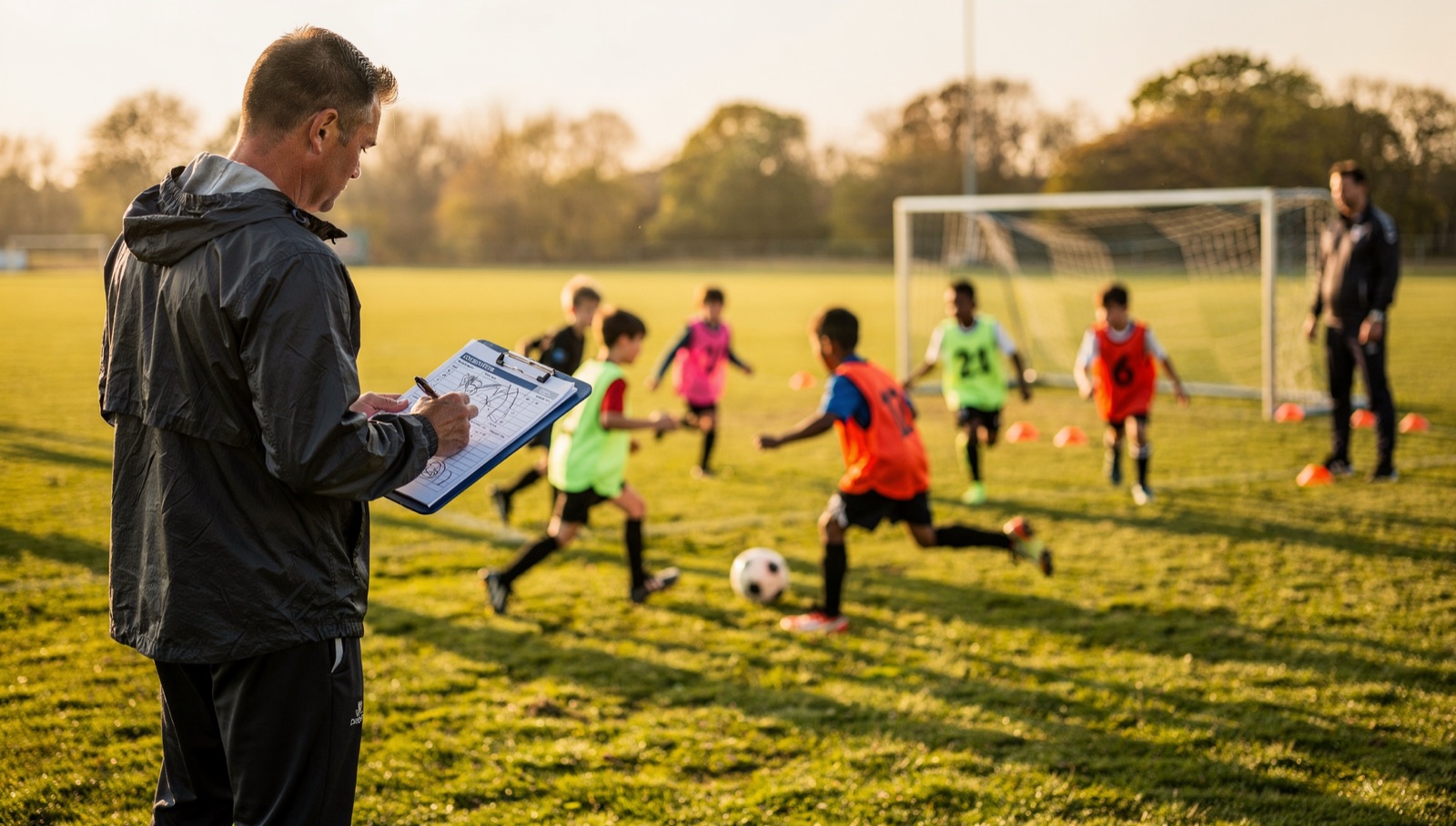
A coach with a clipboard watches kids in numbered bibs play a small-sided game at a youth soccer tryout
AI-generated illustration.
The short answer

Evaluate soccer players mostly in small-sided games, not lines and cones, across two or more sessions. Give every player a number and use neutral evaluators who do nothing else. Rate technique, decisions and attitude from 1 to 5 with defined levels, judge goalkeepers separately, and check birth months so older kids don't win by size alone.

Soccer tryouts at a glance

DecisionWhat the sources recommend
FormatSmall-sided games over isolated drills, because "players who have the best skills may not be the best players in matches" (SoccerHelp).
SessionsMore than one. Players "have good days and bad days" (Burlington SC). Placement should rest on "consistent observation over time – not a single session" (Calgary Blizzard SC).
EvaluatorsNeutral evaluators who do no other job, using "the same defined process at every tryout" (AYSO).
NumbersEvery player wears a unique number for every session (AYSO; Burlington SC).
Scale1–5 with a written description of each level (AYSO).
BirthdaysKnow each player's birth month. Birth-year groups still contain kids "up to 364 days older" (U.S. Soccer PDI).

How to structure the sessions: the AYSO station model

AYSO's open tryout handbook is one of the most complete published tryout procedures in U.S. youth soccer, and it scales down well for a single club team (AYSO).

AYSO open tryout format (source)
ElementHow AYSO does it
Warm-up20 minutes, run by a coach who is not an evaluator
Stations4 stations: Technical (6v6 keep-away), Tactical, Functional Attacking, Functional Defending (6v6 plus goalkeepers, full-size goals)
Station length20 minutes each on roughly a 50 × 50 yd grid, with 10-minute breaks
RotationGroups of 12 rotate; "players rotate, not evaluators"
Team size5 to 7 a side; at most 2 goalkeepers per goal, alternating
Evaluators2 field evaluators + 1 goalkeeper evaluator per station (11 for a full tryout)

Why games and not drills: small-sided games show "game speed" under pressure. A player who looks great in a passing line may not find space in a game, and vice versa (SoccerHelp). Avoid full 11v11 scrimmages at tryouts, because players can "hide weaknesses in crowd" (Digital Record Board).

Scaled-down plan for one team (75 minutes)

MinutesBlockWhat you're rating
0–12Warm-up with a ball (run by a non-evaluator)First touch, attitude, listening
12–27Rondo or 4v2 / 5v2 keep-awayFirst touch, passing under pressure, scanning
27–401v1 and 2v1 to small goalsDribbling, defending, courage
40–704v4 or 5v5 games on a small field; reshuffle teams every 8–10 minutesDecisions, movement off the ball, shooting, stamina
70–75Cool-down; evaluators finish cards—

Tip: Calgary Blizzard places U10–U13 players through small-sided games and U14–U19 in a team-training setting (Calgary Blizzard SC). Match the format to the age.

What to evaluate in field players

AYSO's rubric gives each station its own criteria and adds a separate 1–5 score for "Sportsmanship, Coachability, Attitude and Leadership" at every station (AYSO):

  • Technical: dribbling (turning, touch, shielding, feints, change of speed), passing (accuracy, pace, timing, deception), receiving (multiple surfaces, moving into the line of the ball, cushioning, setting up the next move).
  • Tactical: field awareness, communication, leadership, team shape, play on and off the ball, supporting runs.
  • Attacking: keeping the ball under pressure, creating space, turning a defender, going directly at goal, timing of shots.
  • Defending: control and balance, marking distance, goal-side and ball-side positioning, stopping the attacker from turning, tackling.
Form rowWhere to see itA 5 looks likeA 1–2 looks like
First touch & ball controlRondos, receiving in gamesTouch sets up the next action, uses either foot and many surfacesBall bounces away, needs two or three touches to control
Passing (short & long)Rondos, gamesRight weight and timing, can switch playPasses behind teammates, only one foot
Dribbling & 1v11v1 to small goals, gamesBeats a player and keeps going, protects the ballLoses it on the first challenge, or never takes a player on
Shooting & finishingSmall-sided gamesHits the target, picks a side, shoots early when it's onRushes, blazes over, won't shoot
Defending & tackling1v1 and gamesGoal-side, patient, wins the ball cleanlyDives in, gets turned, fouls
Positioning & movement off the ballGamesOffers an angle, makes runs, recovers shapeStands still, follows the ball like a bunch
Speed & agility1v1s, races to loose ballsQuick over 5–10 yards and changes direction sharplySlow to react and to turn
StaminaLast game of the sessionSame intensity at the end as at the startFades and walks late
Soccer IQ / decisionsGamesChooses pass, dribble or shot correctly, scans before receivingSame bad choice repeatedly
Coachability & effortAfter any coaching pointApplies it on the next ball, encourages othersIgnores it, complains

SoccerHelp's scrimmage checklist is a good thing to read before the first game: who defends bravely, who scores, who passes well, who hogs the ball, who shows courage in contact, who wins the ball and forces turnovers, and who moves well off the ball (SoccerHelp).

Fitness testing: we found no authoritative fitness standard for youth soccer tryouts. Some guides mention timed runs and shuttles without benchmarks. The free form rates speed and stamina from what you see in games, which is more honest than an arbitrary time.

How to evaluate goalkeepers

Use a separate evaluator for keepers. AYSO staffs a goalkeeper evaluator at every station (AYSO). Its keeper rubric covers:

  • Ready position and adjusting to the angle
  • Taking the initiative from the attacker and reading the line
  • Focus, and clear, loud communication
  • Starting the attack, making saves, and range of distribution

Other useful things to watch: handling high balls under pressure, 1v1s, decisions about coming off the line, and composure after a mistake (Digital Record Board). Rotate keepers so each one faces both a busy and a quiet half. A keeper who barely touches the ball in a game hasn't been evaluated.

Tip: You can use the same form for keepers. Write "GK" in Position(s) and use the Notes column for handling, positioning, distribution and decisions.

Scoring and evaluators

  • Describe every number. AYSO's 1–5 scale runs from Outstanding to Needs Improvement, with words for each level (AYSO). Example definition for passing at 5: "consistently delivers balls to target feet under pressure" (Digital Record Board).
  • Simpler alternative: SoccerHelp suggests placing each player in the top, middle or lower third of the group (SoccerHelp). It's quick, and it works as a first pass before detailed scoring.
  • Evaluators do nothing else. No running drills, no checking players in (AYSO).
  • Same number every session. Burlington SC hands out numbered shirts and asks players to wear them to every session (Burlington SC).
  • Give every player their evaluation. AYSO gives each player a copy of their evaluation summary, marked selected or not selected (AYSO).
  • Weighting: we found no authoritative source for weighting categories. Ignore any "40/40/20" formula you see online unless your club has decided on it.

The relative age effect: soccer's best-documented bias

Youth soccer groups players by birth year (January 1 to December 31 in the U.S.). That means a January-born and a December-born player can be almost a year apart in the same tryout.

FindingSource
Players born early in the selection year are over-represented, and early-born players were taller and heavierSoccer and Relative Age Effect (PMC)
A 2023 meta-analysis of 563 samples found the effect strongest in adolescence, and rising with the level of playBozdech et al. 2023
In 16,138 German talent-program players, coaches' skill-specific ratings barely tracked relative age (|r| ≤ 0.11), but their overall current and future ratings leaned toward early-born playersLeyhr et al. 2021
Among 3,364 U.S. female players, the effect appeared at club and talent-ID-center levels but not at youth national team levelFinnegan et al. 2024
Birth-year registration "doesn't eliminate" the effect; coaches should know birth monthsU.S. Soccer PDI

The German finding is the practical one. Coaches judged specific skills fairly but drifted toward older players in their gut-feel overall ratings. Score the ten skill rows first and total them; don't start from an overall impression.

  • Record birth year (and month if you can) on the card. Some researchers suggest making birth quarter visible to evaluators, for example through shirt numbers (PMC).
  • Coach education alone isn't enough: "Isolated coach education is not sufficient" (PMC). Build the check into the process.
  • Bio-banding, grouping by maturity rather than age, gave late developers "more opportunity to… express themselves" in a University of Bath study with Premier League clubs (University of Bath).

Age-appropriate formats (U.S. and Canada)

Evaluate players in the format they actually play. U.S. Soccer's Player Development Initiatives set small-sided standards by age:

U.S. Soccer small-sided standards (PDI; overview)
AgeFormatFieldGame time
U6–U84v4, no goalkeepers25–35 × 15–25 yd4 × 10 min
U9–U107v755–65 × 35–45 yd2 × 25 min
U11–U129v970–80 × 45–55 yd2 × 30 min
U13+11v11Full field—
  • Heading (U.S.): no heading for U11 and younger, in practice or games; limited heading practice at U12–U13 (SoccerWire). Don't evaluate heading at those ages.
  • Canada: Canada Soccer's long-term development pathway builds play up to age 12 on small-sided games with "no league standings," and introduces position-specific technique later (Canada Soccer LTPD).
  • At the youngest ages the decision is often grouping, not cutting. Use the form's Development group option.

Telling players the result

  • Call players who didn't make it before the roster is posted. Never leave "not selected" in a voicemail (Soccer America).
  • Give positives and things to work on, follow up with a short letter, and stay available afterwards.
  • Give every player a written summary, as AYSO does (AYSO). The Strengths and Areas to develop lines on the form are written for this.

Common soccer tryout mistakes

What coaches say on video

We watched coaches’ tryout videos and read their transcripts. These are the specific, usable points from each. Where they disagree with each other or with the guidance above, we say so.

Designing a Tryout Session!

Inside Surf Soccer · YouTube
  • Three phases: 10–15 minutes of ball activation (for comfort, not assessment), 1v1 lanes where players can score on either goal, then 5v5 to 7v7 games.
  • Grow the 1v1s into 2v2 and 3v3 with end-line players.
  • Keep stoppages and coaching to a minimum. Short games keep the tempo high.

A Player Centered Approach to Youth Soccer Tryouts

Coach KW · YouTube
  • A pool of 5–7 neutral evaluators picks teams, not the coaches. No one rates an age group where they coach or have a child.
  • No drills: players play the format they're moving into (e.g. 9v9), because unfamiliar drills make kids choke.
  • Four categories at 25% each: technical, tactical, physical and "engagement". Physical is reduced at younger ages to counter big-kid bias.
  • Bubble swaps only when scores are within 2 points.

Running Successful Soccer Tryouts

Coaches Training Room · YouTube
  • All evaluators agree uniform criteria: game intelligence, scanning, balance, first touch, desire.
  • Balance short repetition stations with small-sided games, because players perform differently in each.
  • Beware of picking for early physical maturity.

Questions coaches ask

Should soccer tryouts use drills or games?

Mostly small-sided games. They show decisions at game speed, and skilled drill players aren't always the best in matches. Use a few short technical drills, then 4v4 to 7v7 games.

How many evaluators do I need for a soccer tryout?

At least two who do nothing else, plus one for goalkeepers if you can. AYSO's full model uses two field evaluators and one goalkeeper evaluator per station.

What is the relative age effect in soccer?

Players born early in the birth year are picked more often, largely because they're older and more physically mature. Record birth months and score specific skills before forming an overall view.

How do you evaluate a goalkeeper at tryouts?

Use a separate evaluator and watch ready position, angles, handling, coming off the line, 1v1s, communication, distribution and composure after mistakes.

Is the soccer evaluation form free?

Yes. It's a free printable PDF with a tryout-number box, ten 1–5 skill rows, notes and a decision row, two players per page.

Running the games after tryouts? CourtClok keeps the score and player stats on your phone, puts the scoreboard on any TV and can livestream games with the score on screen. Free to start; some features need a paid plan.

Get the app

Sources

  1. Open Tryout Procedures Handbook — AYSO
  2. Player Development Initiatives — U.S. Soccer (PDF)
  3. Five Things to Know About the PDIs — U.S. Soccer
  4. Canada Soccer Pathway LTPD Community Guide
  5. US Club Soccer heading guidelines — SoccerWire
  6. Soccer and the Relative Age Effect — PMC
  7. Relative age effect meta-analysis — Bozdech et al. (2023)
  8. Relative age and coach ratings — Leyhr et al. (2021)
  9. Relative age in U.S. female soccer — Finnegan et al. (2024)
  10. Bio-banding study — University of Bath
  11. Soccer Tryouts Evaluation Form — SoccerHelp
  12. Select & Travel Soccer Tryout Tips — SoccerHelp
  13. Assessment FAQs — Burlington SC
  14. Player Placement — Calgary Blizzard SC
  15. Tryouts: the worst part of coaching — Soccer America
  16. Soccer Tryout Drills for Effective Evaluations — Digital Record Board