By the CourtClok team · Updated October 2026 · 14 min read · 15 sources
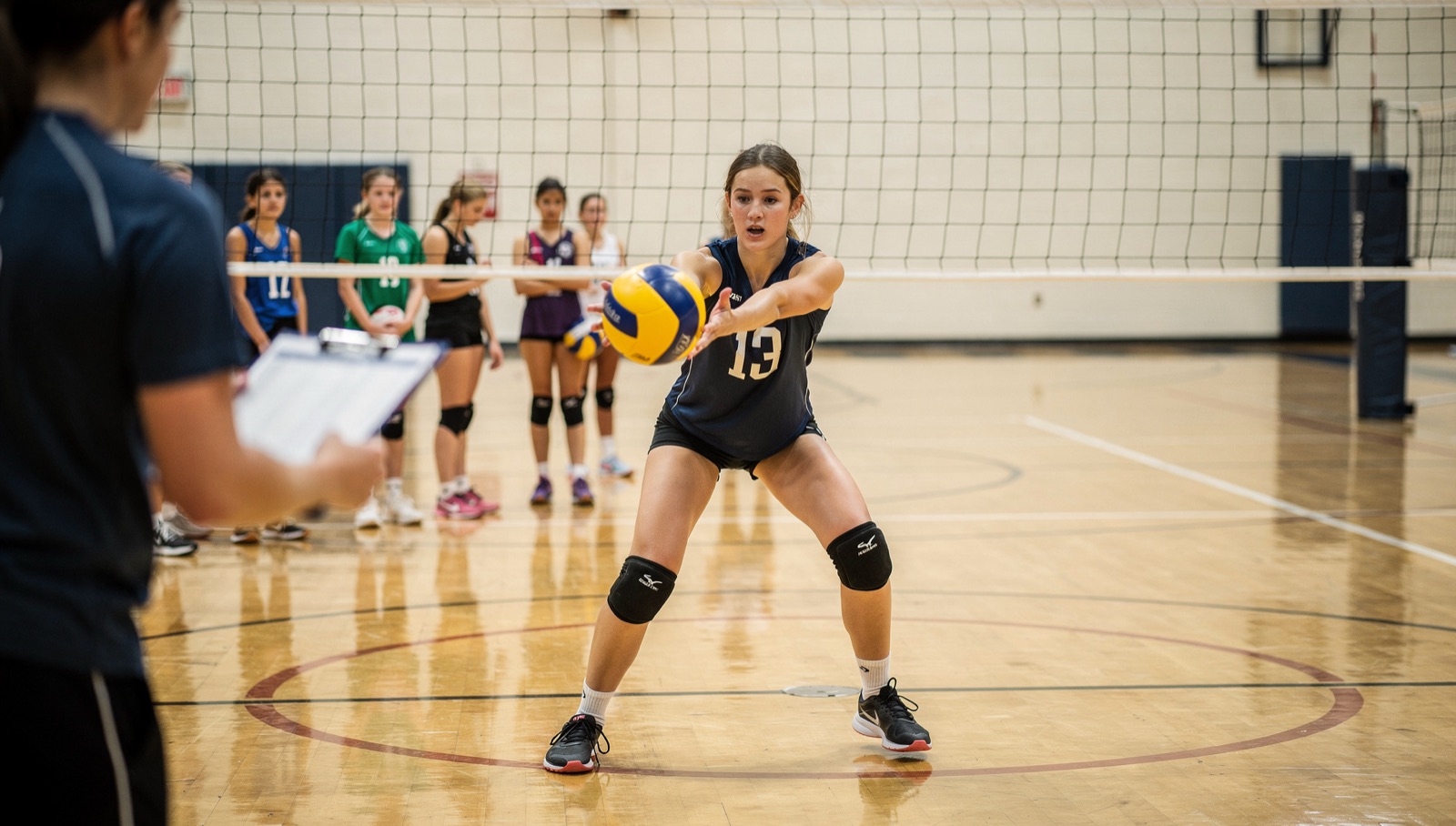
AI-generated illustration.
The short answer
Test serving and first contact with numbers you can count (a 0–3 pass rating and a 0–4 serve rating). Then watch players in small-sided and 6v6 games, with numbered shirts and evaluators who stay on one court. Rate each skill 1 to 5, judge setters and liberos in their role, and don't let height decide.
Volleyball tryouts at a glance
Decision
What the sources recommend
Order
Athletic testing, then position work, then team play with players placed on courts by ranking (JVA).
Games
Short, intense games: "Play to 7 or 8 points or 3 balls to each side" (JVA). Queen of the Court shows who wins (Smarter Volley).
Separate drill runners from evaluators, keep evaluators on one court, and use numbered shirts (Art of Coaching Volleyball).
Height
Matters most for middles and opposites, least for setters and liberos. Never the deciding factor alone (CoachingVB).
Telling players
Soon, privately, with reasons and somewhere to keep playing (Sport for Life).
Before tryouts
Hold a parent meeting during tryouts covering format, criteria and cost. Have the club director and a coach available for players who aren't selected. Offer an alternate tryout date for players who can't attend (Art of Coaching Volleyball).
Define the standard in advance. Write it down, and make sure every player gets a written evaluation. A spreadsheet works (Smarter Volley).
Keep the same evaluators all the way through and make the criteria clear to them (JVA).
Pair experienced coaches with newer ones. Keep drill runners and evaluators as separate people (Art of Coaching Volleyball).
Numbered shirts or nametags for everyone. Numbers also make video review possible later (Art of Coaching Volleyball). The free form starts every card with a Tryout no. box.
Know what you're looking for. Before day one, list the roles you must fill: your strongest left-side attackers and servers, at least two setters, and players who can pass and dig (Smarter Volley).
How to structure the sessions
JVA's sample club structure runs athletic testing first, then 30–60 minutes of position work, then team play. Players are placed on courts by ranking so that, as Art of Coaching Volleyball puts it, "the best players [should] see the other best players" (JVA; Art of Coaching Volleyball). USA Volleyball's women's national team open tryout followed the same shape with 238 athletes: measurements and jumps, single-position drills, multi-position drills, then 6v6 (USA Volleyball).
Serve receive in groups of 3, every pass rated 0–3
Passing: the skill that wins youth matches
60–85
Position stations: hitting lines, setter reps, libero dig and tip coverage
Attacking, setting, defense
85–120
Short games: wash games, Queen of the Court, then 6v6
Volleyball IQ, communication, competing
Tip: Skip the mile run. Coach Trinsey's advice is to test what the sport needs. Timed distance runs aren't it, and small-group games show more than isolated drills (Smarter Volley).
Games that show decisions under pressure
Wash games: a team must win two rallies in a row to score a point. Players have to produce twice (CoachingVB).
Bonus points for a sideout or a transition kill reward the skills you want (CoachingVB).
Queen of the Court: the top six Queen of the Court players are often your starters (Smarter Volley).
Rate passing and serving with numbers
Passing and serving can be scored ball by ball, which makes them the most objective part of a volleyball tryout. Use the same definitions for every evaluator.
Benchmarks: CoachingVB says teams aim for a 2.0 average or better, and top passers average about 2.3–2.4 (CoachingVB). Definitions aren't standardised. Art of Coaching Volleyball scores an overpass as a 1, not a 0 (Art of Coaching Volleyball). Pick one version and tell your evaluators.
Turning averages into the 1–5 form score: average a player's passes or serves, then place them against the group. For example, a passer averaging 2.3+ is a 5, around 2.0 is a 4, and so on. Decide the bands before tryouts, not after. To test ball control, Art of Coaching Volleyball uses the Coleman-McKenzie drill, alternating forearm pass and set at least 6 feet above the head, aiming for 25–50 in a row (Art of Coaching Volleyball).
What to evaluate in every skill
For each skill (passing, setting, serving, attacking, blocking) Art of Coaching Volleyball looks at three things: physical strength (can they hold a defensive position, move explosively, generate arm speed), technique (footwork and body position) and accuracy (consistency) (Art of Coaching Volleyball).
Form row
Where to see it
A 5 looks like
A 1–2 looks like
Serving (accuracy & consistency)
Serve test, games
Tough serves that still go in; puts teams out of system
Misses often, or only floats easy balls in
Serve receive / passing
Rated serve receive
Averages 2+ on the 0–3 scale, moves feet before arms
Swings arms, shanks, avoids the ball
Setting (hands & location)
Setter station, games
Hittable sets from good and bad passes, consistent location
Location varies, double contacts, only sets perfect passes well
Attacking / hitting
Hitting lines, games
Full approach, hits around the block, hits the off-speed shot on purpose
Stutters approach, one shot, nets or hits long
Blocking (timing & hands)
Blocking footwork, games
Closes the block, presses over, times the jump
Late, reaches, drifts
Defense / digging
Dig and tip station, games
Reads the hitter, low and balanced, keeps digs on the court
Upright, reacts late, ball goes everywhere
Footwork & court movement
Every station, transition in games
Gets to the ball early and balanced, efficient approach
Arrives late, reaches instead of moving
Athleticism (jump, speed)
Measurements, approach and block jumps, shuttle
Explosive jump and first step for the age group
Slow first step, low jump
Volleyball IQ & communication
Wash games, 6v6
Calls the ball early, reads and anticipates, adjusts to bad balls
Silent, collisions, same mistake each rally
Coachability & effort
After any correction
Fixes it next rep, chases every ball
Repeats the error, gives up on balls
In live play, Art of Coaching Volleyball watches for players who communicate early, balance the court, adjust to bad balls and read the play. Some kids "are just play-makers," and that can make up for limited experience (Art of Coaching Volleyball). CoachingVB's priorities run in this order: first-contact reliability, game awareness, athletic ceiling vs what the player can contribute now, position-specific value, and competitive response and coachability (CoachingVB).
Setters and liberos
Evaluate specialists in their role: "Give them repeated reps in their role, then evaluate how the team functions with them on the floor" (CoachingVB). A setter who makes everyone on her court hit better is worth more than her individual numbers suggest. Liberos should spend their station time receiving serve and digging hard-driven balls and tips (JVA).
Scoring the card
JVA's sample structure scores players 1–5 across position training, component play and attitude/effort, with notes to support each ranking (JVA). (Note: JVA uses 1 = elite. The CourtClok form uses 5 = standout. Tell your evaluators which way you count.) CoachingVB offers an even lighter option: mark each moment "helps / neutral / hurts the team," with "short notes, not essays," such as "late to seam" (CoachingVB).
Use the Notes column for evidence: "2.4 pass avg", "3 aces in 10", "setter: hitters better with her".
We found no authoritative source giving numeric weights between skills. If you weight passing more heavily for a younger team, decide it beforehand.
Height, birthdays and other biases
Height
Height is the most visible attribute in a volleyball gym and the easiest to over-weight. CoachingVB's view: height should not be the deciding factor, and how much it matters depends on position. It matters for middles (speed to the attack and block point) and opposites, and matters least for setters and liberos (CoachingVB). Record height and reach on the card, then score skill separately.
Relative age and maturity
A study of Polish youth volleyball found players born early in the year over-represented in selected groups. Only 6.03% of selected boys and 11.42% of selected girls were born in the last quarter of the year. Vertical jump, height and spike reach predicted who got picked (Frontiers in Psychology, 2020). The authors recommend talent ID that accounts for age and maturity differences and uses open-skill agility tests rather than pure measurements.
Write birth year on every card so you can check whether your roster skews old.
When two players are close, ask who is ahead on skill and reading the game, not on size or jump.
Volleyball Canada's long-term development model warns that mismatching activities to a player's development stage has "serious negative consequences" (Volleyball Canada).
Coachability
One club coach writes that "95% of coaches are willing to lose more games in order to protect their team from the uncoachable" (Active.com). That's an opinion, not a statistic, but it's a common one. Treat effort errors differently from careless ones.
Telling players the result
Research by Dr. Lauren Sulz and colleagues (52 interviews, 1,667 surveys) recommends telling players as soon as possible after the final tryout, privately rather than by public list, with somewhere else to keep playing, and with expectations set up front for athletes and parents (Sport for Life).
Give the outcome first, then specific reasons. Don't cite things the player can't change (height is the classic one). Put the feedback in writing.
One-on-one meetings are best. With very large numbers, one club announced rolling cuts at each session instead (CoachingVB).
For offers, consider a 24-hour window to commit before moving to the waitlist. Give brief feedback during tryouts so nobody is blindsided (JVA).
Copy the Strengths and Areas to develop lines from the form into a short note for every player, including those who make the team.
Common volleyball tryout mistakes
Testing fitness the sport doesn't use, like mile runs (Smarter Volley).
No written criteria and no written evaluation for each player (Smarter Volley).
Judging setters on their own numbers instead of on how the team plays with them.
What coaches say on video
We watched coaches’ tryout videos and read their transcripts. These are the specific, usable points from each. Where they disagree with each other or with the guidance above, we say so.
Pairs measured tests with an intangibles checklist, because some players freeze in 6v6 and games alone misjudge them.
Example tests: 15 tossed passes counting only perfect 3s; best-of-10 serving plus a 1–5 "aggressive factor" (a missed tough serve can still score well); 10 sets to a taped target.
"Teach the test" before tryouts, publish a day-by-day timeline and film from a corner.
Writes the positions needed on a whiteboard ("I need 2 setters, 4 passers") so players understand roles are being filled.
One coach uses a timed run, judged on steady pacing and helping teammates rather than the time. Other coaches skip runs entirely. This is a genuine disagreement.
Runs skill work after conditioning to see who keeps their quality when tired.
Questions coaches ask
What is the 0–3 pass rating in volleyball?
Each serve-receive pass is scored 3 (setter has every option), 2 (about two options), 1 (one option or a non-setter sets) or 0 (aced or overpassed). A team average of 2.0 or better is a common target.
How do you evaluate a setter at tryouts?
Give setters repeated reps in their role, then watch how the team plays with them on the floor: hittable sets from bad passes, consistent location and decisions, not just their own touches.
How much should height matter at volleyball tryouts?
It depends on position. It matters most for middles and opposites and least for setters and liberos. Record it, but score skill separately and don't let height decide on its own.
Should volleyball tryouts include a fitness test?
Test what the sport uses: approach and block jumps and short agility or shuttle runs. Long timed runs tell you little about volleyball players.
Is the volleyball evaluation form free?
Yes. It's a free printable PDF with a tryout-number box, ten 1–5 skill rows, notes and a decision row, two players per page.
Running the games after tryouts? CourtClok keeps the score and player stats on your phone, puts the scoreboard on any TV and can livestream games with the score on screen. Free to start; some features need a paid plan.