By the CourtClok team · Updated October 2026 · 14 min read · 14 sources
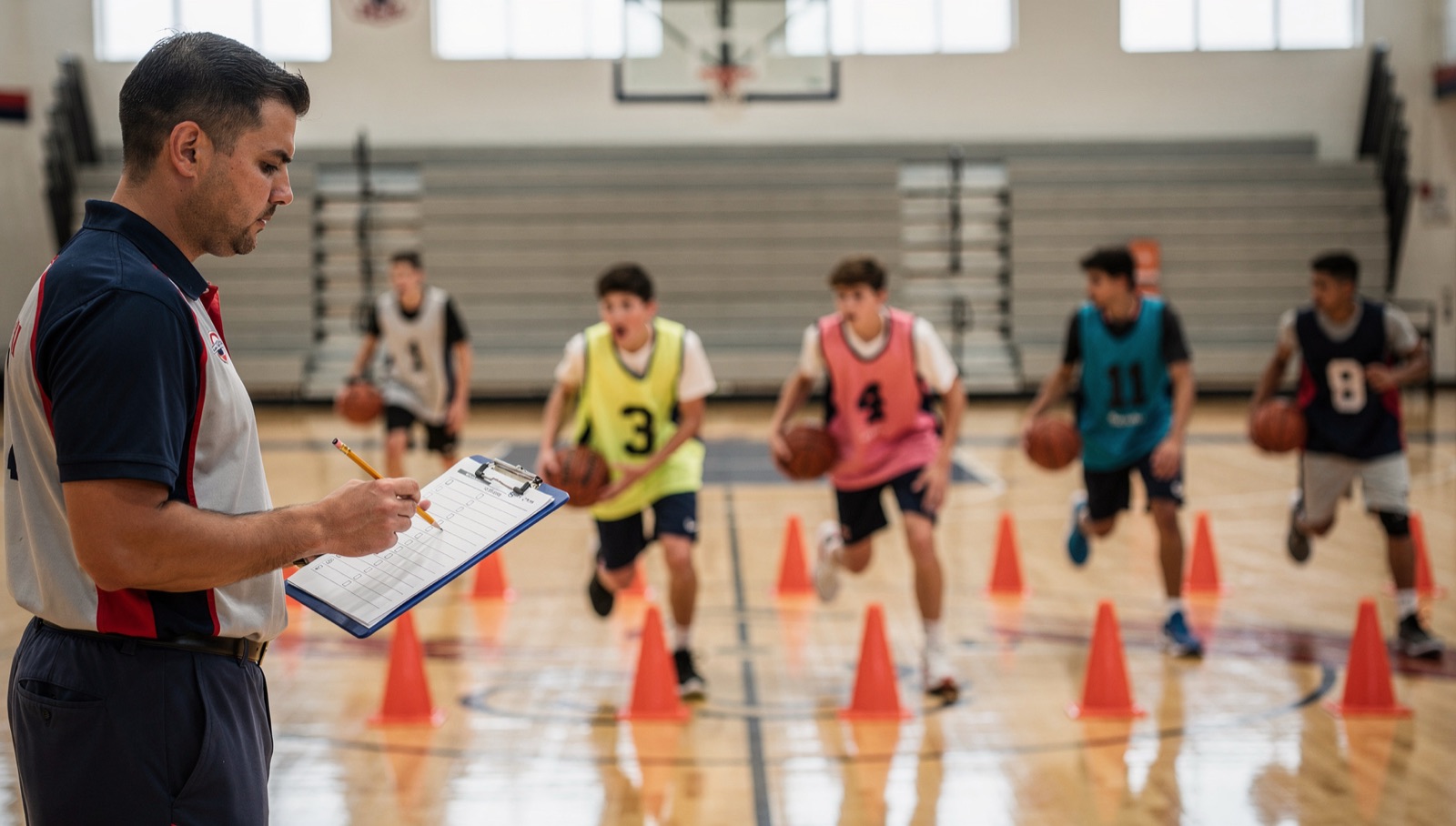
AI-generated illustration.
The short answer
Run at least two short sessions, not one long one. Put a number on every player, use evaluators with no connection to the kids, and rate ten skills from 1 to 5 in drills and small-sided games. Spend most of your attention on the bubble players, then tell every player the result privately and soon.
Basketball tryouts at a glance
Decision
What the sources recommend
How many sessions
Two or three short sessions in the same week. "Two 60-minute tryouts are far better than one 120-minute tryout." (Basketball for Coaches)
Most tryout complaints come from surprises: parents didn't know what was being judged, who was judging, or how cuts would be delivered. NFHS reports that high school coaches who publish rubrics before tryouts find cut conversations turn into development conversations (NFHS). Researchers who surveyed 1,667 people about being cut recommend explaining the process to players and parents in writing before the first session (Sport for Life).
Write down, and share, these six things
The skills you'll rate and the 1–5 scale. Copy the ten rows from the free form if you don't have your own.
How many sessions, their dates, and whether missing one rules a player out.
Who evaluates. Name the evaluators or describe them (e.g. two coaches from outside the club).
How many spots there are per team, if you know.
How and when you'll tell players: in person, by phone, within 48 hours. Basketball BC commits to informing players within 48 hours (Basketball BC).
Whether players get feedback and in what form. Decide this now, not after an angry email.
Set up evaluators properly
Get outside eyes. The Positive Coaching Alliance's first tip is evaluators who have no personal connection to any player (PCA). Basketball Manitoba's provincial selection committee includes neutral community coaches approved by its board (Basketball Manitoba).
Handle conflicts of interest in writing. Basketball BC's selection policy says coaches "refrain from providing evaluations or commentary on relatives" and must disclose players they coach elsewhere. Apprentice coaches can comment but don't vote (Basketball BC).
Separate running drills from rating. Run stations with assistants so the people with clipboards are free to watch (Coaches Clipboard).
Coach during tryouts, don't just watch. Coaches who stand against the wall like "prison guards" can't assess coachability. Give instructions, fix a stance, and see who adjusts (Basketball for Coaches).
Number every player
Give each player a tryout number on a pinnie, a shirt or tape on the shoulder, and keep the same number for every session. Rate the number, not the name (PCA). The free form puts the Tryout no. box first on each card for exactly this reason. Write the number before the name, so evaluators can fill in a card without knowing who the player is.
How to structure the sessions
The strongest point of agreement across sources is that a single long tryout is a poor test. Players "have good days and bad days," and tryout nerves mean many don't "play their game" (28 coaches). Short, repeated sessions give each player a clean slate and give you a second look (Basketball for Coaches).
Sample 60-minute session
This plan follows the order and split the sources recommend: warm-up, skills, then games, with conditioning last so fatigue doesn't hide skill. Adjust the times to your gym.
Built from the recommendations of Basketball for Coaches, JerseyWatch and Coaches Clipboard
Minutes
Block
What you're rating
0–8
Dynamic warm-up and intro (set by a coach who isn't rating)
Attitude, listening, how players respond to a first instruction
8–16
Dribble tag in a half court, then full-court zigzag dribble
Ball handling with eyes up, weak hand, control in traffic
16–26
Form shooting, then around-the-world or a timed spot-up test
Shooting form and range
26–34
Three-man weave into 3-on-2
Passing timing, decisions, who runs the floor hard
34–40
Close-outs and 2-on-2 box-out
On-ball defense, rebounding, toughness
40–55
3-on-3 half court, then short 5-on-5 games (first to 5 or five minutes)
Basketball IQ, help defense, communication, off-ball movement
55–60
Shuttle run or ¾-court sprints
Speed and conditioning
Tip: Shuffle teams for every game. Don't let friends group together, because a group of friends hides weaknesses and inflates the players in it (Coaches Clipboard).
Drills or games?
Experienced coaches disagree on the mix. Brian McCormick: "Play games. I'll never understand how coaches make decisions about players based on drills." Ganon Baker spends "a good portion" on 3-on-3 and 5-on-5. Damin Altizer warns that 5-on-5 can turn into "glorified 1-on-1" (28 coaches). A practical answer: use drills to see each skill in isolation in session one, then lean on 3-on-3 and short 5-on-5 games in later sessions to find the "gamers" who don't stand out in lines (Coaches Clipboard).
What to evaluate, and the drill that shows it
Basketball for Coaches rates eight categories: shooting, passing, dribbling, defense, rebounding, attitude, athleticism and basketball IQ (source). The free CourtClok form splits these into ten rows, so defense and finishing get their own lines. Here's what each row means and where to watch for it.
Skill (form row)
Where to see it
A 5 looks like
A 1–2 looks like
Ball handling
Dribble tag, zigzag, pressure in games
Eyes up, uses both hands, keeps the ball through contact
Looks at the ball, one hand only, loses it under pressure
Shooting form & range
Form shooting, spot-up test, open shots in games
Same motion every rep, makes from range, shoots in rhythm off the catch
Changes form at distance, hesitates or rushes when open
Finishing at the rim
3-on-2, layup lines, games
Finishes with either hand and through contact
Only one side, avoids contact, misses in traffic
Passing & vision
Three-man weave, 3-on-2
Passes on time and on target, sees the open player early
Late or forced passes, eyes stay on the rim
On-ball defense
Close-outs, 1-on-1 in games
Stance, chops feet on close-out, keeps the ball in front
Stands up, lunges, gets beaten on the first step
Help defense & communication
3-on-3, 5-on-5
Talks, rotates, helps and recovers
Silent, ball-watches, doesn't see their player cut
Rebounding & boxing out
2-on-2 box-out, games
Finds a body, holds position, goes up strong
Watches the shot, reaches over the back
Speed & conditioning
Sprints, shuttle test, last game of the session
Sprints the floor at the end as at the start
Jogs back, fades late
Basketball IQ / decisions
3-on-3 and 5-on-5
Right pass, right time; knows when to shoot
Forces plays, turns it over in the same way twice
Coachability & effort
After any correction
Fixes it on the next rep, encourages teammates
Ignores the cue, sulks after mistakes
Tip: Don't skip rebounding. Basketball for Coaches calls it "under-tested at tryouts" and uses 2-on-2 box-out to see both rebounding and toughness (source).
Scoring: the 1–5 scale and how to use it
A scale only works if every evaluator means the same thing by each number. NFHS recommends describing every level in words. Its example for passing: a 4 "consistently delivers accurate passes in both structured drills and game-like situations" (NFHS). The free form prints its scale at the top of the sheet:
Score
Meaning
5
Standout: would be one of the best at this skill on the team
4
Above level for this age group
3
At level: can do it in a game
2
Developing: can do it in a drill, not yet under pressure
1
Needs significant work
Three rules that keep scores honest
Rate what you see today. Give every player a clean slate each session (Basketball for Coaches). The form says this in its header for a reason.
Compare totals only within the same age group. A 32/50 at U12 and a 32/50 at U16 mean different things.
Write a note to back up every 1 and every 5. Take notes on every player so you can justify every pick later (Mike Costello, in 28 coaches). The Notes column and the Strengths / Areas to develop lines exist for this.
Other scoring methods worth knowing
Plus / zero / minus. Basketball BC grades each player after each session as + (positive), O (neutral) or − (poor), and a player may move only one category per meeting (Basketball BC). It's fast and works well for a volunteer panel.
Three piles. Sort players into "definitely", "might" and "won't". Then spend "80% of your attention" on the "might" pile and use the closing 5-on-5 games to separate them (Basketball for Coaches).
Mock teams. After session one, each coach writes a mock roster on their own, then the panel compares (Basketball for Coaches). The differences show you who to watch in session two.
Weighting: we found no published source that recommends numeric weights between categories, so the form doesn't apply any. If you weight (say, doubling IQ for an older team), decide before tryouts and tell families.
Removing bias: reputation, parents and birthdays
The Positive Coaching Alliance's five anti-bias tips are a good checklist: outside evaluators, numbers not names, a variety of drills, noting intangibles like hustle and coachability, and making evaluation criteria available (PCA).
The birthday problem (relative age effect)
When players are grouped by birth year, the oldest kids in a group are often bigger and more mature, and they get picked more. Canada Basketball's development model says it bluntly: "Too often it is the early maturing athlete who gets to make the elite teams." It also notes that late maturers "very often… become the superior athletes," and that a January 1 cutoff works against December-born players (Canada Basketball LTAD). A study of Brazilian youth players aged 9 to 18 found that the early-birth advantage at selection "disappears during the specialization years," and urged coaches to avoid "hasty decisions" (Frontiers, 2021).
Record birth year (or grade) on the card. The form has a field for it, so you can check whether your picks skew old.
When two players are close, ask which one is ahead on skill, not size.
Give late-developing players a place to keep developing, such as a development group, rather than a flat cut. The form's Decision row includes Development group.
Parents
Closed sessions keep things calm. One club's published guidelines bar parents from contacting coaches during the tryout period and write the tryout number on each player's calf and arm (Melbourne Tigers, an Australian club). Whatever you choose, put it in the pre-tryout note.
Age-appropriate tryouts
USA Basketball and the NBA publish age-appropriate standards. They change what you should be evaluating at younger ages. If there's no zone defense, for example, you shouldn't be rating zone rotations (NBA / USA Basketball).
Selected USA Basketball / NBA youth standards
Ages
Basket
Ball
Notes
7–8
8 ft
Size 5
Equal playing time all game, no zone defense
9–11
9 ft
Size 6
Equal playing time through the first three periods, no zone
12–14
—
—
30-second shot clock
The same guidelines recommend delaying single-sport specialization until age 14 or older (NBA / USA Basketball).
In Canada's development model, "Learn to Train" covers girls 8–11 and boys 9–12, and "Train to Train" covers girls 11–15 and boys 12–16 (Basketball BC). At Learn to Train ages the job is development, so evaluate fundamentals and effort, not position play.
At youth level: "Don't cut anyone if you can avoid it" (Basketball for Coaches). If you have the gym time, a second team or development group beats a cut.
Making the final decisions
Total each card (out of 50) and average across evaluators. Look for big gaps between evaluators on the same player and talk those through first.
Lock the clear yeses and clear nos. Most of your time belongs to the middle group.
Build the roster, not just a ranking. Ten guards and no one who rebounds isn't a team. Use the Position(s) field.
Break ties on game evidence. Who made the right decisions in the 3-on-3s and 5-on-5s? Who responded to coaching?
Write the feedback while it's fresh. Fill in Strengths and Areas to develop for every player, including those who make the team.
How to tell players (and parents)
Dr. Lauren Sulz and colleagues interviewed 52 people and surveyed 1,667 about being cut. They recommend four things (Sport for Life):
Principle
What it means in practice
Immediacy
Tell players as soon as possible after the final session
Privacy
Tell each player individually. No list taped to the gym door
Encouragement
Point them to another team, a development group or a skills program
Expectations
Explain the process in writing before tryouts start
In the conversation, give the outcome first, then specific reasons. Don't cite things the player can't change, like height, and put the feedback in writing.
Tell players "face to face—not by email, not on a list on the gym door," say what to work on, and leave the door open (Basketball for Coaches).
Frame the decision around team fit, not the player's worth as a person, and meet individually with empathy (PCA).
Should you hand over the scoring sheet? Sources disagree. PCA suggests making evaluation forms and scores available (PCA). Basketball for Coaches says never give forms to parents or players and to talk to them instead (source). A middle path is to copy only the Strengths and Areas to develop lines into a short note.
We watched coaches’ tryout videos and read their transcripts. These are the specific, usable points from each. Where they disagree with each other or with the guidance above, we say so.
Tests five areas: 1v1, 3v3, 5v5, shooting and toughness.
1v1 with a two-dribble limit, where the scorer keeps the ball, which rewards offensive rebounding. Run it at every basket at once.
"14-in-90" shooting test: make two in a row at each of seven spots within 90 seconds, with the same passer and rebounder for everyone. Used as a tie-breaker for bubble players and as hard evidence for parents.
Suggested shape: about 10 minutes of warm-up, 40 minutes of stations, 20–25 minutes of 5v5 scored by stops and points, then tie-breakers.
Running drills and evaluating at once is "like teaching a class and grading the test at the same time." Have someone else run the drills.
With big groups, split into A/B/C courts and move three or four players between courts at a time, never just one.
Use pinned, numbered bibs, and keep two sets so one group is being numbered while another plays.
Questions coaches ask
How many basketball tryout sessions should we run?
At least two. Coaching sources recommend two or three short sessions in the same week rather than one long one, so a single bad day doesn't decide a player's season.
What should I rate at basketball tryouts?
Ball handling, shooting, finishing, passing, on-ball defense, help defense, rebounding, conditioning, basketball IQ and coachability. The free CourtClok form has a 1–5 row for each, with a notes column.
Should evaluators know players' names?
Ideally not. Give each player a tryout number and rate the number. The CourtClok form puts the tryout number first on every card.
How should I tell players they've been cut?
Privately, soon after the last session, face to face or by phone, with specific reasons and a suggestion for where to keep playing. Avoid posted lists and email-only cuts.
Is the evaluation form free?
Yes. It's a free printable PDF, two player cards per page, with no sign-up.
Running the games after tryouts? CourtClok keeps the score and player stats on your phone, puts the scoreboard on any TV and can livestream games with the score on screen. Free to start; some features need a paid plan.