Tryouts · Hockey

How to evaluate hockey players at tryouts

By the CourtClok team · Updated October 2026 · 15 min read · 12 sources

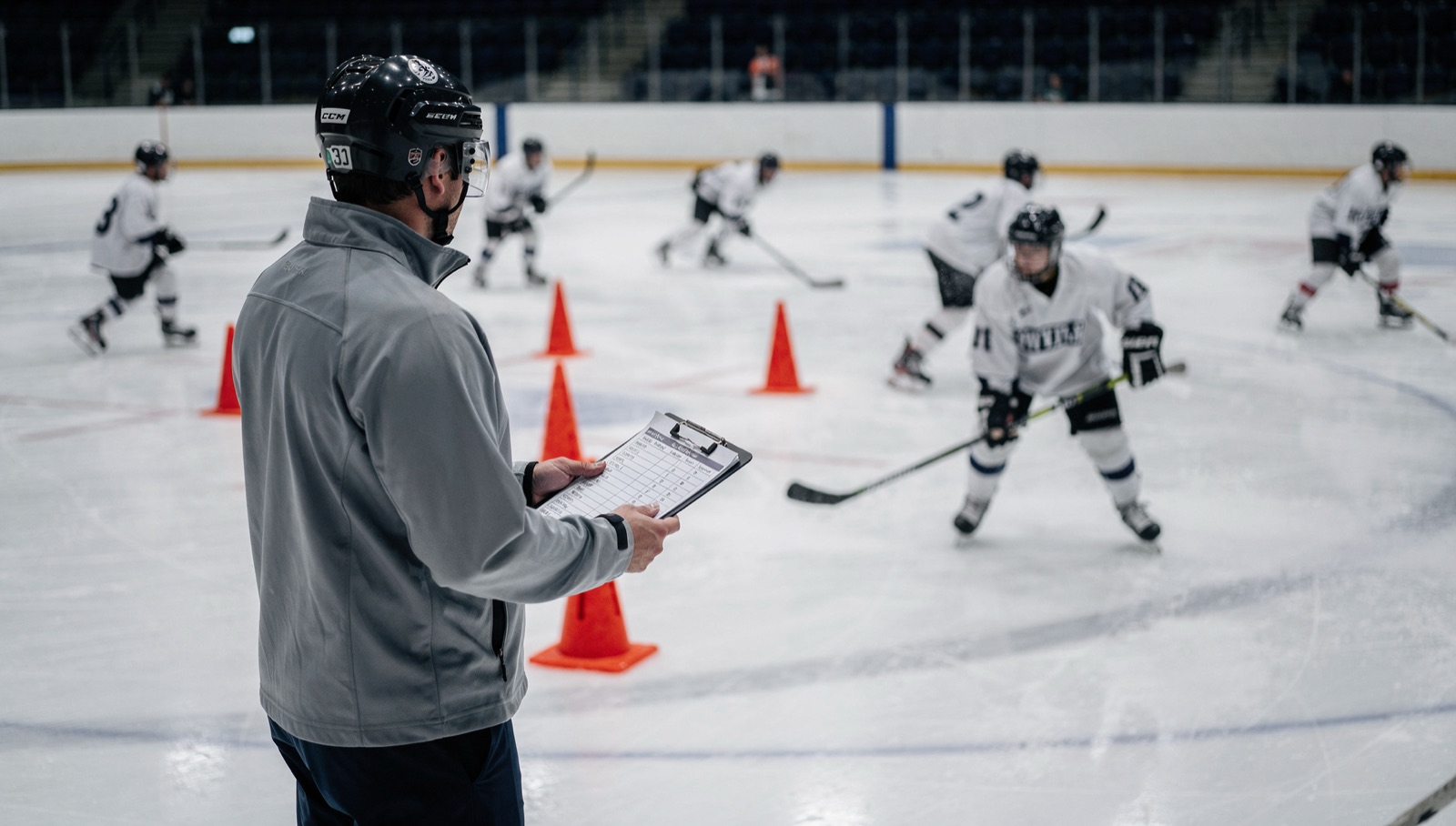
A coach with a clipboard at the boards watches young skaters in numbered jerseys do a crossover drill around pylons
AI-generated illustration.
The short answer

Run at least two or three skates: skills first, then small-area games, then a scrimmage. Use independent evaluators who don't coach that division, put a unique number on every player, and rate each skill 1 to 5 in whole numbers. Evaluate goalies separately, watch the players rather than the game, and publish how releases and appeals work.

Hockey tryouts at a glance

DecisionWhat the governing bodies say
Sessions before a releaseAt least 2 (Hockey Canada); 2–3 (Hockey Alberta); at least 3, each with a different focus (Hockey New Brunswick).
Skills vs gamesSee every player in both. Skills weigh more at younger ages, games more as players get older (Hockey Alberta).
Scale1–5, whole numbers only, no half points (Hockey Canada; Hockey Alberta).
Evaluators4–6 qualified, non-parent evaluators per session (Nanaimo MHA). Coaches don't rate players in their own division (Hockey Regina).
GoaliesInclude them in every session plus at least 3 goalie-specific sessions (Hockey Canada).
AppealsOnly on process, bias or a grossly unreasonable decision, not on the merits (Hockey Canada).

How to structure the skates

Hockey New Brunswick's process is the clearest template we found. Each session has its own job, and no tryouts with cuts are held between March and August (Hockey New Brunswick):

Three-session model (Hockey New Brunswick)
SessionFocusWhat evaluators rate
1Technical skills, first without a puck, then with oneSkating, puck handling, passing, shooting
2Small-area gamesSmall-area skills, compete level, hockey sense
3Scrimmage or game (repeat if needed)Positional play, decisions, the whole package
  • Staffing a session (OHF U13 model): an on-ice lead, at least 3 coaches running drills, at least 4 off-ice evaluators, and an age-division coordinator who tallies scores. Forwards and defence do split drills while a goalie coach works the goalies at the far end (OHF). The OHF guide includes full 50-minute plans.
  • Attendance: Hockey Alberta suggests requiring players to attend at least half to two-thirds of sessions to be eligible for the top team (Hockey Alberta).
  • Keep drills the same and explained. The lead coach explains each drill, the order stays the same every session, and a player gets a redo if something outside their control spoils the attempt (Hockey Alberta).
  • Compete drills reveal more than lines. USA Hockey recommends puck races, board play, small-area games and 1-on-1s. One coach: "throw a puck in the corner four or five times" (USA Hockey).

Sample 60-minute skills skate (session 1)

MinutesDrillWhat you're rating
0–8Warm-up laps and edge work (run by a non-evaluator)Stride, knee bend, edges
8–18Forward and backward skating, stops both ways, pivots around pylonsSkating stride & speed; edges & agility
18–28Puck handling through pylons at speed, head-up cuesPuck handling
28–38Moving passes: forehand and backhand, to stationary and moving targetsPassing & receiving
38–48Shooting off the pass and in strideShooting: release, accuracy, shot selection
48–601-on-1s and puck races into the cornerBody position & battles, compete level

Tip: "Watch the players, not the game!!" is Hockey Alberta's first evaluator hint. In a scrimmage, follow your assigned numbers and ignore the scoreboard (Hockey Alberta).

What to evaluate in skaters

Hockey Alberta publishes cue cards for evaluators. The table maps them to the ten rows on the free form (Hockey Alberta; OHF; Nanaimo MHA).

Form rowWhat to look for (from the sources)A 5 looks likeA 1–2 looks like
Skating stride & speedStride length with full recovery, knee bend, keeping up with playLong, powerful stride, top speed with the puckShort choppy stride, upright, falls behind the play
Edges & agility (crossovers, pivots)Turning and stopping both ways, pivots and transitions, "equal ability with both feet"Stops and turns equally well both waysStrong on one side only, loses speed on pivots
Puck handlingHead up, handling at speed, dekes, control in trafficHead up at full speed, protects the puckEyes down, loses it when pressured
Passing & receivingForehand and backhand, to moving targets, vision; saucer and board passes at higher levelsTape-to-tape on both sides, finds the open playerOnly forehand, passes behind teammates
ShootingTechnique, accuracy, velocity, release, shot selectionQuick release, hits the net, picks the right shotSlow wind-up, misses the net
Body position & battlesStick checks, angling, gap control, body position; safe body contact only at checking agesWins corners and loose pucks, stays on the right sideAvoids battles, chases from behind
Defensive positioningPositional play, supporting the puck, read and reactRight place without being toldPuck-chases, leaves the slot open
Hockey IQ / awarenessRead and react, supporting the puck, communicationAnticipates the play, moves the puck at the right timeSame mistake shift after shift
Compete levelEffort in battles and backchecksWins races and backchecks every shiftCoasts, gives up on the play
Coachability & effortAttitude, listening; behaviour on the bench and in the roomApplies corrections, supports teammatesIgnores instructions, poor body language

Nanaimo has evaluators watch the bench and dressing rooms, under the Two-Deep Rule, for attitude and coachability (Nanaimo MHA). The OHF drills value "efficiency over speed" when skating backward (OHF).

How to evaluate goalies

Goalies need their own evaluator and their own ice. Hockey Canada recommends including goalies in every session plus at least 3 goalie-specific sessions (Hockey Canada). Hockey Alberta's goalie criteria (Hockey Alberta):

AreaWhat to look for
Skating and movementLateral movement, edges, stance
PositioningSquare to the puck, set before the shot, net coverage, when to go down
Puck tracking and controlRebound control, seeing through traffic
Goaltender senseReading plays, anticipating passes
Battle / competeFights for every puck, recovers after goals

Hockey Canada's goalie progression adds transition play and advanced positioning, with beginner, intermediate and advanced criteria for each (Hockey Canada). Use the same form for goalies: write "G" in Position(s) and use the Notes column for each area.

Scoring rules every evaluator should follow

Hockey Canada uses a 1–5 scale in whole numbers only. Evaluators should use the full range in every session, so the top player gets a 5 and the bottom a 1 (Hockey Canada). Hockey Alberta adds these rules (Hockey Alberta):

  1. "Watch the players, not the game!!"
  2. Don't compare notes with other evaluators during the session.
  3. No half points.
  4. "Rate what you see today, forget what you know from the past."
  5. Every evaluator gets the same sheet with the same pinny numbers and colours, sits apart from other evaluators and from spectators, and sends questions to an administrator.

Who decides what

A common model: independent evaluators place the top and bottom groups, and team coaches decide the middle group. Hockey Alberta's sorting grid roughly maps 5s and 4s to the top team, 3s to the middle, and 1s and 2s to the bottom. Whatever split you use, announce it before tryouts and stick to it (Hockey Alberta).

Weighting skating: none of the guides we read gives a numeric weight for skating. The only weighting guidance is Hockey Alberta's: skills count more at younger ages, games more as players get older (Hockey Alberta).

Independent evaluators and the relative age effect

  • Non-parent evaluators. Nanaimo uses 4–6 qualified, non-parent evaluators per session (Nanaimo MHA).
  • Coaches don't score their own division. "Coaches do not submit evaluation ratings that contribute to player rankings within divisions where they coach" (Hockey Regina).
  • Anonymous numbers. Nanaimo assigns each player a unique number for every session "to anonymize players," and asks for plain socks and no pant shells, so gear doesn't identify anyone (Nanaimo MHA). The free form puts the tryout number first on each card.
  • No stacking. Hockey Canada warns against head coaches "recruiting" the coaches of better players to stack a team, and about talking with parents during tryouts: "perception is often reality" (Hockey Canada).

Birth month matters in hockey

Birth quarter distribution (Lemoyne et al., Frontiers 2021)
GroupJan–Mar (Q1)Apr–Jun (Q2)Jul–Sep (Q3)Oct–Dec (Q4)
Canadian minor hockey30.4%27.2%21.0%19.8%
CHL (major junior)41.6%——11.2%
Expected if birthdays didn't matter~25%~25%~25%~25%

The gap grows with level: by major junior, Q1 births outnumber Q4 by nearly four to one. The authors recommend educating coaches and giving late-born players more exposure. In practice: record birth year on every card, and when two players are close, ask who is ahead on skating and hockey sense rather than size.

Age considerations: checking and young divisions

Body checkingHockey CanadaUSA Hockey
When it startsU15 / Bantam (13–14); removed from U13 / Peewee and below from 2013–14 (source)Bantam (14U); 12U allows body contact as a learning step (USA Hockey ADM)
What to rate below that ageStick checks, angling, gap control, body position, no body contactSame, plus legal body contact at 12U
  • Nanaimo spells this out in its criteria: U13 and below are judged on stick checks, angling, gap control and body position with no body contact. U15 and up are judged on safe, effective body contact (Nanaimo MHA).
  • U7: no formal tryouts. Two or three practices are used to group players (Hockey New Brunswick).
  • Check your own association's current rules: provincial and state bodies vary, especially for non-elite U15 and U18.

Releases, feedback and appeals

  • Publish everything up front: format, session focus, who decides, cut dates, absence policy, how goalies are placed, and whether feedback will be given. Hockey Alberta notes families often wrongly expect a written evaluation, so say clearly if there won't be one (Hockey Alberta; Hockey New Brunswick).
  • Releases should come from a knowledgeable, unbiased person, delivered "with compassion and empathy" (Hockey Alberta). In Hockey Canada's sample process, later-stage releases are one-on-one with the coach, who explains the reasons and the player's options (Hockey Canada).
  • Offer a conversation about what to improve to every player not selected (USA Hockey). Copy the Strengths and Areas to develop lines from the form.

Appeals

Hockey Canada's guidance limits appeals to three grounds: the rules or process weren't followed, there was bias, or the decision was grossly unreasonable. "The merit or substance of the decision is not a valid ground" (Hockey Canada). Hockey Saskatchewan's appeal policy has the same kinds of grounds and excludes the substance of team selection (Hockey Saskatchewan). This is why written criteria and consistent scoring matter: they are your defence in an appeal.

Common hockey tryout mistakes

  • Watching the game or the scoreboard instead of your assigned players (Hockey Alberta).
  • Letting what you knew about a player last season override what you saw today (Hockey Alberta).
  • Comparing notes during a session, or using half points (Hockey Alberta).
  • Talking with parents during tryouts (Hockey Canada).
  • Coaches stacking a team by recruiting other coaches' players (Hockey Canada).
  • Drills players don't understand, or that change between sessions (Hockey Alberta).
  • Judging goalies only in drills, where they know what's coming.

What coaches say on video

We watched coaches’ tryout videos and read their transcripts. These are the specific, usable points from each. Where they disagree with each other or with the guidance above, we say so.

Quick Clips: Best Drills for Coaches to Run in Tryouts

The Hockey Think Tank · YouTube
  • With 80 skaters and three ice slots, run small-area battle games, 4–5 at once, to show compete level and hockey sense.
  • Go to the bench and watch body language.
  • "Not the 20 best, the 20 right ones."

Hockey Tryouts – Tips for Evaluators

Leslie Global Sports · YouTube
  • You can be about "80% there after 30–45 minutes." Sort into A/B/C groups early, then spend the time on the bubble.
  • Note gear identifiers and ask players to wear the same gear every day.
  • Keep anecdotes ("hardest shot on the ice") to justify rankings.

Evaluating Goalies in Tryouts

HockeyShare · YouTube
  • Repeated, controlled goalie drills expose movement and conditioning.
  • Scrimmages show reads. Drills don't, because the goalie knows what's coming.
  • In the end: does the goalie stop the puck consistently?

The HOCKEY TRYOUT Process

PowerTech Hockey · YouTube
  • Three looks at every player: compete (backchecking shift after shift, winning corners), team attitude, and baseline skating, passing and shooting.
  • A newcomer has to clearly beat the bottom of the returning roster.
  • Don't lock young players into positions.

Questions coaches ask

How many skates should a hockey tryout have?

Hockey Canada recommends at least two sessions before anyone is released, and many associations use three: skills, small-area games, then a scrimmage.

Who should evaluate at minor hockey tryouts?

Independent, qualified evaluators who aren't parents of players in the group and don't coach that division. Many associations use 4–6 per session, sitting apart from each other.

How do you evaluate a goalie at tryouts?

Separately, with a goalie evaluator. Look at skating and movement, positioning, rebound control and tracking, goaltender sense and compete. Watch them in scrimmages, not just drills.

Can you appeal a hockey tryout decision?

Usually only if the process wasn't followed, there was bias, or the decision was grossly unreasonable. Most associations don't hear appeals on whether the player was good enough.

Is the hockey evaluation form free?

Yes. It's a free printable PDF with a tryout-number box, ten 1–5 skill rows, notes and a decision row, two players per page.

Running the games after tryouts? CourtClok keeps the score and player stats on your phone, puts the scoreboard on any TV and can livestream games with the score on screen. Free to start; some features need a paid plan.

Get the app

Sources

  1. Player Evaluation and Selection Guide — Hockey Canada
  2. Player Evaluation & Selection Resource Guide (2025) — Hockey Alberta
  3. U13 Player Evaluation Guidelines — Ontario Hockey Federation
  4. Minor Hockey Try Out Document (2025) — Hockey New Brunswick
  5. Competitive Tryout Process (2026) — Nanaimo Minor Hockey
  6. 2026 Evaluations — Hockey Regina
  7. Appeal Policy — Hockey Saskatchewan
  8. Best Practices for Structuring Tryouts — USA Hockey
  9. 5 Tips for a Successful Tryout — USA Hockey ADM
  10. 12U Q&A: Transition to Body Checking — USA Hockey ADM
  11. Hockey Canada Bans U13 Body Checking — St. Thomas MHA
  12. Relative Age Effect in Canadian Hockey — Frontiers in Sports and Active Living (2021)