How to use a soccer lineup sheet (and track fair playing time)
By the CourtClok team · Updated October 2026 · 8 min read · 2 sources
From our video. The example team is made up.
The short answer
Write your starters into the position boxes and list the whole squad in the minutes table. Before kick-off, put a light dot in each 10-minute block you plan for each player and check every column has 11. During the game, tick the blocks each player really plays, check the rows at half-time, then total the minutes at full time.
The playing-time mistake
It is easy to leave a game thinking playing time was fair. Then a parent asks why their child played twenty minutes, and nobody can say for sure. Substitutions happen in a rush, and from the bench it's hard to remember who went on when.
The fix is to write it down in blocks. Plan the minutes before kick-off, tick what really happens, and add it up at the end. It takes a few seconds per substitution, and you finish the game with a record instead of a guess.
Tip: [Get the free soccer lineup sheet (PDF)](/templates/soccer-lineup-sheet): one Letter page with a pitch for your starting XI and a minutes table for up to 18 players in eight 10-minute blocks.
What you need
The lineup sheet, printed. Our free soccer lineup sheet has a pitch with eleven position boxes, the team, opponent, date and formation, and a minutes table with a Total column.
A pencil and a pen. Pencil for the plan, pen for what actually happens. A clipboard helps.
A watch or phone showing the match time, so you know which block you're in.
Your squad list, ideally written in before you get to the field.
Before kick-off: the top and the starting XI
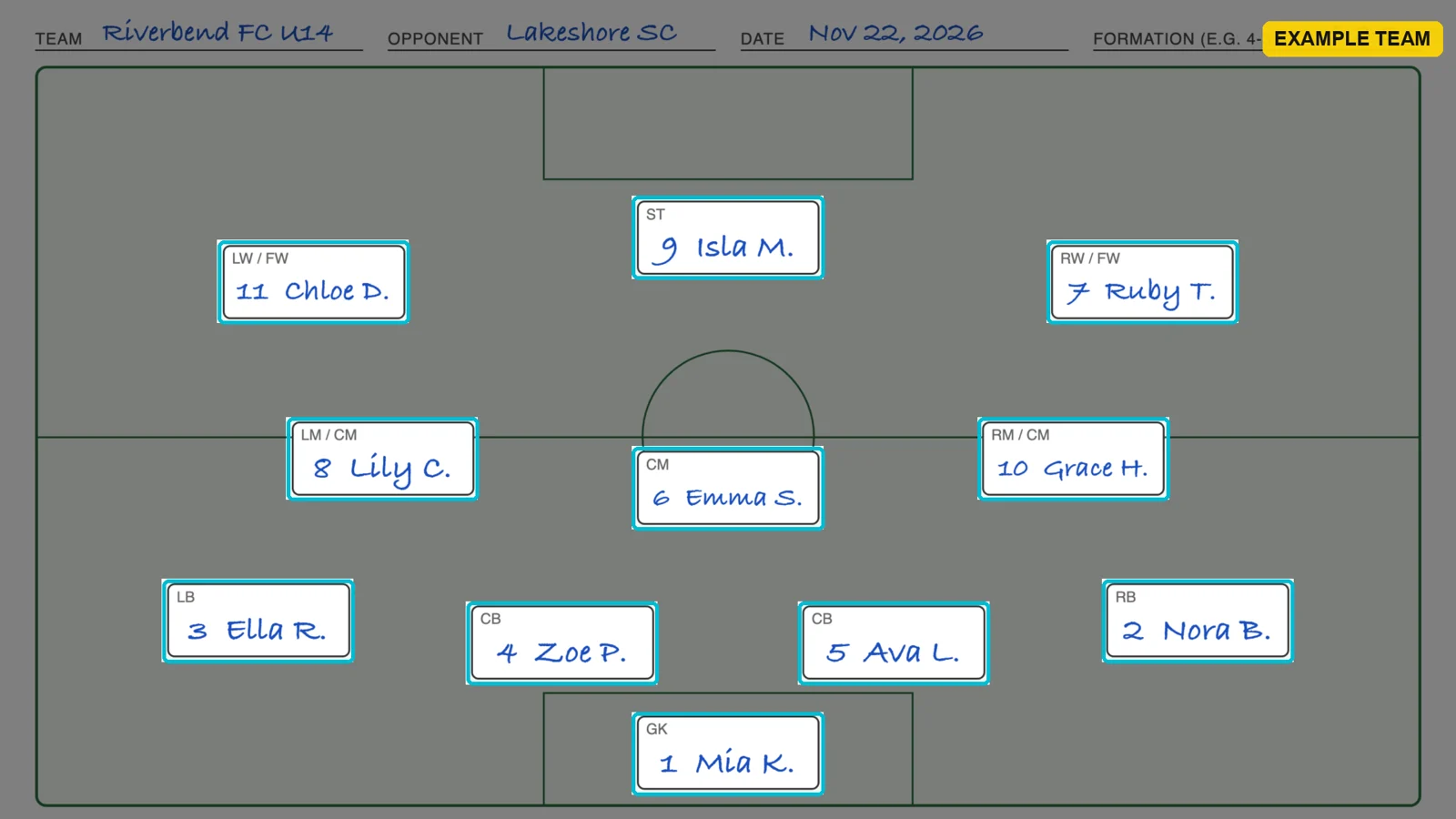
Fill in the top: your team, the opponent, the date and the formation.
Write each starter's number and name in a position box. The pitch is drawn as a 4-3-3 (GK, LB, CB, CB, RB, three midfielders, three forwards). If you play another shape, write your own positions in the boxes.
One starter per box, number first
Under the Laws, a match is played by two teams of up to eleven players, one of whom must be the goalkeeper, and a match can't start or continue if a team has fewer than seven (Law 3). Youth formats are often smaller, so go by your league.
In matches played under the Laws, the names of the substitutes must be given to the referee before kick-off, and a substitute who isn't named can't take part (Law 3). Your league may handle this with its own team list.
Plan the minutes with dots
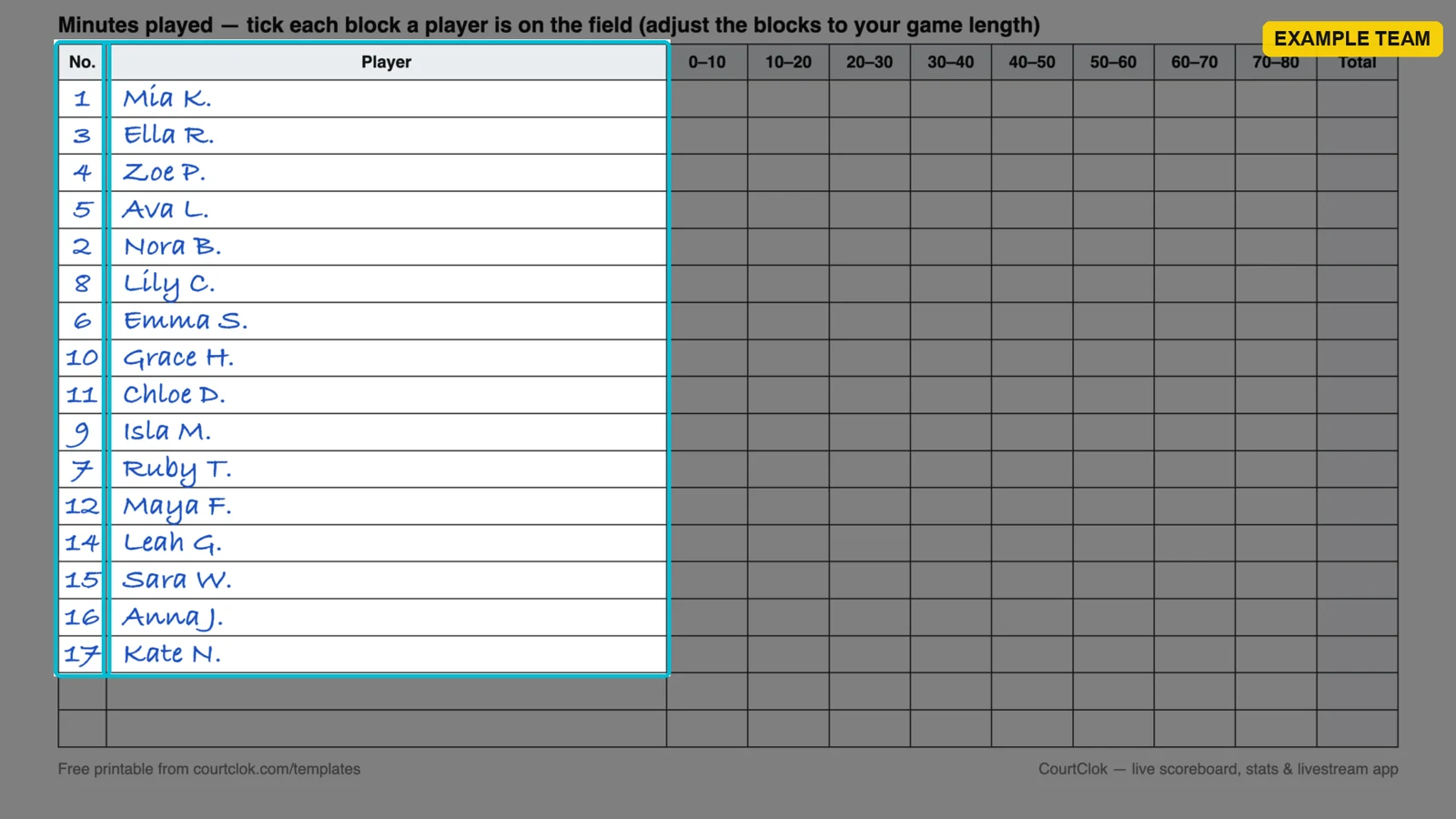
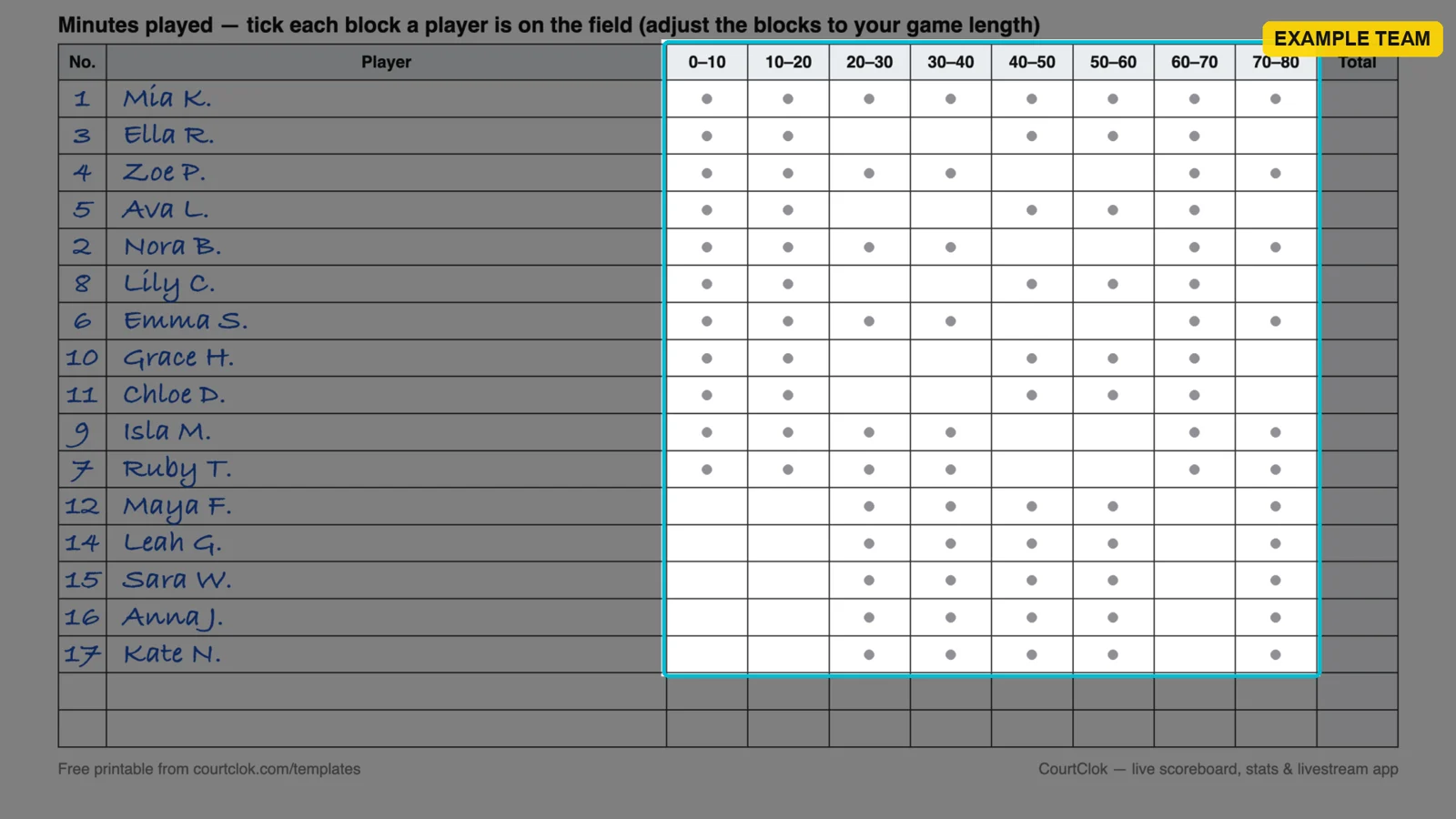
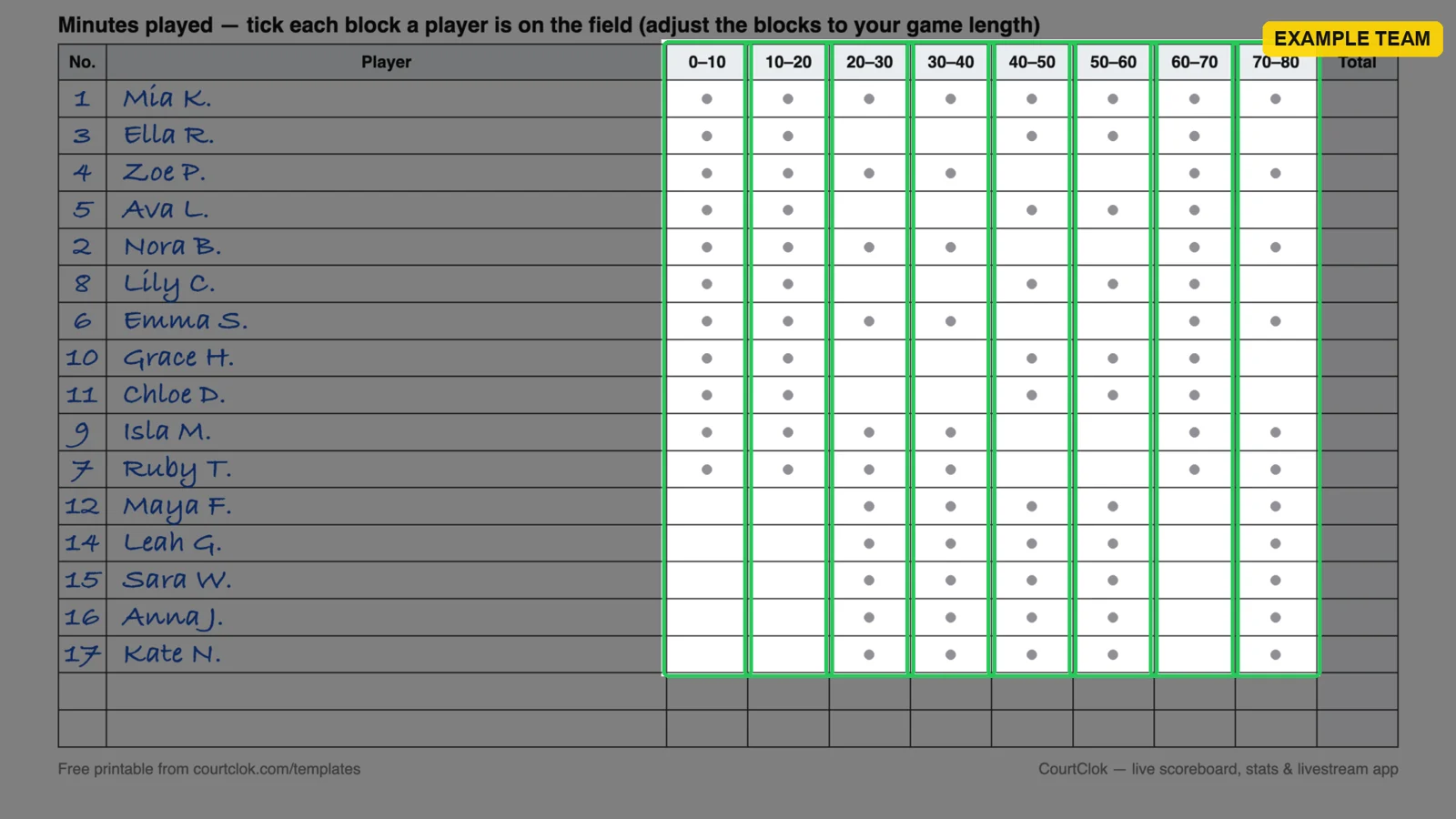
List the whole squad in the minutes table, starters first, jersey number first. Then, in pencil, put a light dot in each 10-minute block you expect each player to play.
The whole squad, starters firstThe plan: a light dot in each planned block
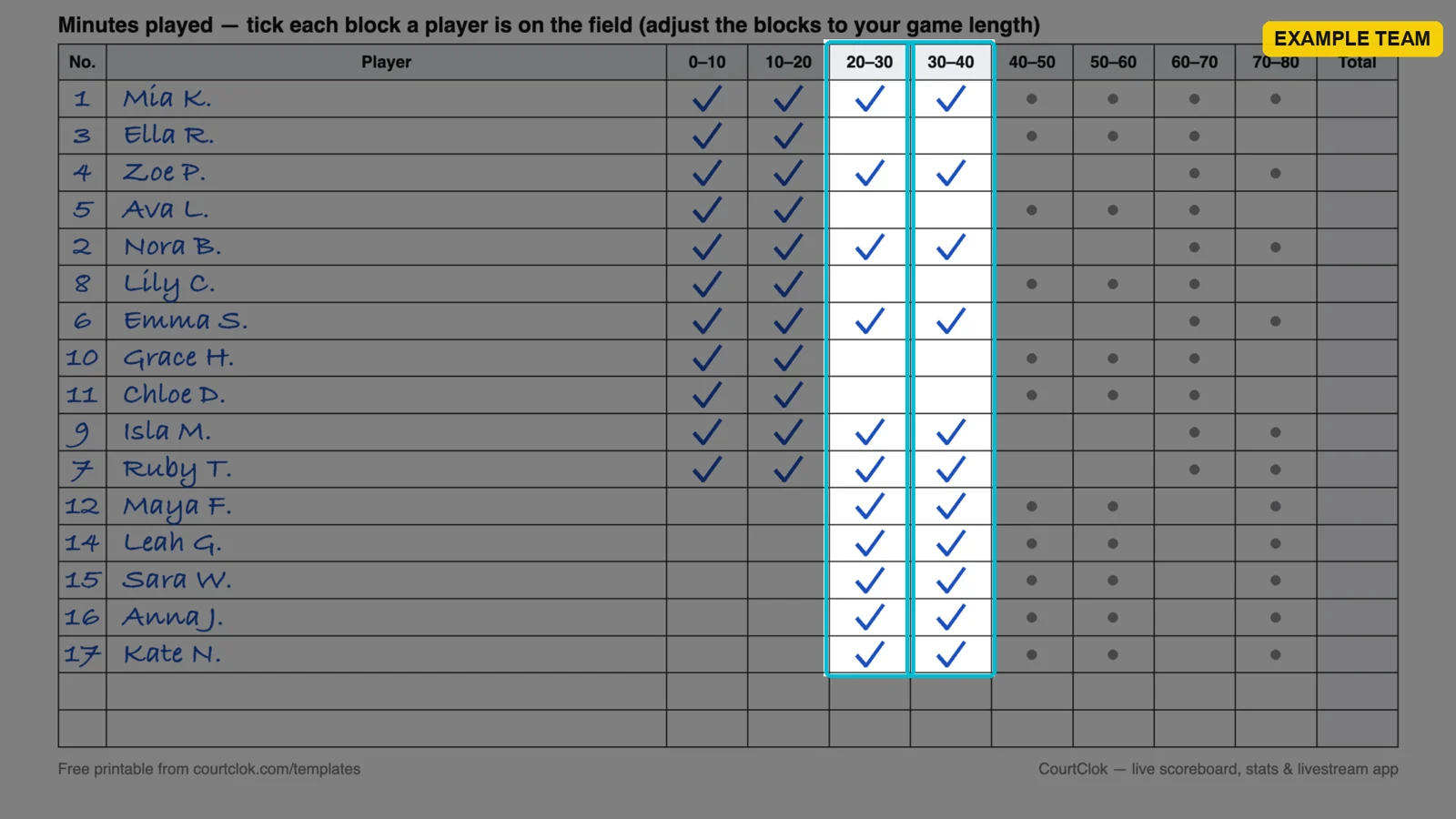
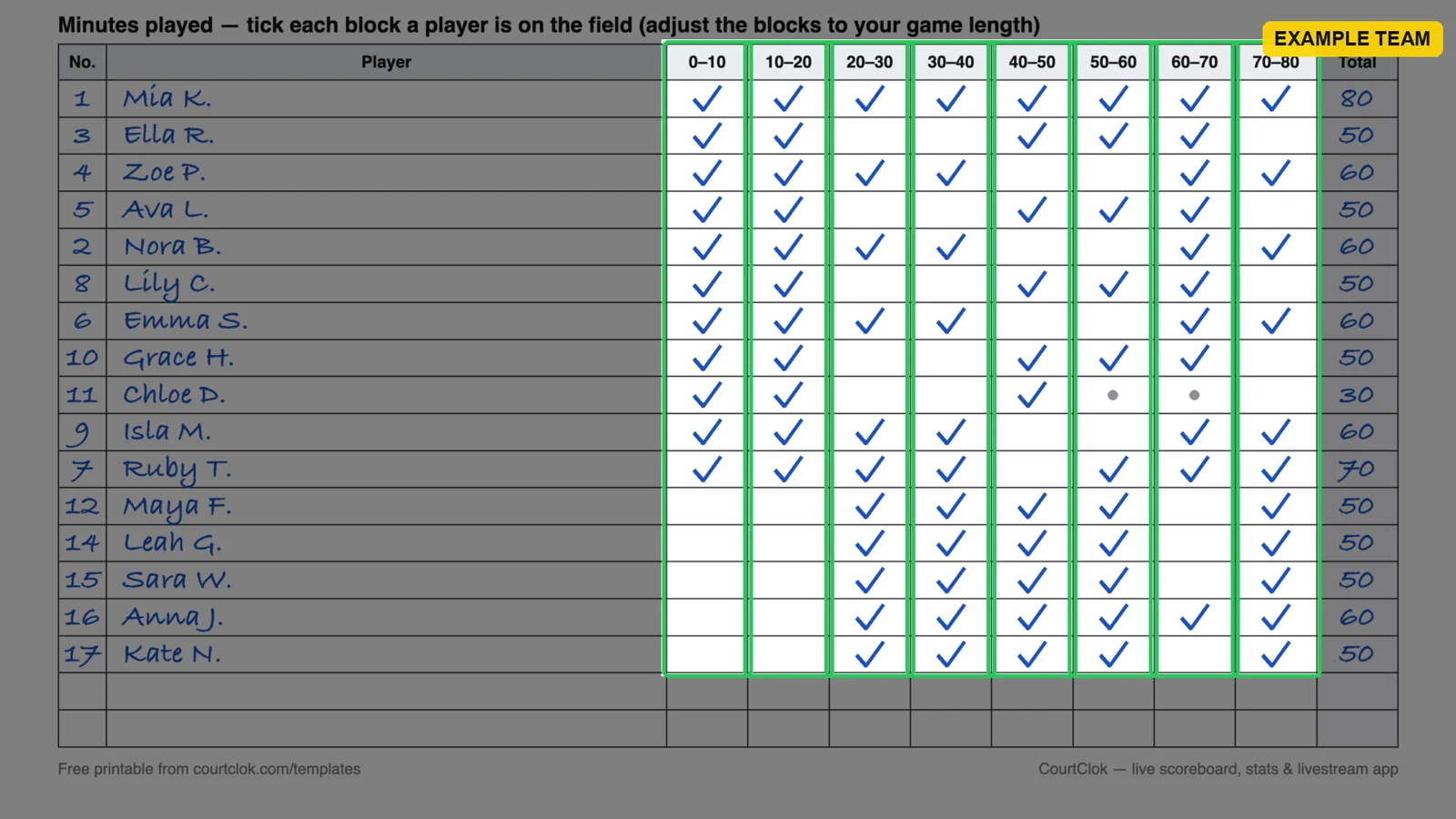
Check the plan before kick-off. Every column needs exactly as many dots as players on the field: 11 in an 11-a-side game. Then read across the rows and make sure the minutes are shared the way you intend.
Every column: exactly 11 dots
Quick maths for a fair share
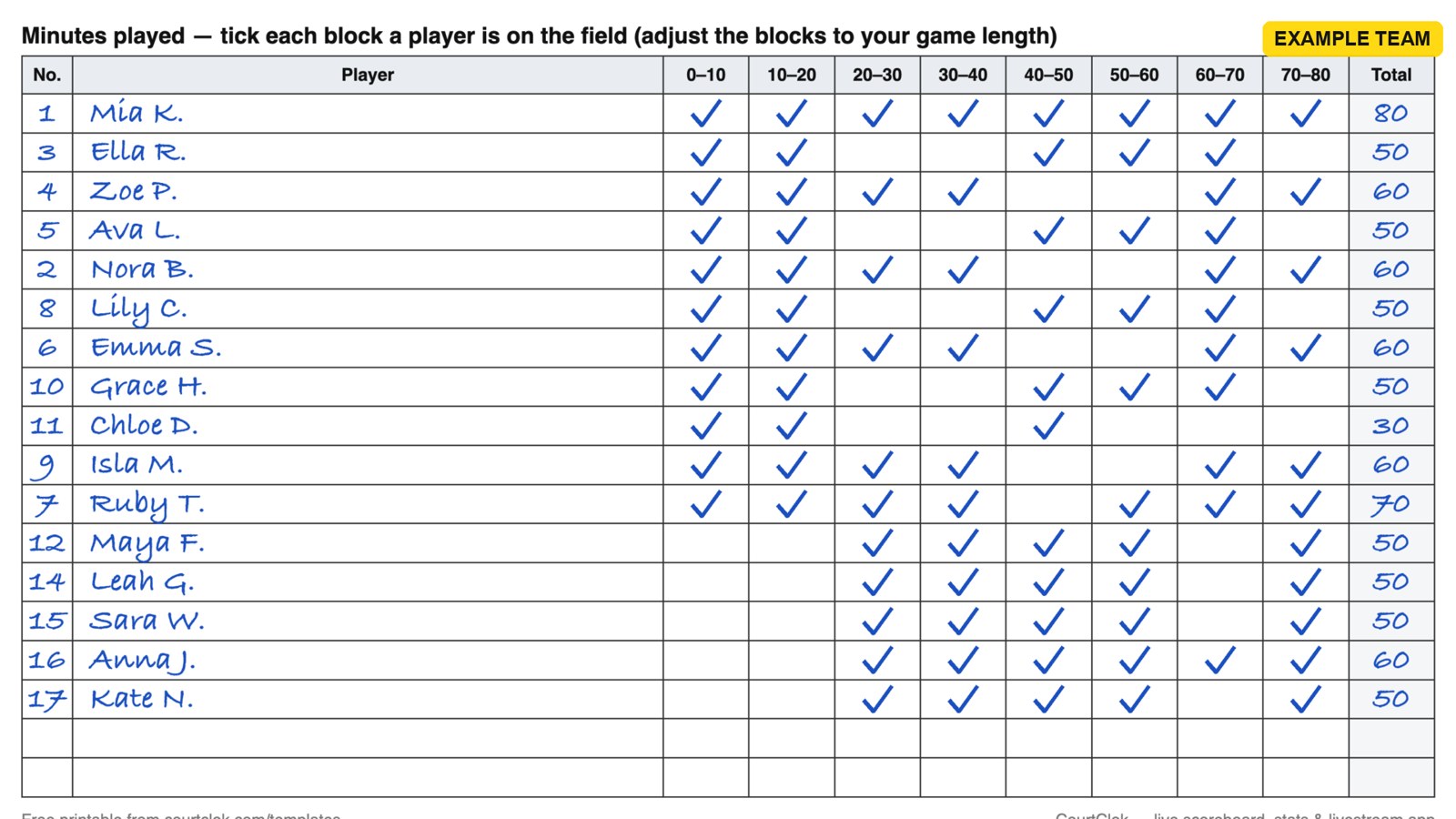
Multiply the players on the field by the number of blocks, then divide by your squad size. In our example, 11 players × 8 blocks = 88 player-blocks for a squad of 16, so the average is 5.5 blocks (55 minutes) each. The goalkeeper plays all eight, and everyone else plays five or six.
Tip: Your league may have its own playing-time rule, such as a minimum for every player. Check it and build your plan around it.
During the game: tick what really happens
In pen, tick each block a player is actually on the field. The ticks go over the dots. If the game goes as planned, every dot becomes a tick.
Ticks replace the dots as you go
Pick one rule for part blocks and use it every game. A common choice: tick a block if the player was on for most of it. What matters is that you do the same for everyone.
The half-time check
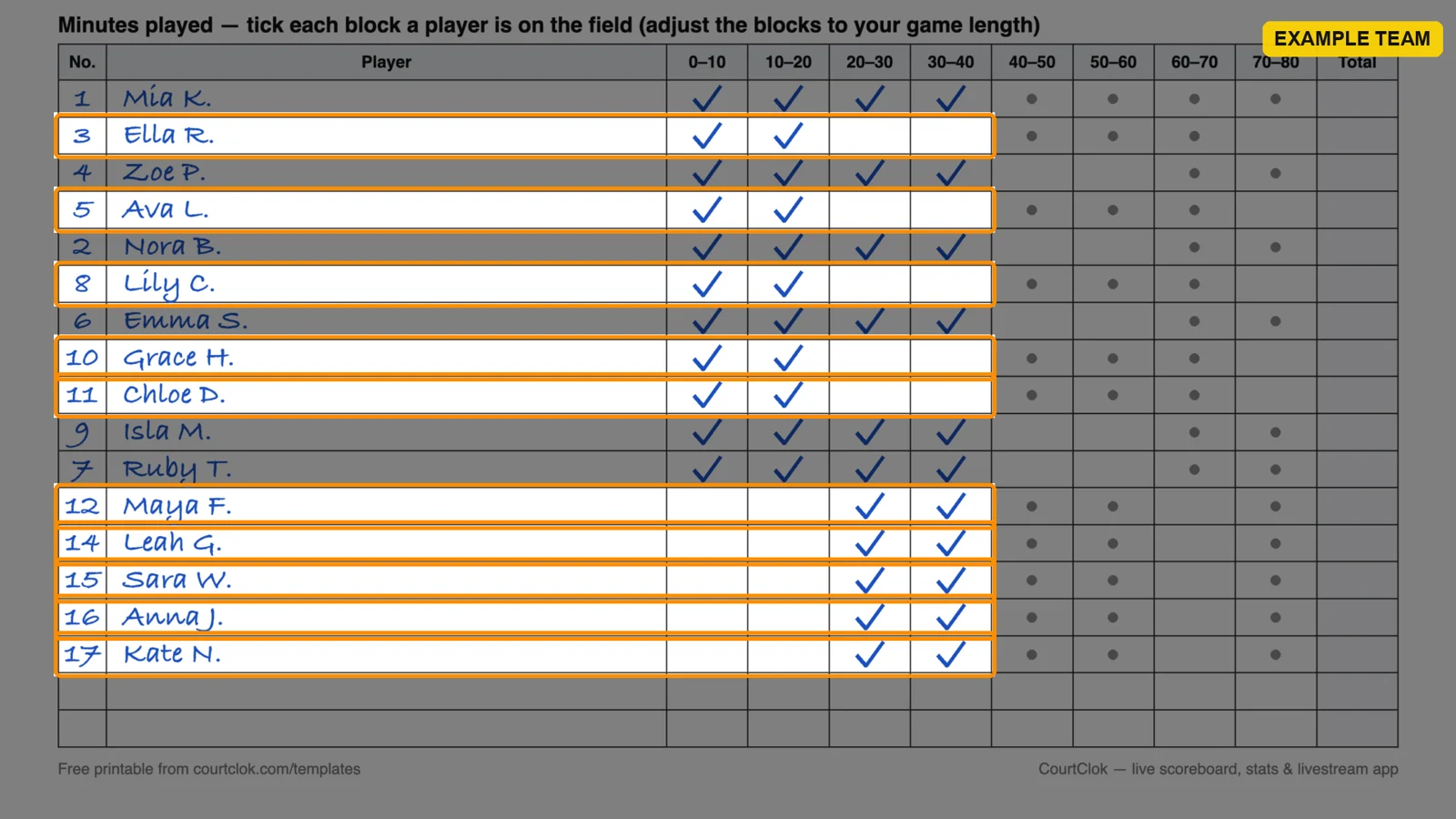
At half-time, read across the rows. Anyone with fewer ticks than the rest should get more of the second half. It's much easier to fix playing time at half-time than to explain it after the game.
Fewer ticks at half-time: more of the second half
Second half: substitutions and changes to the plan
Bringing a player back on after they've come off is a return substitution. The Laws only allow return substitutions in youth, veterans, disability and grassroots football, and only where the national football association, confederation or FIFA agrees (Law 3). Many youth leagues use them, but check your league before you plan around them.
How many substitutes you can use is set by your competition. In official competitions the competition decides, up to a maximum of five, and in other matches teams can agree on more if the referee is told before the match (Law 3). Youth leagues often have their own rules, so check yours.
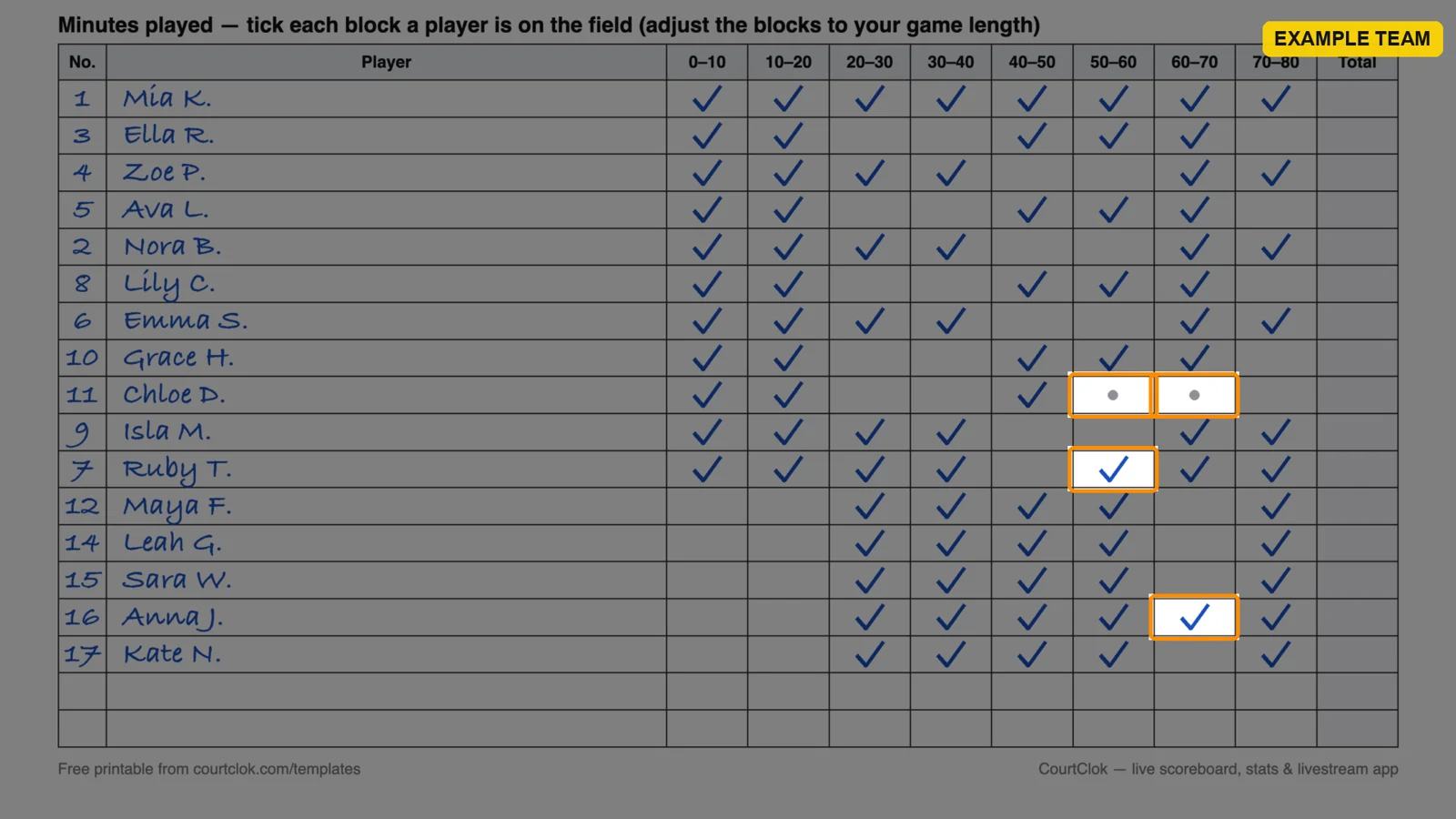
When the game changes the plan, tick what really happened. An injury, a tired player or a tactical change means some dots won't become ticks, and some ticks land where there was no dot. A dot without a tick is a block that was planned but not played.
A dot without a tick: planned, not played
Full time: totals and the column check
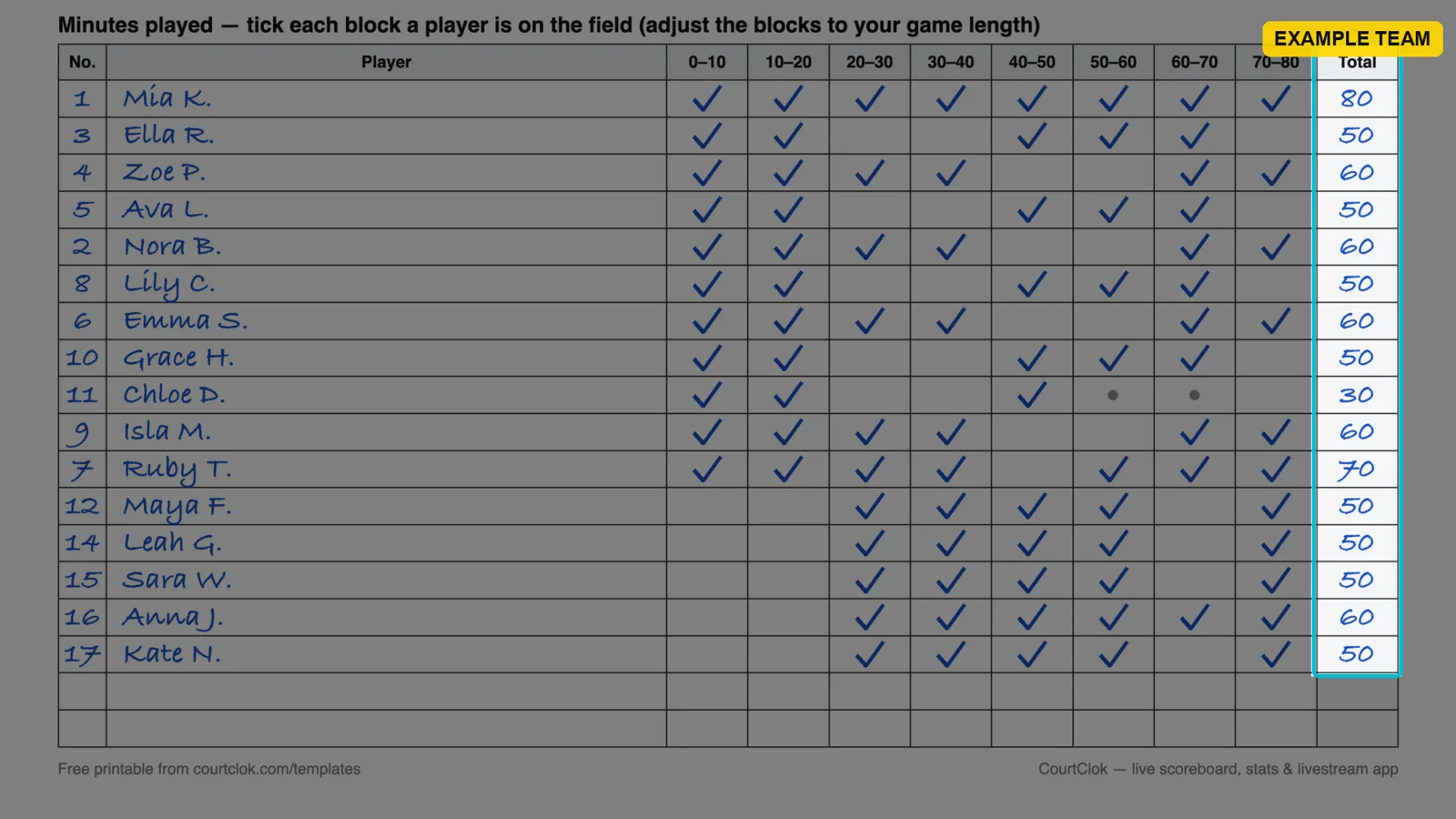
Count each player's ticks and write the minutes in Total. With 10-minute blocks, six ticks is 60 minutes.
Check the columns. Every block should have exactly 11 ticks (or however many your team plays). A column with 10 or 12 means a substitution was missed or ticked twice.
Ticks × 10 = minutes11 ticks in every column
If your games aren't 80 minutes
The headings are printed 0 to 80 in 10-minute blocks. Under the Laws, a match is two equal halves of 45 minutes, which can only be shortened if the referee and both teams agree before the start and the competition rules allow it (Law 7). Youth leagues often play shorter games, so use your league's length.
Write your own headings over the printed ones and keep every block the same length. For two halves of 30 minutes, use the first six blocks and cross out the last two. For other lengths, pick a block size that divides each half evenly.
Over a season
Keep every sheet. Over a season, the Total column shows who is really getting time and who keeps ending up on the bench. If a player or parent asks, you have an answer on paper.
Common mistakes and how to fix them
Mistake
How to fix it
No plan before kick-off
Dot the blocks in pencil while you pick the team. Two minutes before the game saves the argument after it.
A column with 10 or 12 ticks
A substitution was missed or ticked twice. Fix it at the next stoppage, while you still remember.
Different rules for part blocks
Choose one rule (for example, most of the block) and use it for everyone, every game.
Writing the plan in pen
Pencil for the plan, pen for what happened, so the two stay easy to tell apart.
Games that aren't 80 minutes
Rewrite the headings for your league's length and keep every block the same size.
Planning around return substitutions your league doesn't allow
Check your league's rules before the season.
Watch it filled in
Coach On fills in the whole sheet for a made-up team, Riverbend FC U14.
Plan the lineup in pencil dots before kick-off, then tick what actually happened in each block.
Split the match into equal blocks so every substitution lands on a block line.
Every block should have exactly 11 ticks, one per player on the field.
Total each player’s minutes after the game, so playing time is written down, not guessed.
Soccer lineup sheet questions
How many players are on the field in soccer?
Under the Laws of the Game, up to eleven per team, one of whom must be the goalkeeper. A match can't start or continue if a team has fewer than seven. Youth formats are often smaller, so check your league.
Can a substituted player come back on?
Only where return substitutions are allowed. The Laws permit them in youth, veterans, disability and grassroots football, subject to the national association's agreement. Check your league's rules.
How many substitutes can a soccer team use?
It depends on the competition. Official competitions set the number, up to five, and in other matches teams can agree on more if they tell the referee before the match. Youth leagues often have their own rules.
How do I track fair playing time?
Split the game into equal blocks, plan who plays each block with a light dot, tick the blocks each player really plays, and total the minutes at full time. Check the rows at half-time so you can fix any imbalance.
What if my games are shorter than 80 minutes?
Rewrite the block headings for your league's game length and keep every block the same size. For two halves of 30 minutes, use six 10-minute blocks.
Is the lineup sheet free?
Yes. It's a free printable PDF with a pitch for the starting XI and a minutes table for up to 18 players.
Running the games after tryouts? CourtClok keeps the score and player stats on your phone, puts the scoreboard on any TV and can livestream games with the score on screen. Free to start; some features need a paid plan.