How to use a hockey stat sheet (plus-minus, shots, faceoffs)
By the CourtClok team · Updated October 2026 · 9 min read · 4 sources
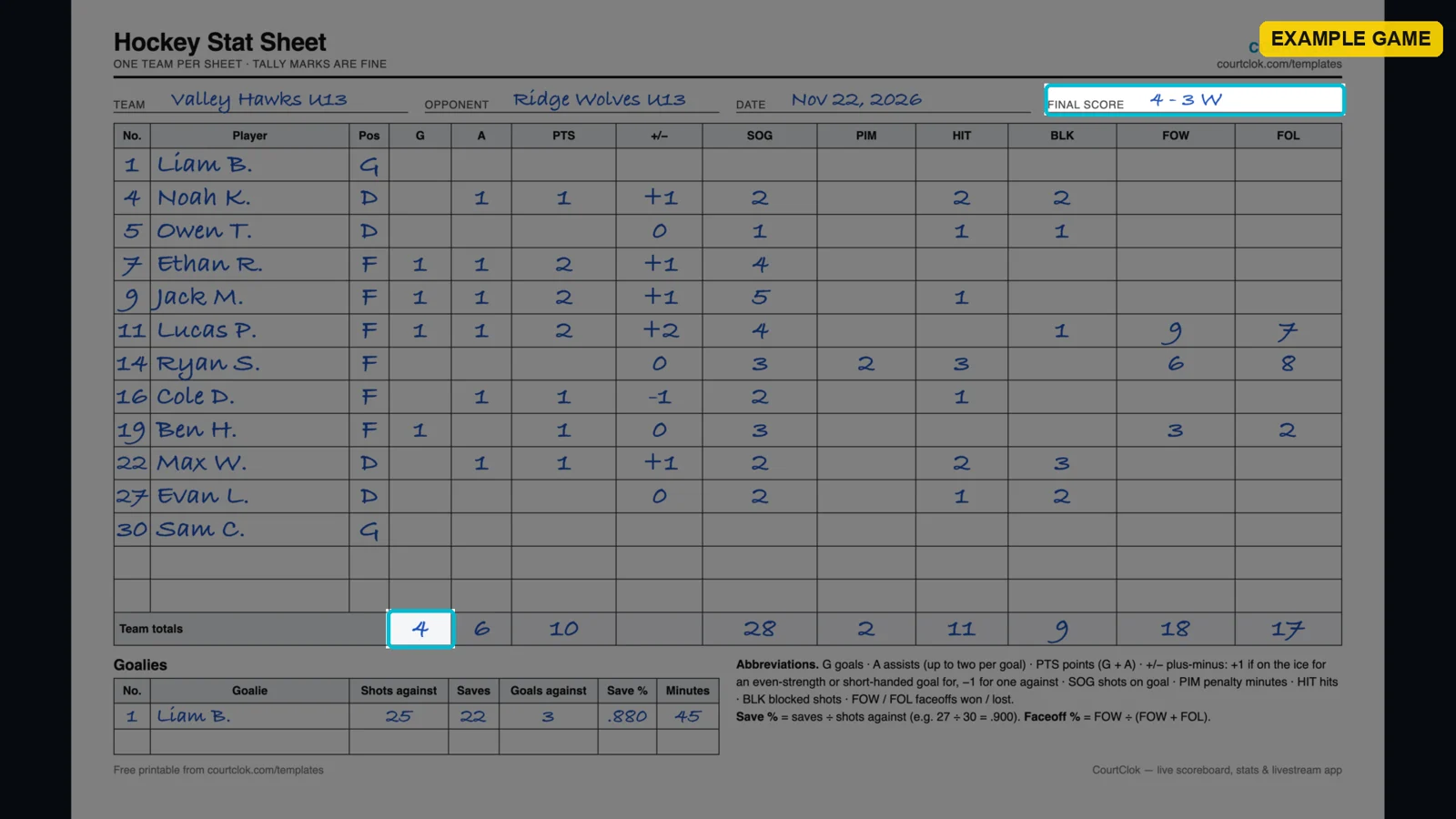
From our video. The example game is made up.
The short answer
Use one sheet per team. Write the roster before the game, then add goals and up to two assists as they happen. Give +1 to every skater on the ice for an even-strength or short-handed goal for, and −1 for one against; power-play goals don't count for plus-minus. Tally shots on goal, penalty minutes, hits, blocks and faceoffs, fill in the goalie line, then total every column after the game.
The stat people get wrong: plus-minus
Goals and shots are easy to count. The column that goes wrong is +/−. New stat keepers give every skater on the ice a plus for every goal, including power-play goals. That's not how it works.
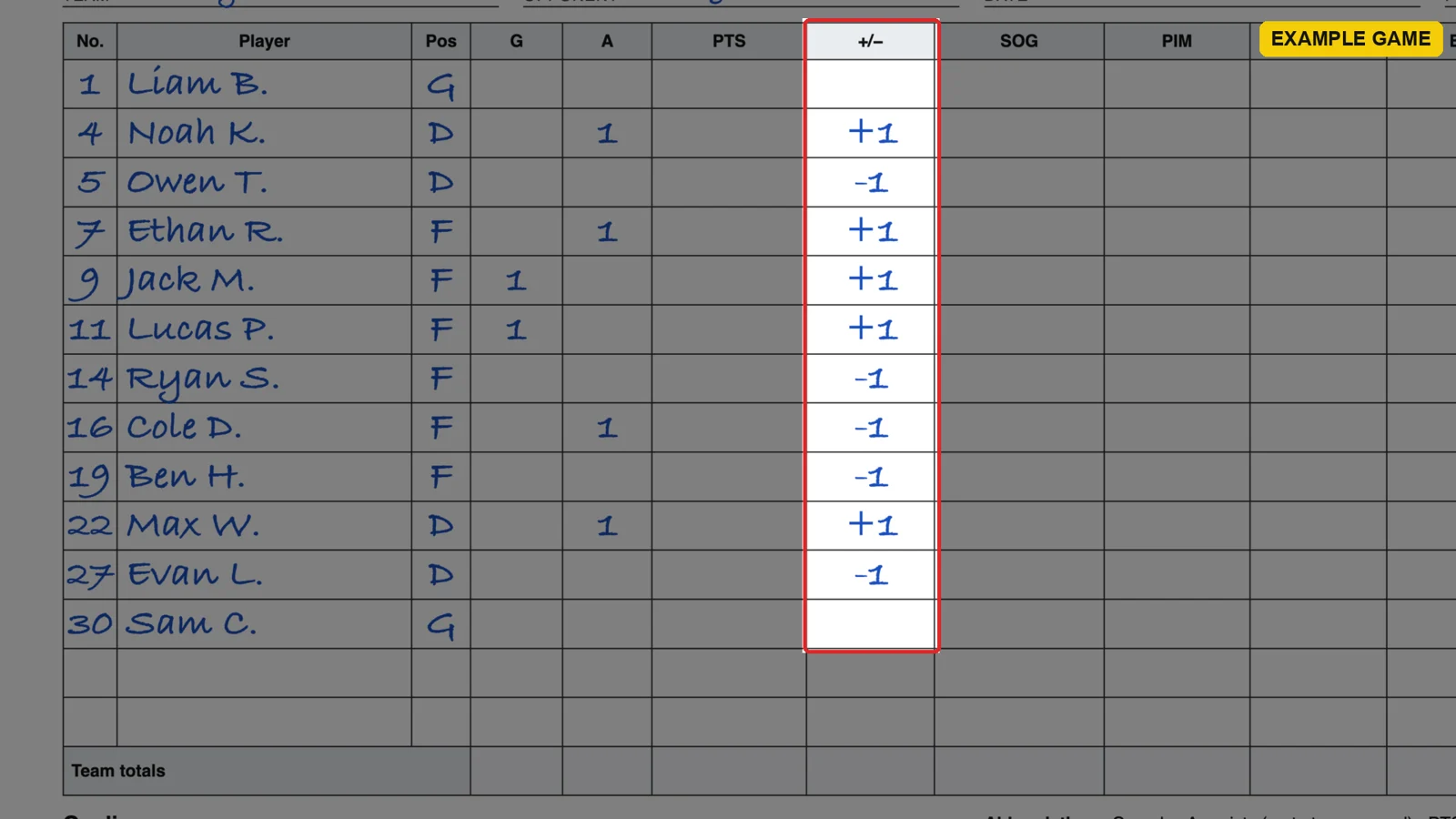
Plus-minus only counts even-strength and short-handed goals. A player gets +1 for being on the ice when their team scores one, and −1 when the other team scores one. Goals scored on the power play aren't counted, for either team (NHL.com hockey glossary).
Tip: [Get the free hockey stat sheet (PDF)](/templates/hockey-stat-sheet): 14 player rows with G, A, PTS, +/−, SOG, PIM, HIT, BLK, FOW and FOL, a team totals row and two goalie lines on one Letter page.
Before the game: one team per sheet
A stat sheet is for your team. (The game sheet, with both rosters, the scoring table and the penalties, is a different sheet.) Fill in the top: your team, the opponent and the date. Leave the final score for the end.
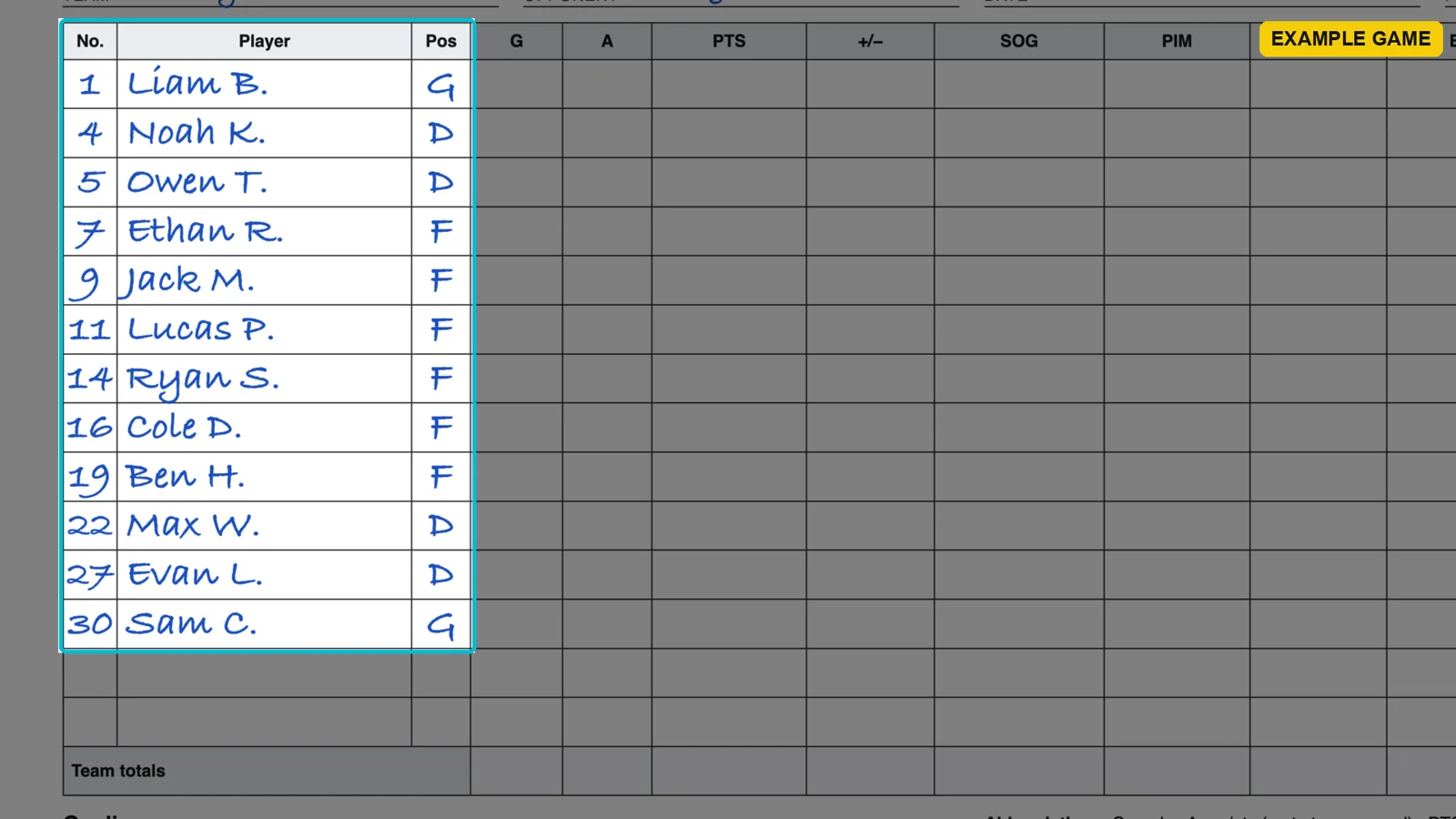
Then the roster: number, name and position (F, D, or G for the goalies). Tally marks are fine during the game; you'll turn them into numbers afterwards.
Number, name, position. Goalies get G
Tip: One person per sheet works best. If you're also running the clock or the game sheet, track fewer columns (G, A, +/−, SOG) rather than guessing at all of them.
Goals, assists and points
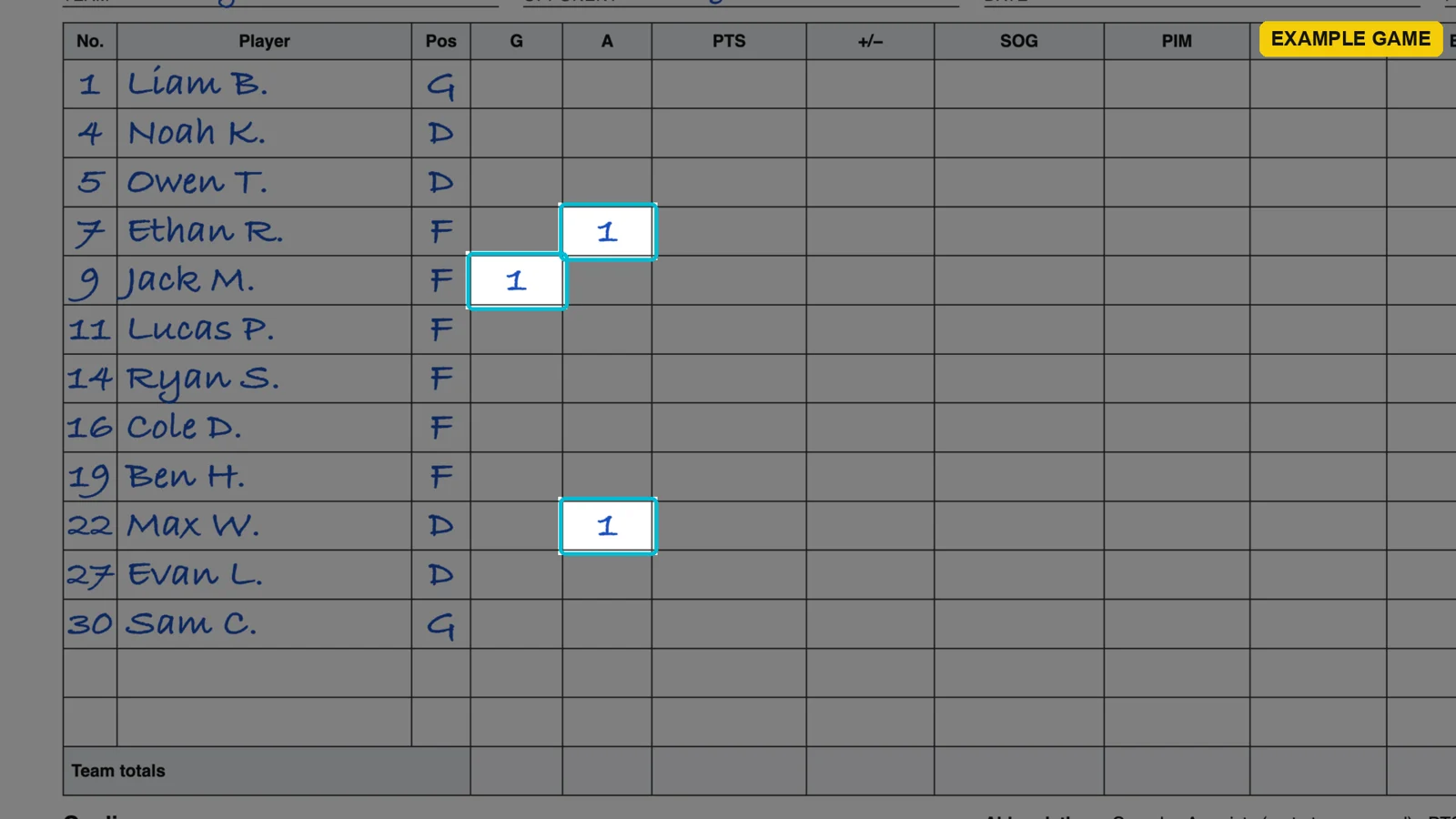
When your team scores, add 1 to G for the scorer and 1 to A for each player who gets an assist. A goal can have up to two assists, or none (Hockey Canada rule 6.6; NHL rule 33). Use what the referee announces, not what you saw from the bench.
#9 scores, #7 and #22 get the assists
PTS is points: goals plus assists. Leave it empty during the game and add it up afterwards, so you only do the sum once.
Plus-minus (+/−)
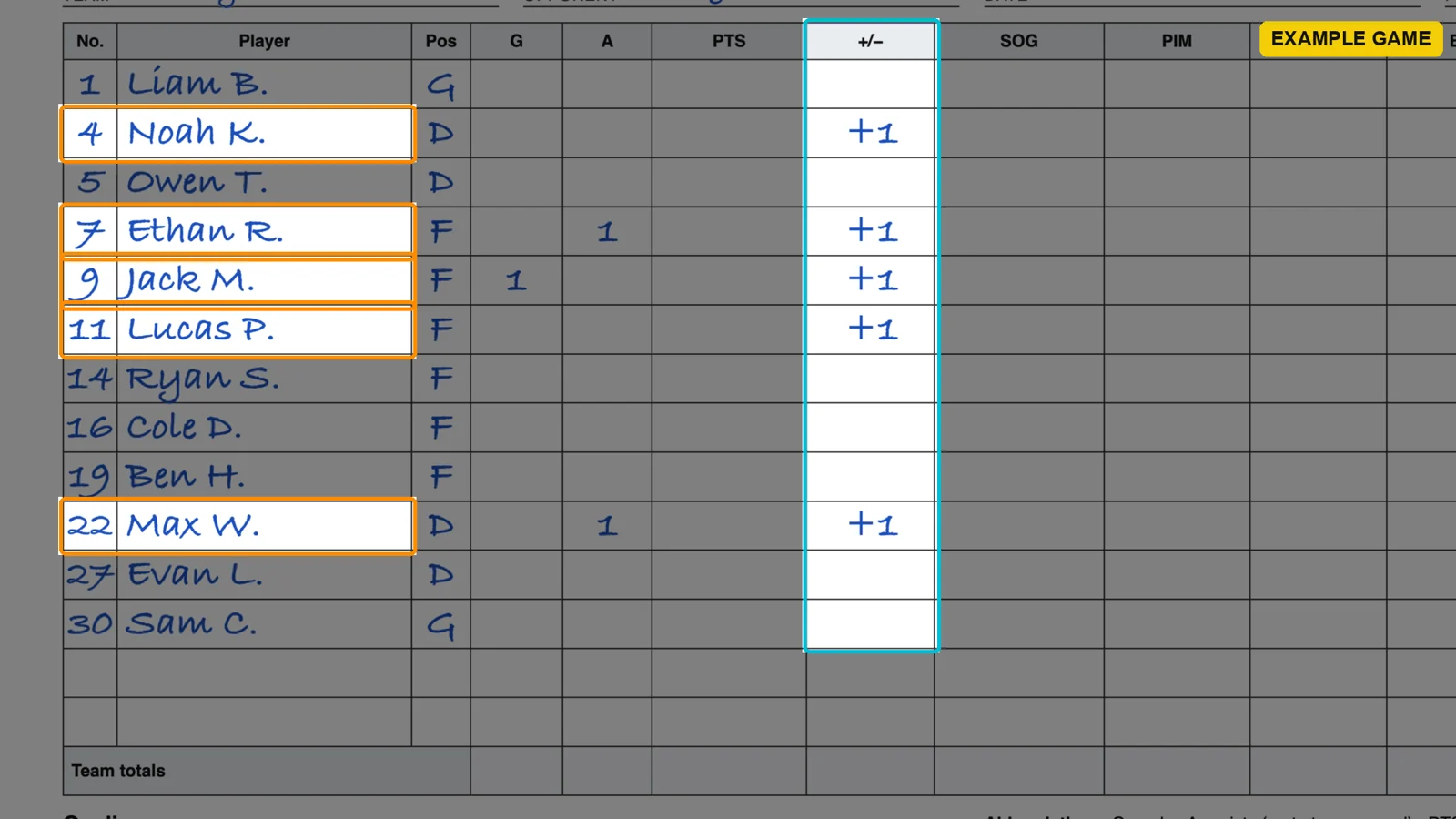
For every goal, look at who was on the ice for your team. Skaters only: goalies don't get plus-minus on this sheet.
Who gets plus-minus
Goal
Skaters on the ice for your team get
Example
Your team scores at even strength
+1 each
5-on-5 goal for: five skaters get +1
Your team scores short-handed
+1 each
You're killing a penalty and score: four skaters get +1
The other team scores at even strength
−1 each
5-on-5 goal against: five skaters get −1
The other team scores short-handed
−1 each
You're on the power play and give one up: your skaters get −1
Any power-play goal, either team
Nothing
Your power-play goal still counts for G and A, not for +/−
Even-strength goal for: +1 for all five skaters on the ice
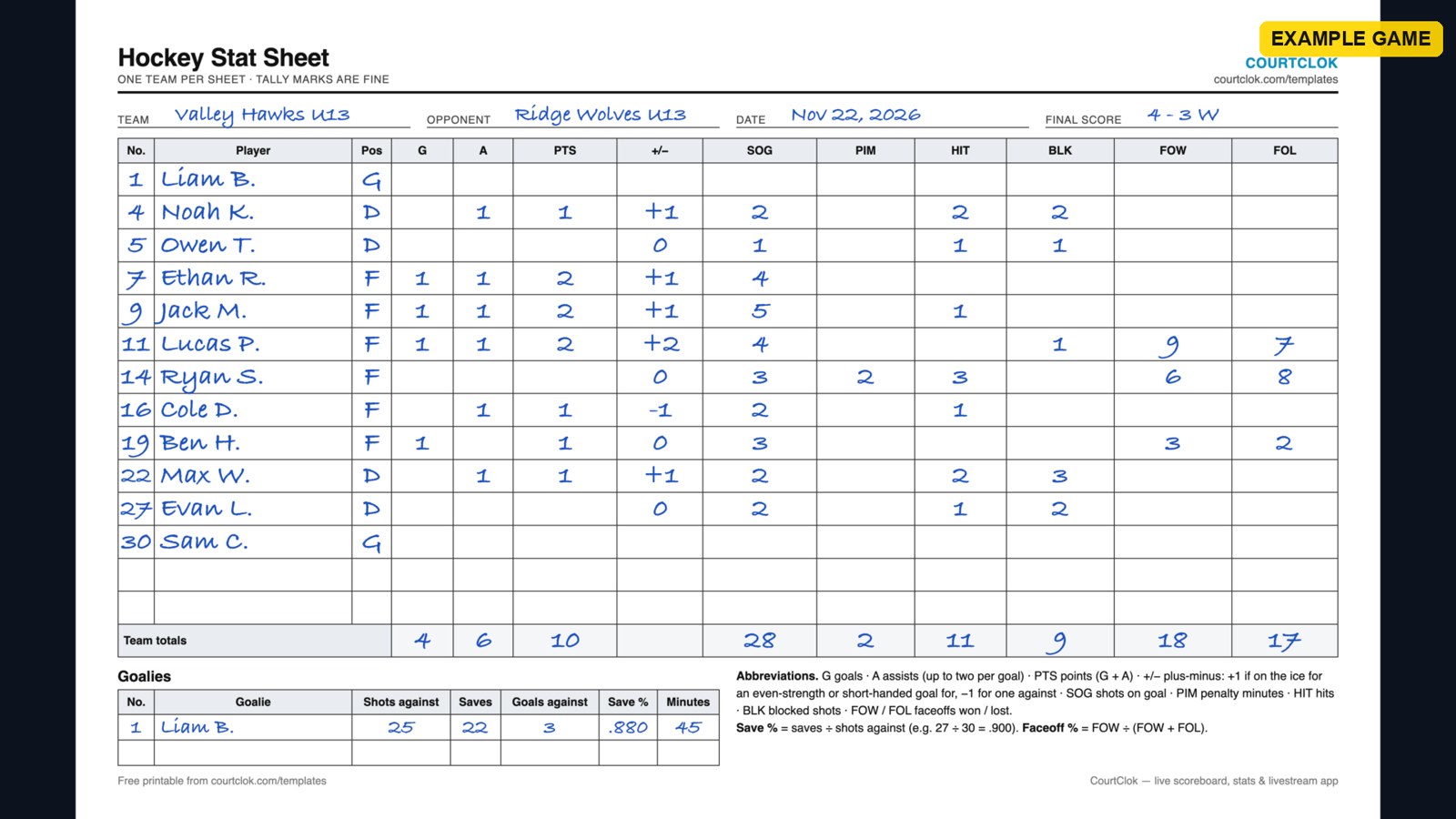
In our example game, Valley Hawks #11 scores on the power play in the 2nd period, set up by #16 and #4. All three get their G or A, and nobody's +/− changes. The same goes for the Ridge Wolves' power-play goal in the 1st.
A power-play goal: G and A yes, +/− no
Tip: Plus-minus is the hardest column to keep live because you need to know who was on the ice. If you can, have a second person watch line changes, or write the five numbers on a scrap of paper the moment a goal goes in.
Shots on goal, penalty minutes, hits and blocks
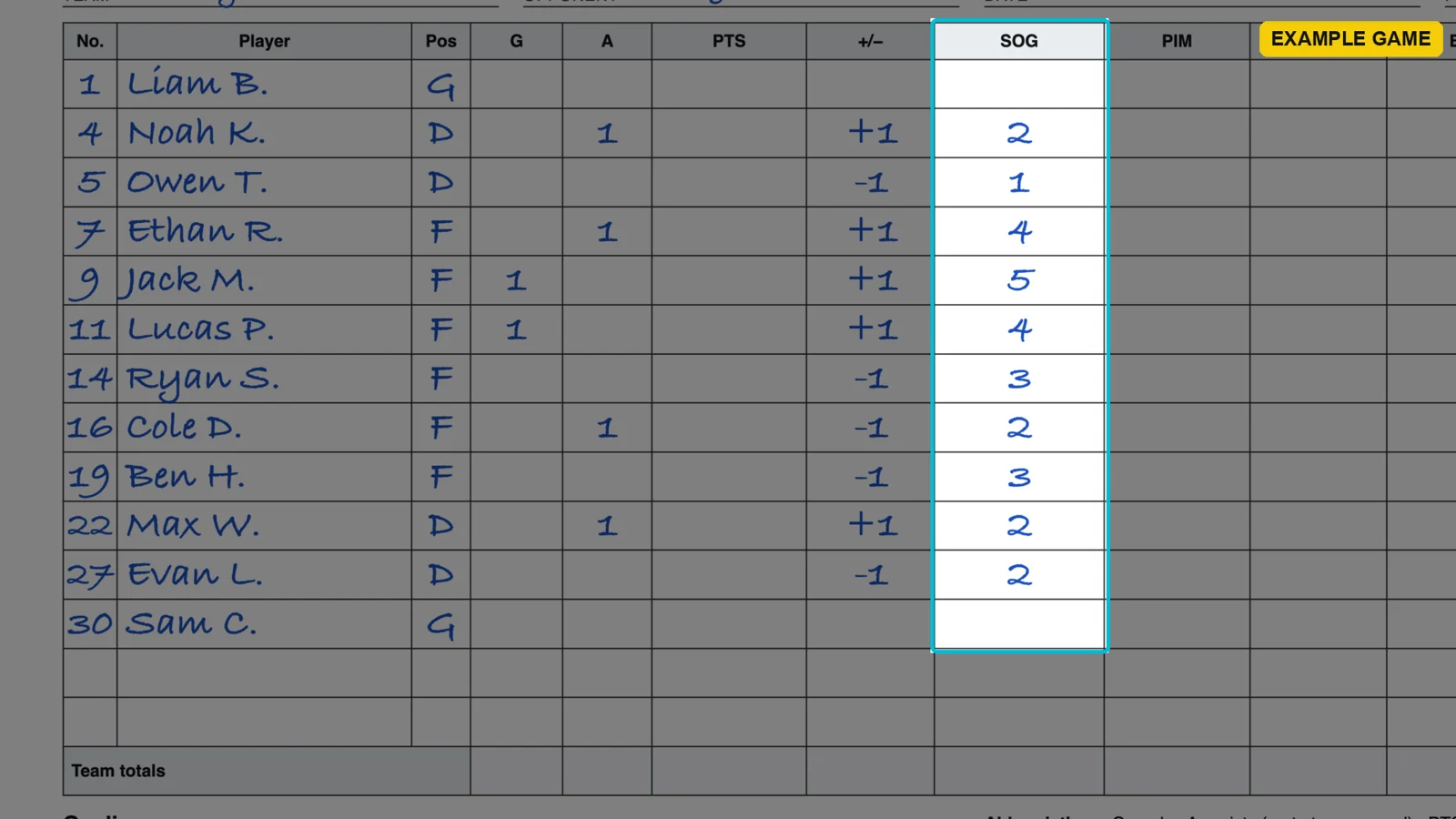
SOG is shots on goal: a shot that goes in, or that would have gone in if the goalie hadn't stopped it (NHL.com hockey glossary). A shot that hits the post or crossbar is not a shot on goal; the NHL counts it as a missed shot (NHL EDGE glossary). Every goal is also a shot on goal.
SOG: shots that go in or that the goalie has to stop
PIM is penalty minutes: add the length of each penalty to the player's box.
HIT and BLK are simple tallies: one mark each time the player makes a hit, and one each time they block an opponent's shot.
Faceoffs
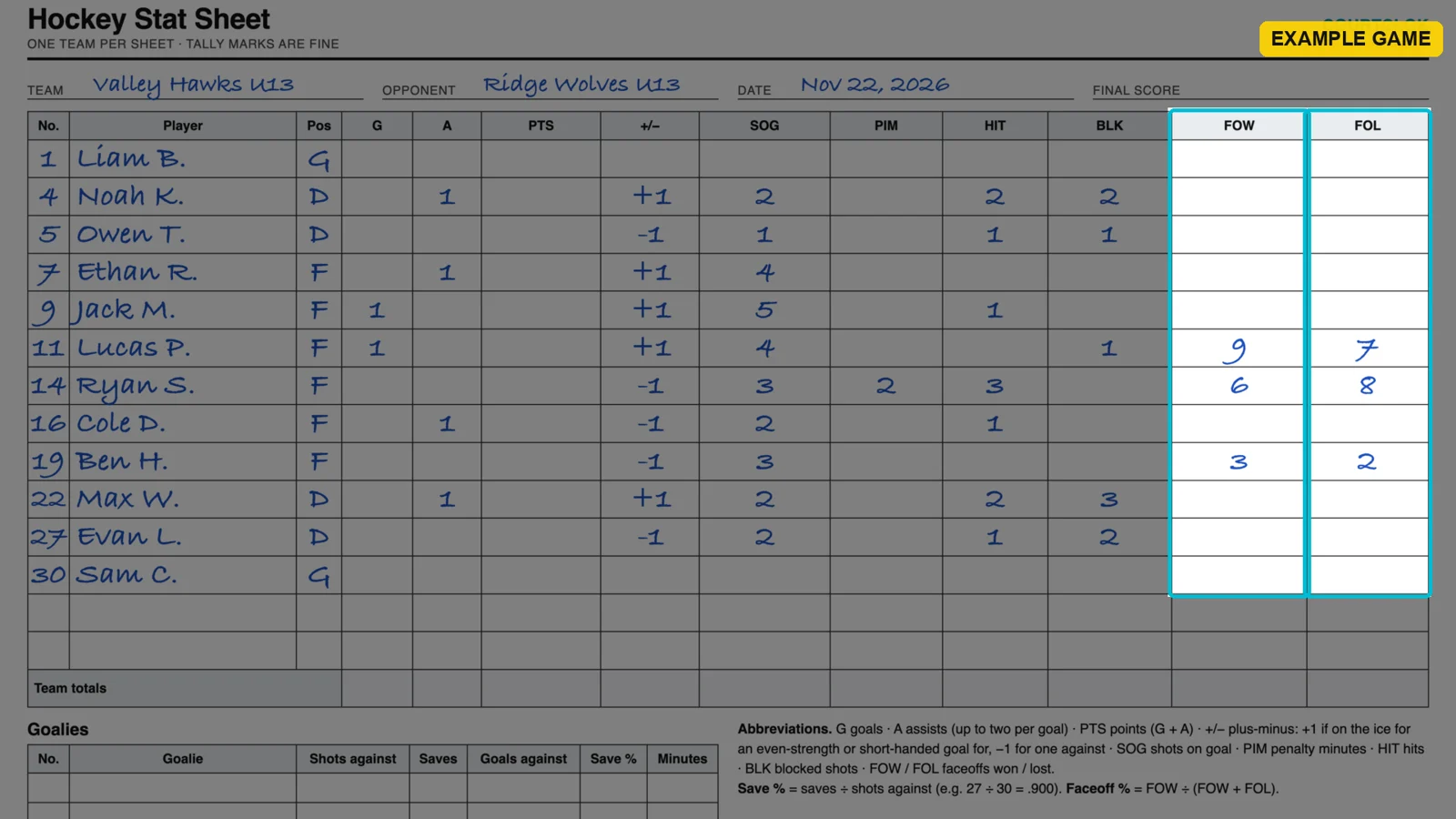
Every faceoff has a winner and a loser. Put a tally in FOW for the player who won it and in FOL for the player who lost it. Usually only your centres will have faceoff numbers.
Faceoffs won and lost, usually just the centres
Faceoff percentage = FOW ÷ (FOW + FOL). In our example #11 won 9 and lost 7: 9 ÷ 16 = 56%.
Goalies and save percentage
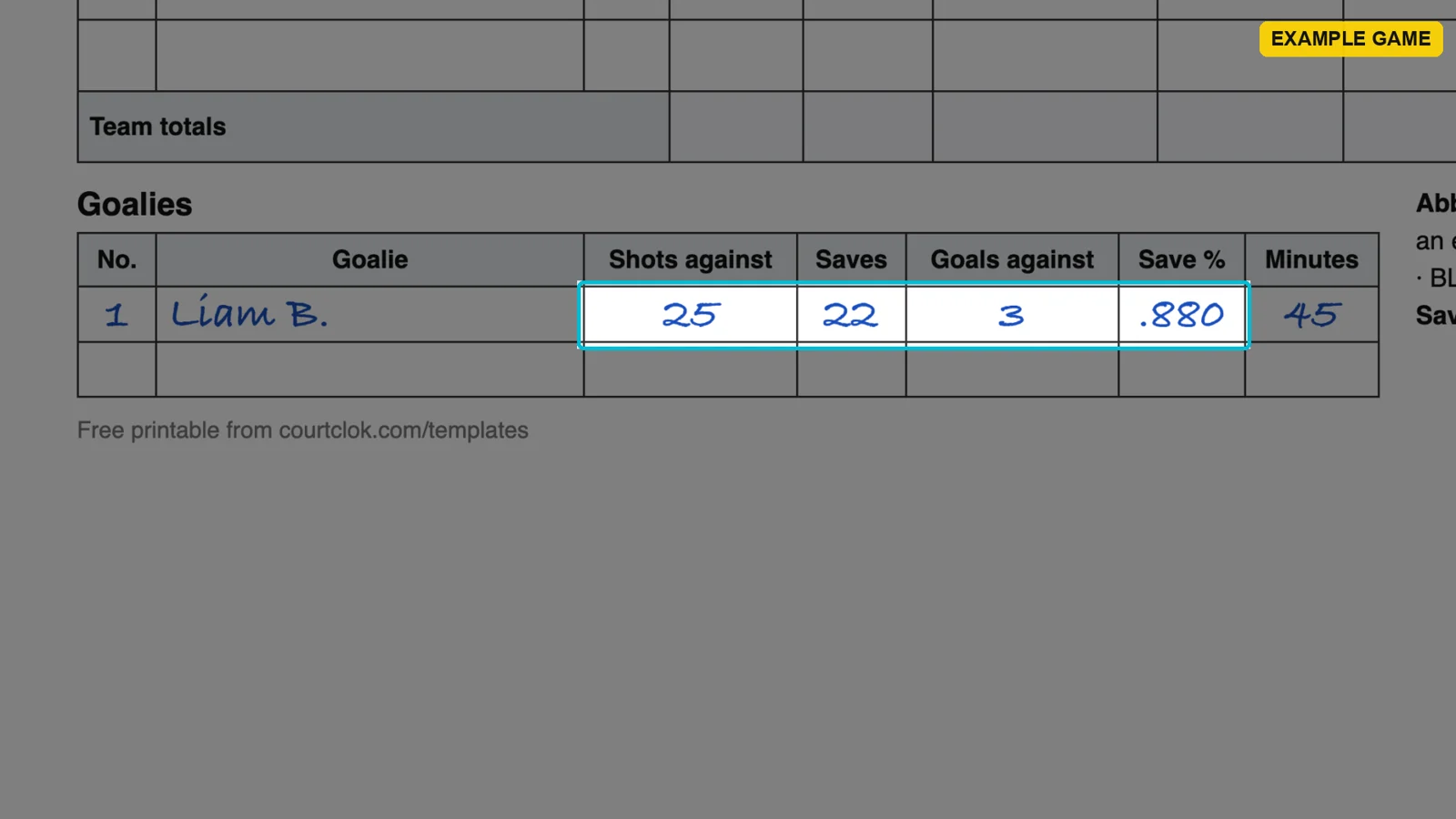
On the goalie line write the number and name, then shots against, saves and goals against, and the minutes played. One check catches most mistakes: saves plus goals against equals shots against. Your goalie's shots against is the other team's shots on goal.
Save percentage = saves ÷ shots against. It's written as a decimal: 22 saves on 25 shots is .880, and 27 on 30 is .900.
22 saves on 25 shots: .880
If the goalie changes mid-game, use the second line and give each goalie only the shots and goals while they were in. Our example game has 15-minute periods, so a full game is 45 minutes; use your league's period length.
After the game: points and team totals
Turn tallies into numbers, add up PTS for every player, then fill in the Team totals row. Before you hand it in, check:
Team G equals your team's final score.
Team A is at most twice team G (never more than two assists per goal).
Every player's PTS is their G plus A.
Team SOG is at least team G, and matches the shots on the game sheet if there is one.
Your goalie's saves plus goals against equals their shots against.
Team goals match the final score
Leave the Team totals box for +/− empty. Adding up everyone's plus-minus doesn't give a useful team number.
Common mistakes and how to fix them
Mistake
How to catch it
Fix
Plus-minus on a power-play goal
A +1 or −1 lines up with a PP goal
Remove it. Power-play goals don't count for either team
Goalie given plus-minus
Numbers in +/− on a G row
Skaters only
Post or crossbar counted as a shot on goal
Team SOG higher than the game sheet
Only shots that go in or that the goalie stops count
Three assists on one goal
Team A more than twice team G
There can only be two. Check with the game sheet
Team G doesn't match the score
Totals row vs final score
Find the goal that's missing or doubled on the player rows
The easy way: keep score on your phone
Paper is fine for a stat keeper at the glass. If you'd rather not do the score and shot counts by hand, the CourtClok app keeps the hockey score, the period clock, shots on goal and penalties for you, and can show them on a TV scoreboard at the rink.
Add a goal for the scorer and an assist for up to two players who set it up.
Plus-minus counts even-strength and short-handed goals only. A power-play goal counts for neither team.
A shot off the post is not a shot on goal.
For the goalie, saves plus goals against should equal shots against: 22 saves on 25 shots is .880.
Hockey stat sheet questions
Does a power-play goal count for plus-minus?
No. Plus-minus only counts even-strength and short-handed goals. A power-play goal gives no plus or minus to either team, but the scorer and assists still get their goal and assists.
Does a short-handed goal count for plus-minus?
Yes. Skaters on the ice for a short-handed goal for get +1, and skaters on the ice for a short-handed goal against get −1.
Is a shot off the post a shot on goal?
No. A shot on goal is one that goes in or would have gone in if the goalie hadn't stopped it. The NHL counts a shot off the post or crossbar as a missed shot.
How do you work out save percentage in hockey?
Saves divided by shots against, written as a decimal. 22 saves on 25 shots is .880.
How do you work out faceoff percentage?
Faceoffs won divided by all faceoffs taken: FOW ÷ (FOW + FOL). 9 wins and 7 losses is 9 ÷ 16, or 56%.
What does PTS mean on a hockey stat sheet?
Points: goals plus assists. A player with 1 goal and 1 assist has 2 points.
Is the hockey stat sheet free?
Yes. It's a free printable with 14 player rows, a team totals row and two goalie lines on one page.
Rather keep score on your phone? CourtClok keeps the hockey score, the period clock, shots on goal and penalties for you.