How to fill out a soccer game sheet (step by step)
By the CourtClok team · Updated October 2026 · 9 min read · 5 sources
From our video. The example match is made up.
The short answer
Fill in the match details and both rosters before kick-off, and tick the starters. Give every goal its own line with the minute, team, scorer and assist, then add it to the player's Goals box. Write substitution minutes and every card as they happen. At half-time and full time, count the goal list, write the score, and have the referee and coaches sign.
The mistake that breaks most game sheets
A goal goes in, everyone cheers, and the person with the sheet updates the score. Nobody writes down the minute or who scored. At the end the final score is right, but nobody can say who scored or when, and the roster Goals boxes don't match anything.
The fix is one habit: every goal gets its own line in the Goals table first, with the minute, the team, the scorer's number and the assist. Everything else on the sheet (player goals, the score by half, the final) is counted from that list.
Tip: [Get the free soccer game sheet (PDF)](/templates/soccer-game-sheet): one Letter page with both rosters, goals, cards, the score by half and signatures.
What you need
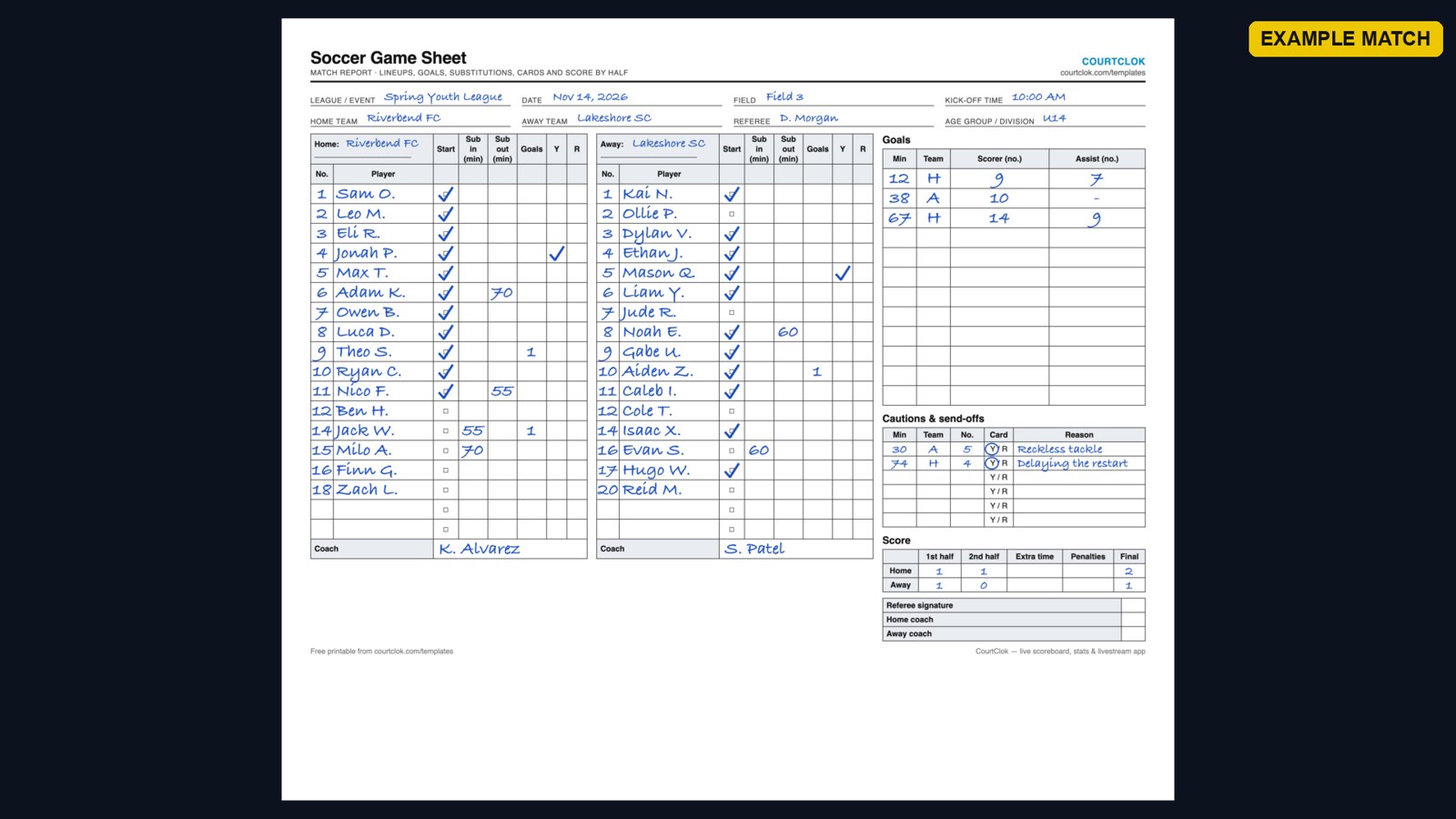
The game sheet, printed. Our free soccer game sheet has both rosters (number, name, Start, Sub in, Sub out, Goals, Y, R), a Goals table, a Cautions & send-offs table, the score by half and signature lines.
A pen and something to lean on. A clipboard works. Pencil smudges in the rain.
A watch or phone that shows the match time. Every goal, sub and card needs a minute. A full game is two halves of 45 minutes (Law 7); youth games are shorter, so check your league.
Both team lists, ideally before kick-off, so you are not copying numbers during play.
Your league may hand you its own official match card. If it does, use theirs. The steps below work the same way on any sheet.
Before kick-off: match details, rosters and starters
Fill in the top: league or event, date, field, kick-off time, home team, away team, the referee and the age group or division.
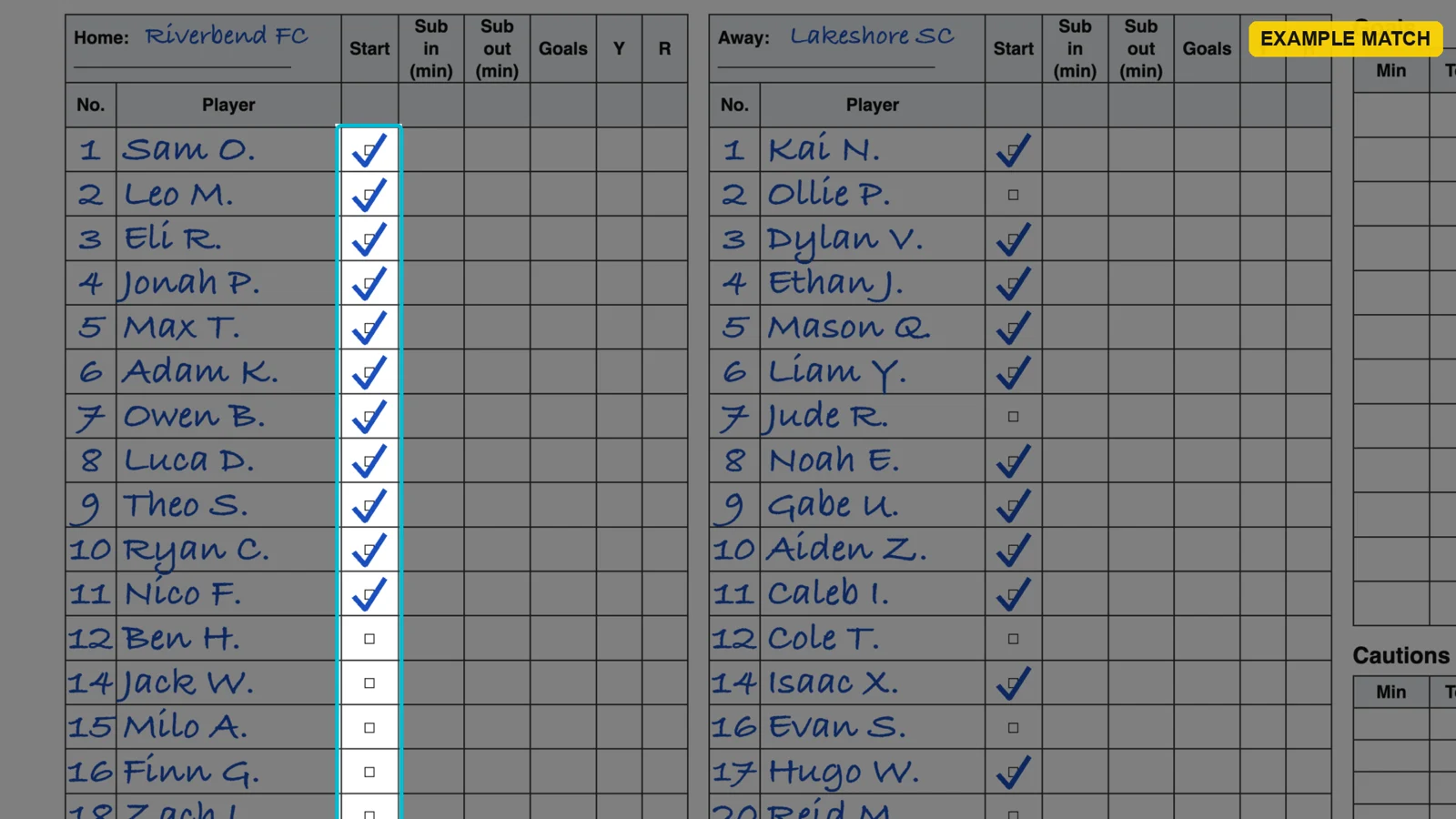
Write both rosters, jersey number first, then the name. Ask each coach to check the numbers against the shirts. A wrong number here breaks every goal and card you write later.
Tick Start for every player in the starting lineup. A full game is played by two teams of up to eleven, one of them the goalkeeper (Law 3). Youth formats are often smaller, so go by your league.
Write each coach's name in the Coach row.
Numbers first, names second, then tick the starters
Goals: one line per goal
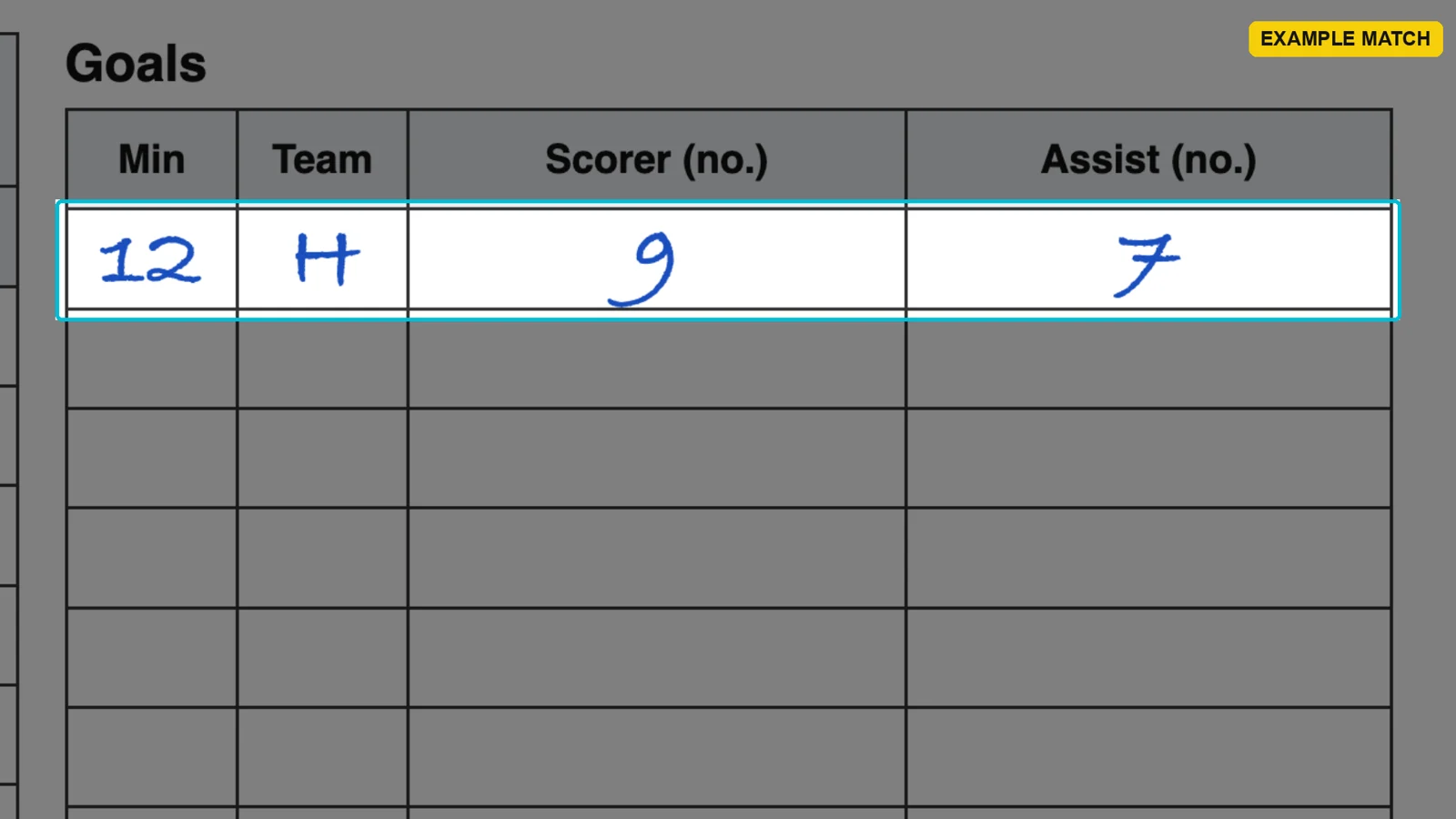
Every time a goal is scored, write a new line in the Goals table: the minute, the team (H or A), the scorer's number and the assist number (leave it as a dash if there wasn't one).
Example: home number 9 scores in the 12th minute, set up by number 7. Write 12, H, 9, 7.
One line per goal: minute, team, scorer, assist
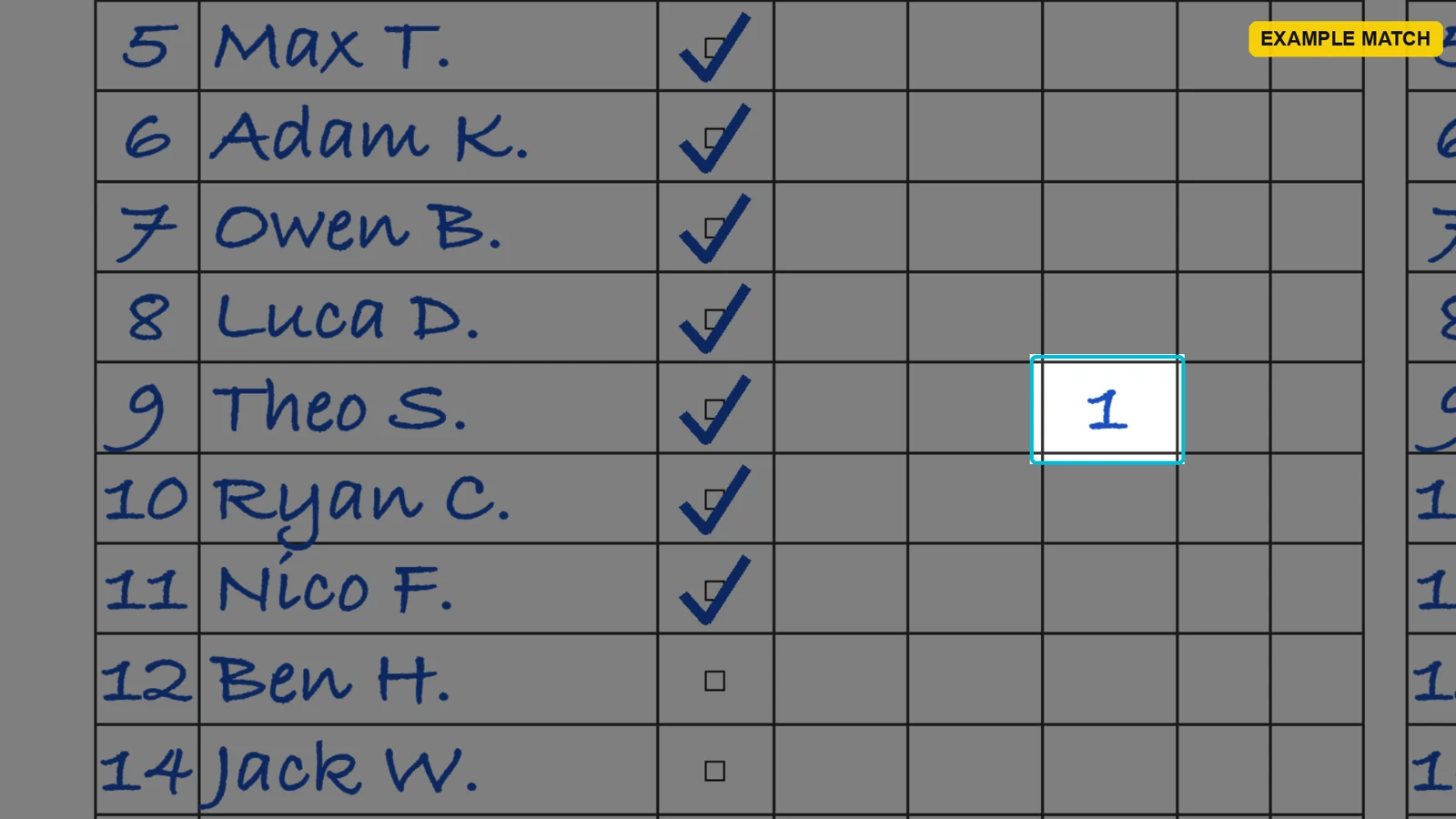
Then add the goal to that player's Goals box on the roster. If they already scored, cross out the old number and write the new total. Goal list first, roster second, every time. If you get interrupted, the list still holds the truth.
Then add it to the scorer's Goals box
Tip: Not sure who scored? Write the minute and team straight away and leave the scorer blank. Ask the referee or coach at the next stoppage. A goal with no minute is much harder to fix later than a goal with no scorer.
Substitutions
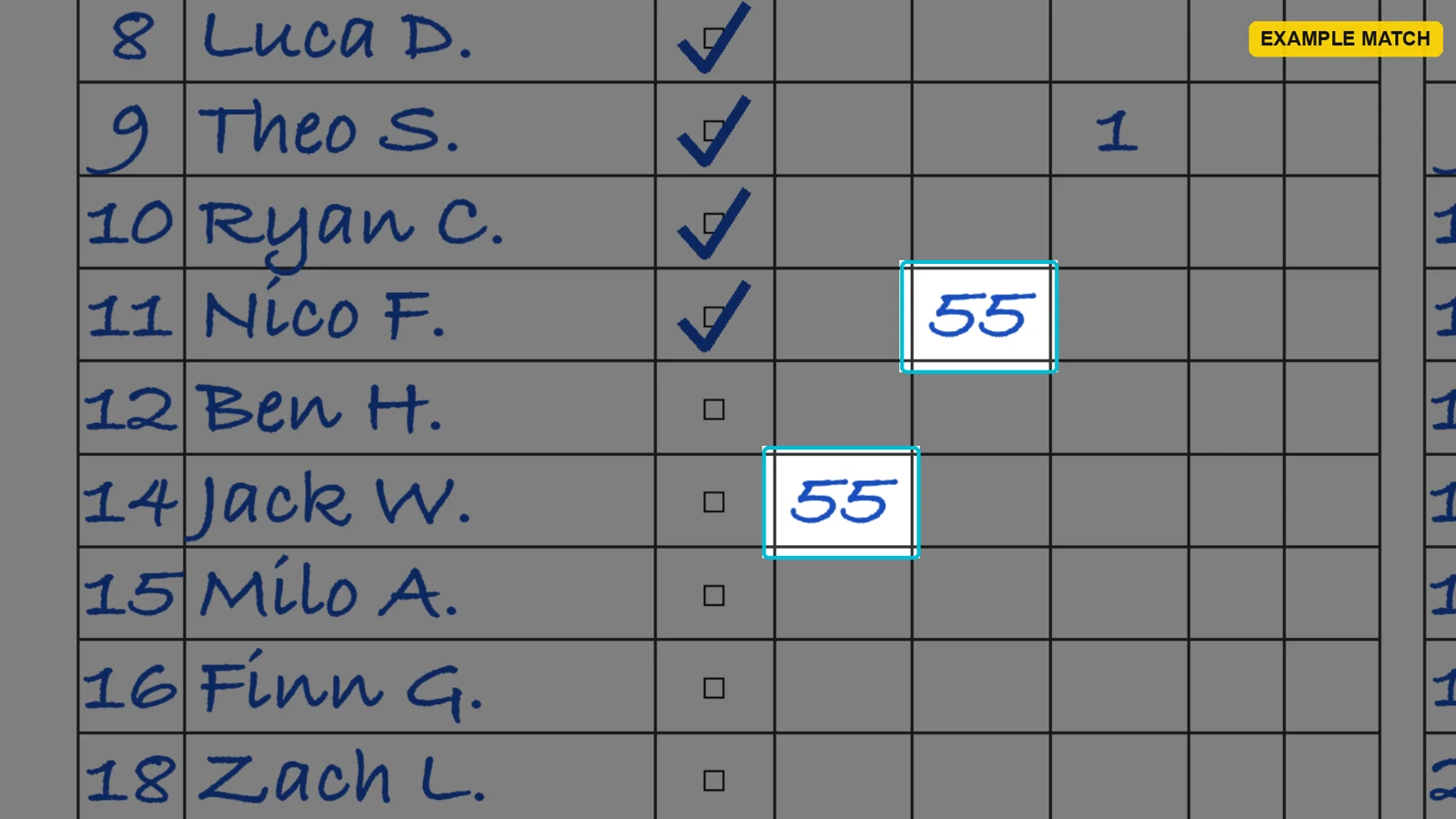
For each substitution, write the minute in Sub in for the player coming on, and the same minute in Sub out for the player going off. Example: number 14 comes on for number 11 in the 55th minute, so write 55 in 14's Sub in box and 55 in 11's Sub out box.
Same minute on both lines: in for one, out for the other
How many substitutions are allowed depends on the competition. The Laws say the competition rules must state how many substitutes may be named (from three up to fifteen), and they set limits for top-level matches (Law 3). Return substitutions (a player who came off going back on) are only allowed in youth, veterans, disability and grassroots football, when the national association agrees (Law 3). Many youth leagues use them.
Tip: If your league allows players to come back on, a player can have several minutes in Sub in and Sub out. Write them one after another, like 20, 41, 63.
Yellow and red cards
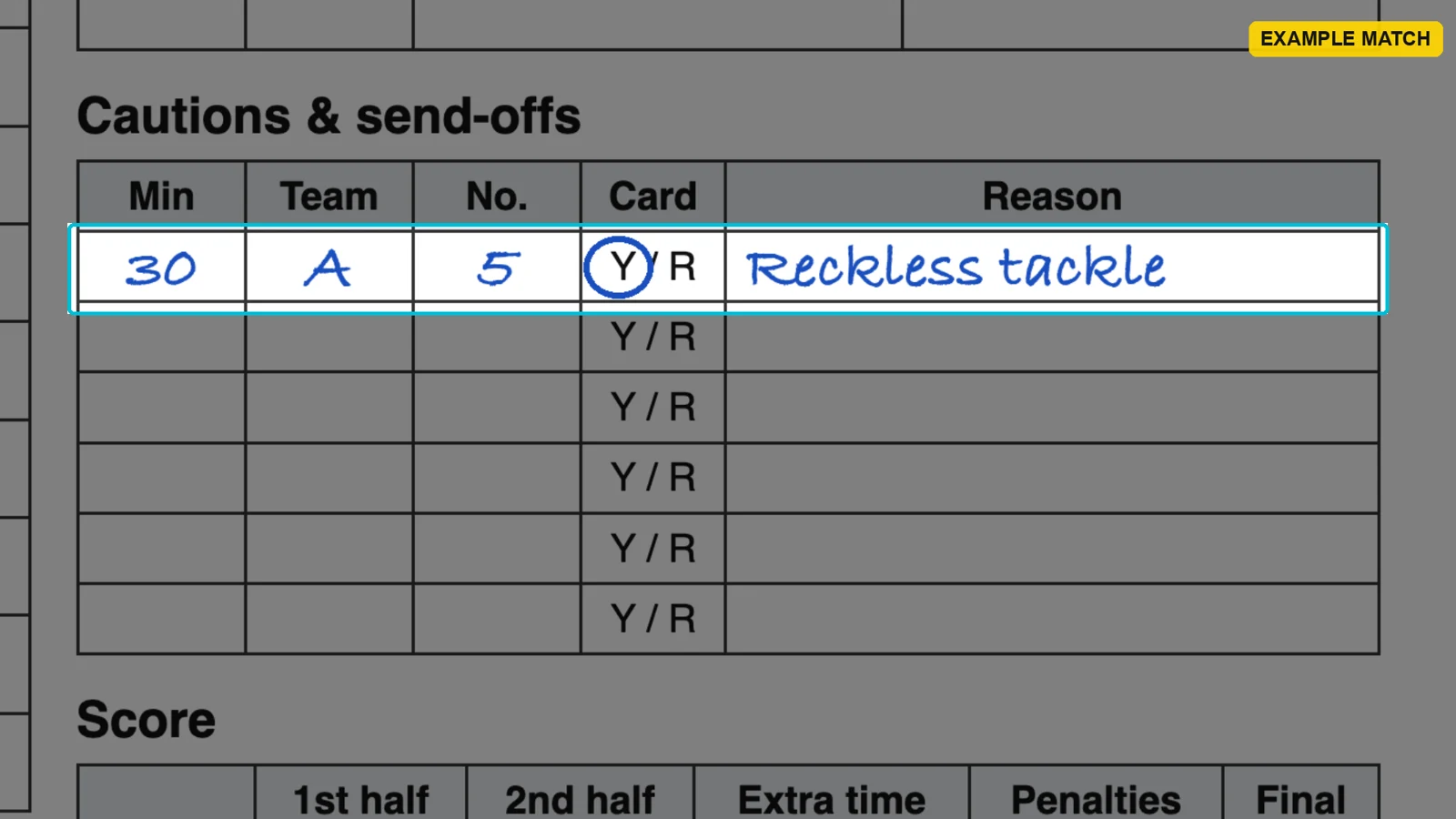
When the referee shows a card, write a line in Cautions & send-offs: the minute, team and number, circle Y (caution) or R (send-off), and the reason. Then tick Y or R on that player's roster line.
Minute, team, number, circle Y or R, then the reason
Use the referee's words for the reason if you can. Common cautionable offences in the Laws include delaying the restart of play, dissent by word or action, persistent offences and unsporting behaviour, and a reckless foul is cautioned (Law 12).
A second caution in the same match is a send-off (Law 12). Before you write a yellow, glance at that player's Y box. If it already has a tick, the player is being sent off, so mark the red as well.
The referee is the one who keeps the official record of the match and sends the match report, including disciplinary action (Law 5). Your sheet helps, but if your numbers and the referee's disagree, check with the referee before anyone signs.
Half-time and full time: the score by half
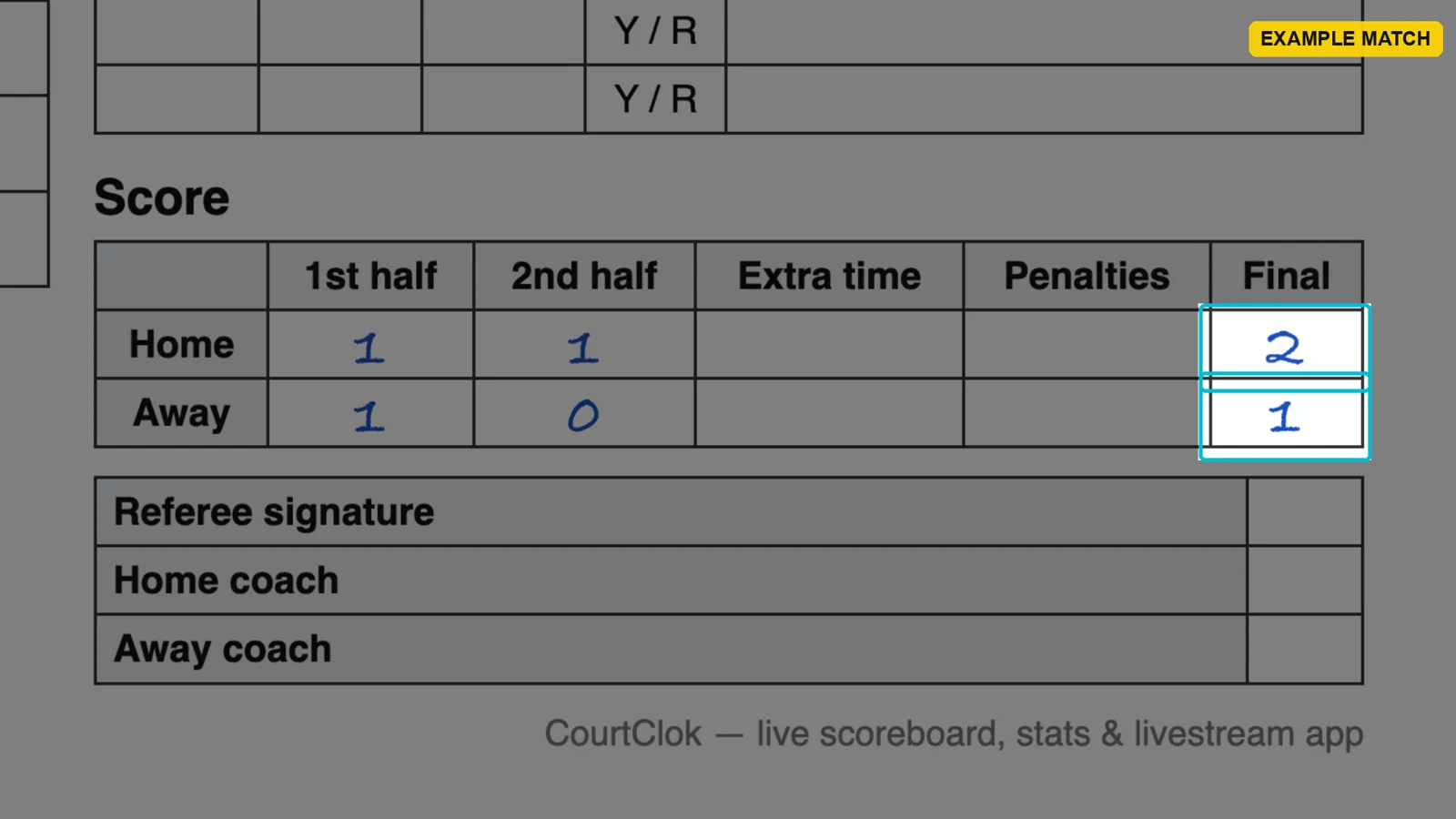
At half-time, count each team's goals in the Goals table and write them under 1st half.
At full time, count the goals scored after half-time and write them under 2nd half.
Extra time and Penalties are only for games that go that far. Extra time is two equal periods of no more than 15 minutes each (Law 10).
Write the final. The team with more goals wins (Law 10).
Count the goal list, then write each half and the final
If a game goes to a penalty shoot-out, the match itself is a draw and the shoot-out decides the winner (Law 10). Write the shoot-out score in Penalties, keep the final as the drawn score, and note who won on penalties.
Check it before anyone signs
Three things must agree: the number of lines in the Goals table for each team, the totals in the roster Goals boxes, and the final score. If they don't, the Goals table is usually right and a roster box was missed. Fix it now, while the referee and coaches are still there.
Signatures
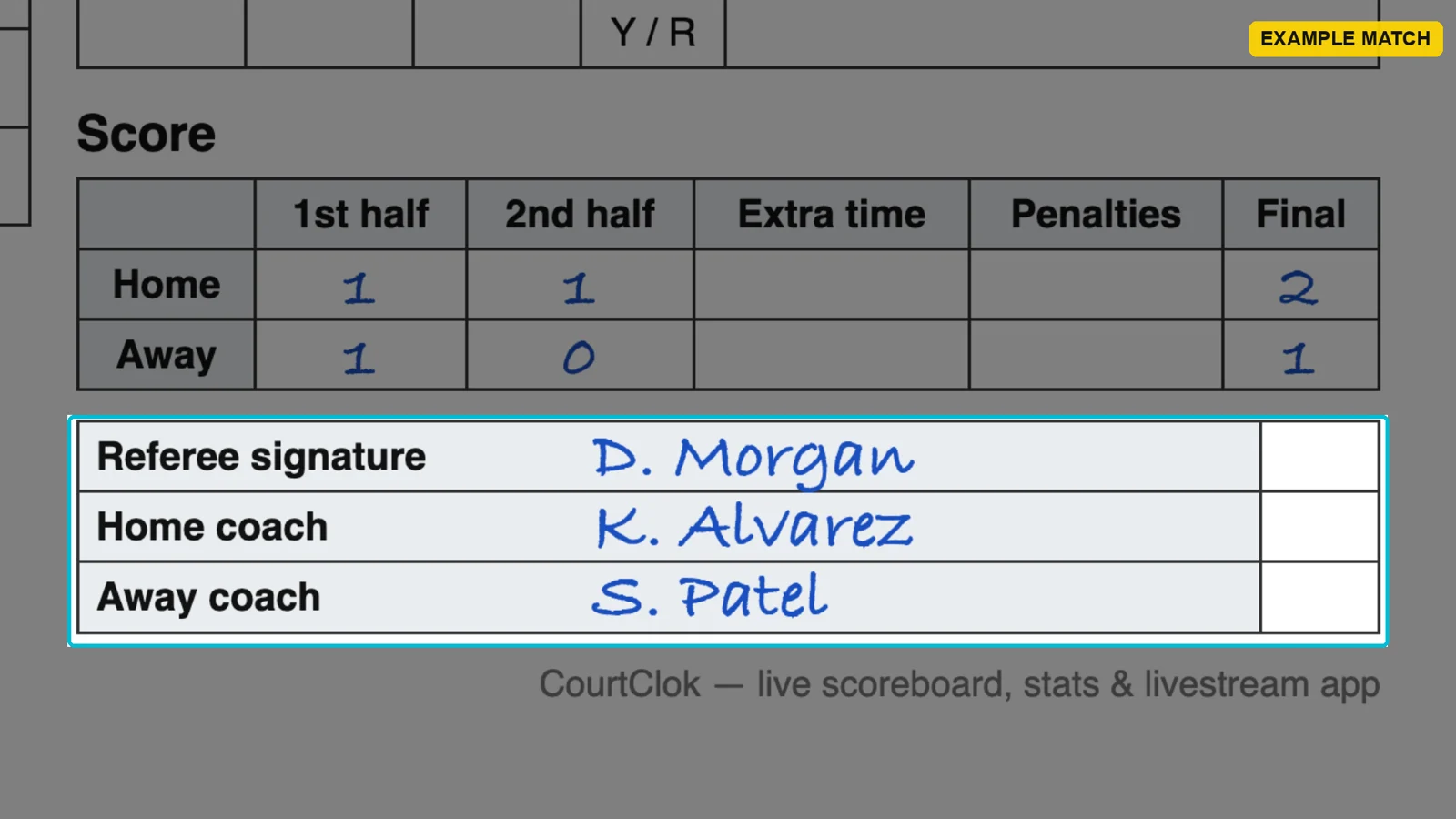
Last, the referee and both coaches sign. If something on the sheet was corrected, point it out before they sign so everyone agrees on the record.
Referee and both coaches sign
Common mistakes and how to fix them
Mistake
How to fix it
Goal on the score but not in the Goals table
Ask the referee for the minute and scorer at the next stoppage and add the line.
Final doesn't match the goal list
Recount the Goals table. Trust the list over a running tally in your head.
Roster Goals boxes don't add up
Go through the Goals table line by line and tick each scorer's box.
Wrong jersey number on a goal or card
Cross it out neatly, write the right number beside it, and tell the referee.
Sub minute written on only one player
Every sub has two lines: the same minute in Sub in and Sub out.
A second yellow not marked as a send-off
Circle R as well, tick R on the roster, and confirm it with the referee.
The app way
Paper works, and our free game sheet is built for it. If you'd rather keep the score on your phone, CourtClok keeps the soccer score and the match clock for you, and it is free to start.
Watch it filled in
Coach On fills in the whole sheet for a made-up match, Riverbend FC vs Lakeshore SC.
Fill in the top before kick-off, then both rosters, jersey number first, and tick Start for the starting lineup.
Every goal gets its own line: the minute, the team, the scorer and the assist. Goal list first, roster second.
Write the minute for every substitution and card. A second yellow in the same game is a red, so check the Y column first.
Total each half, check that the goal list, roster and final score agree, then the referee and both coaches sign.
Soccer game sheet questions
Who keeps the official record of a soccer game?
The referee. The Laws of the Game say the referee keeps a record of the match and gives the authorities a match report, including disciplinary action. A team or league scorekeeper's sheet helps, but check it with the referee before signing.
What do I write for a goal?
One line in the Goals table: the minute, the team, the scorer's number and the assist number. Then add the goal to the scorer's Goals box on the roster.
What does a second yellow card mean?
A player who receives a second caution in the same match is sent off. Mark it as a red card on the sheet and on the player's roster line.
Do penalty shoot-out goals count in the final score?
No. The match ends as a draw and the shoot-out decides the winning team. Write the shoot-out score in the Penalties column and keep the final as the drawn score.
How many substitutes are allowed?
It depends on the competition. The Laws say competition rules must state how many substitutes can be named (three to fifteen), and many youth leagues allow players to come back on. Check your league's rules.
How many players start a soccer game?
A full game is up to eleven a side, one of them the goalkeeper. Youth formats are often smaller, so tick Start for however many your league plays.
What if I miss who scored?
Write the minute and team right away and leave the scorer blank. Ask the referee or a coach at the next stoppage and fill it in.
Rather keep score on your phone? CourtClok keeps the soccer score and the match clock for you. Free to start.