How to fill out a hockey score sheet (step by step)
By the CourtClok team · Updated October 2026 · 10 min read · 2 sources
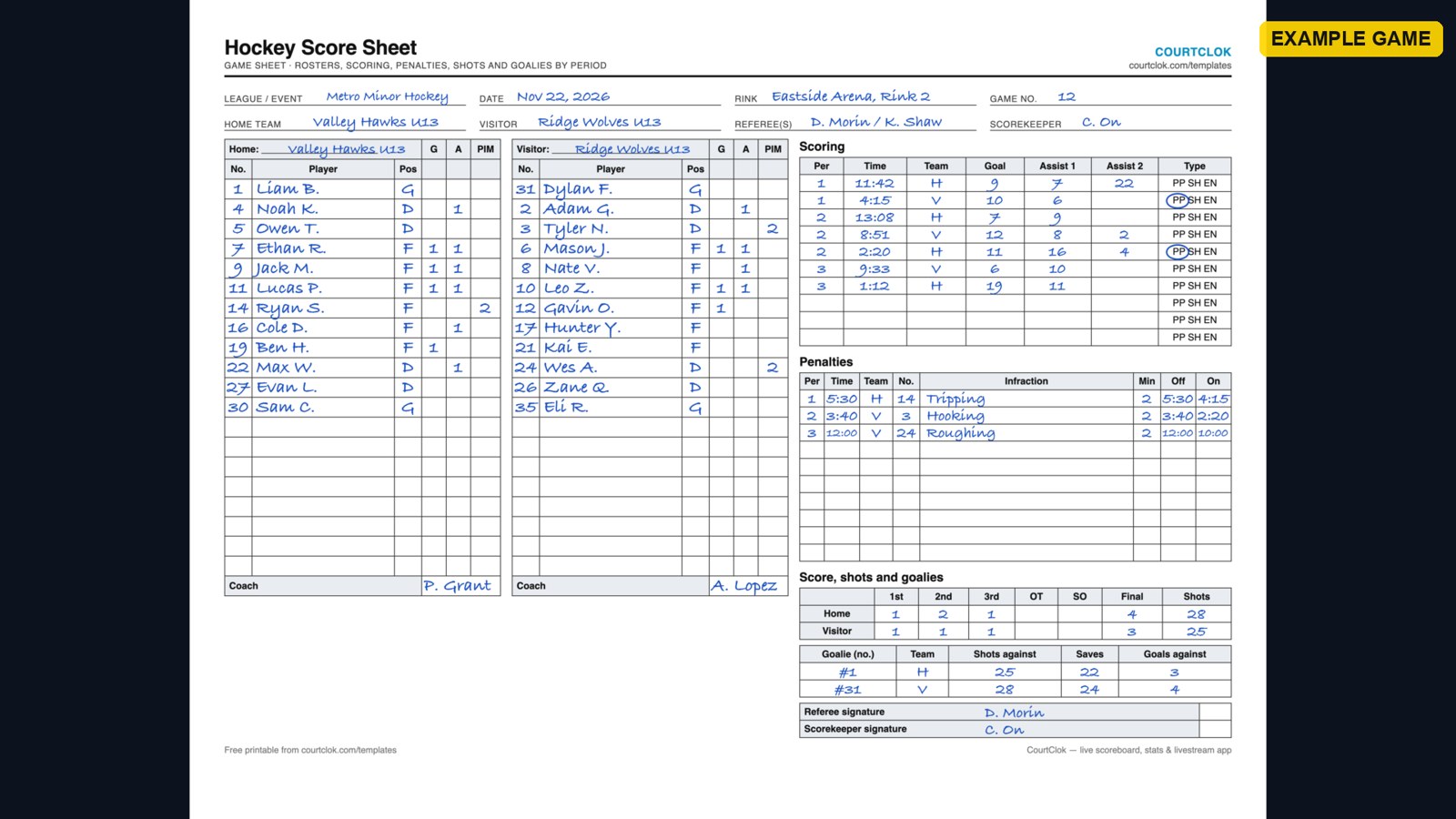
From our video. The example game is made up.
The short answer
Fill in the game details and both rosters before the puck drops. For every goal, write the period, time, team, scorer and up to two assists exactly as the referee reports them, and circle PP, SH or EN if it applies. Log every penalty with its minutes and off and on times. Total goals and shots each period, fill in the goalie lines, then sign.
The easiest mistake: the wrong number on a goal
Most of a hockey game sheet is simple. The part that goes wrong is the goal line: a scorer or an assist written down with the wrong jersey number. That one mistake changes a player's points, and in leagues that track scoring it stays on the record.
The fix is a habit, not a skill. Don't guess from the bench. The referee announces to the scorekeeper who scored and who gets the assists (Hockey Canada rule 5.2 (g)). Wait for that, then write exactly what you're told.
Tip: [Get the free hockey score sheet (PDF)](/templates/hockey-score-sheet): rosters for both teams, a scoring table, a penalty table, period scores, shots, goalie lines and signatures on one Letter page.
What you need
The sheet, printed before you get to the rink. Bring a spare.
Two pens. A pencil smudges, and a sheet that gets signed should be in ink.
A clear view of the clock so you can write goal and penalty times as they happen.
Both coaches' line-ups. Get them before warm-up ends, not after the puck drops.
At bigger games the scorekeeper, the game timekeeper and the penalty timekeeper can be three people. In most minor and rec games one person at the bench does the sheet. This guide covers the sheet itself.
Before the game: details and rosters
Fill in the top first: league or event, date, rink, game number, the home team, the visitor, the referees and your own name as scorekeeper.
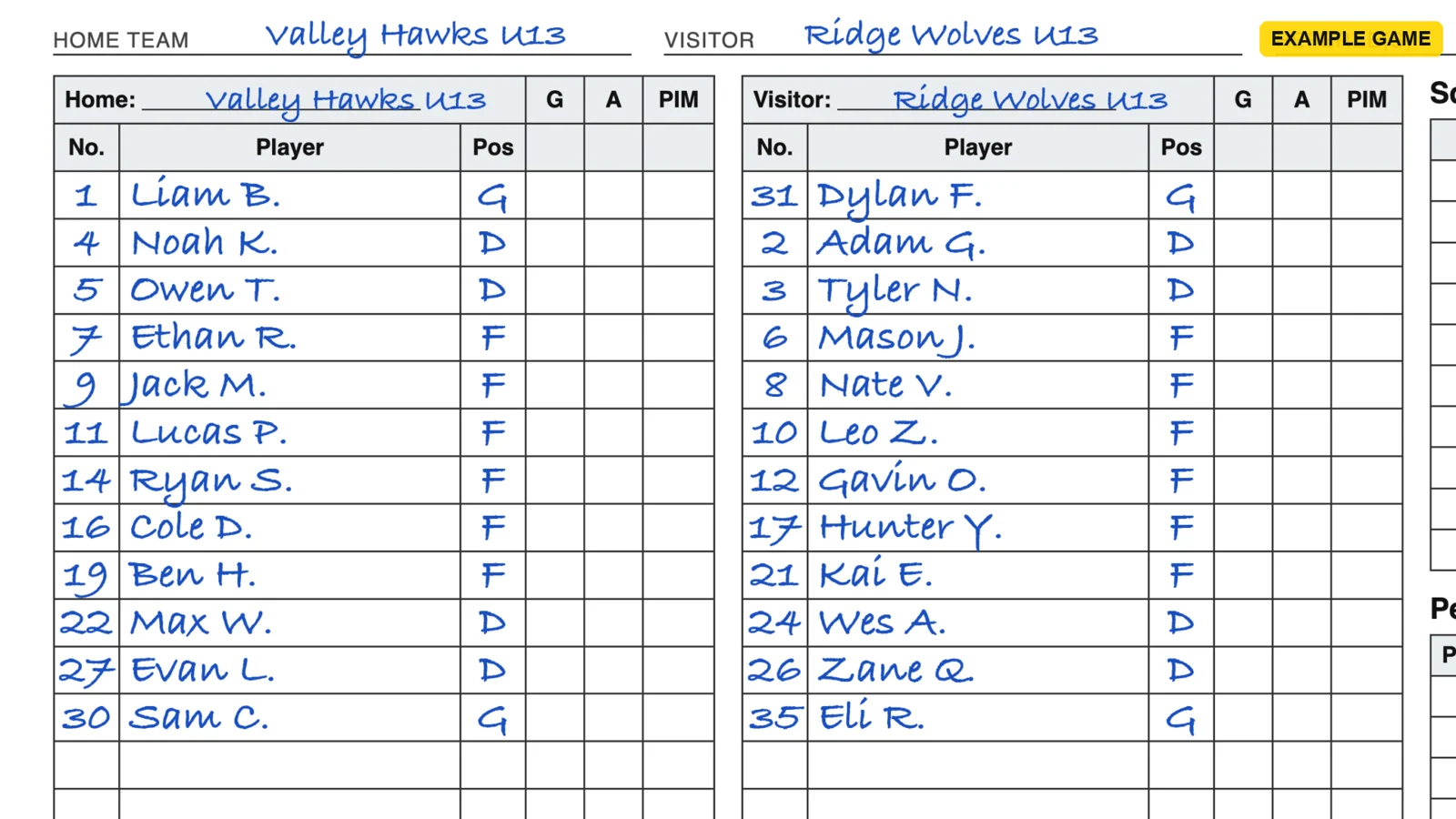
Then both rosters. For each player write the jersey number, the name and the position (F, D, or G for goalies). Under Hockey Canada rules the scorer gets each team's line-up from the coach or manager, verified and signed by the team official, and notes the captain and alternates (rule 5.6 (a)).
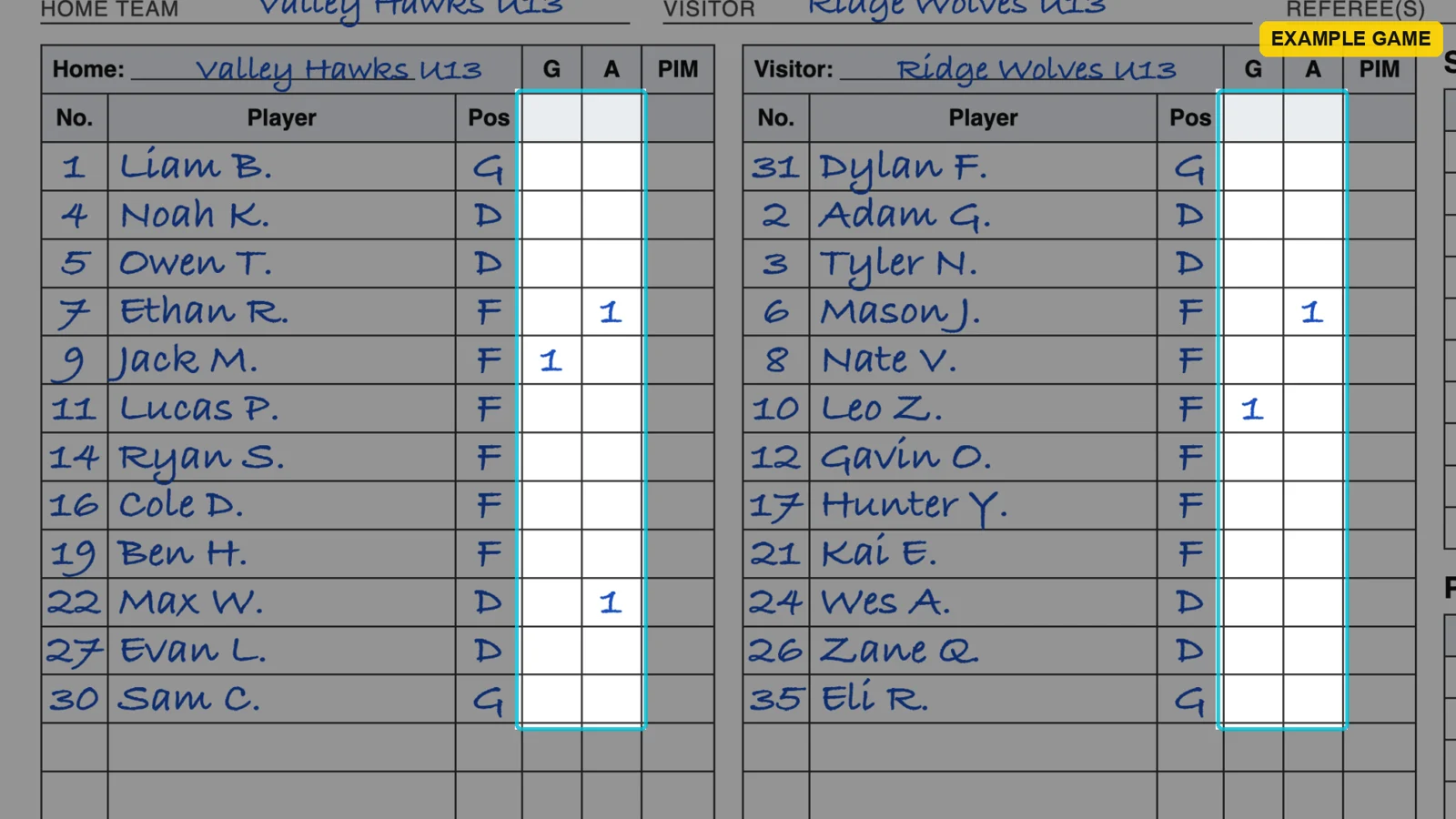
Number, name, position. Mark the goalies with G
Tip: Ask each coach to read their numbers back to you before the game. A number that's wrong here makes every goal and penalty for that player wrong later.
Goals and assists
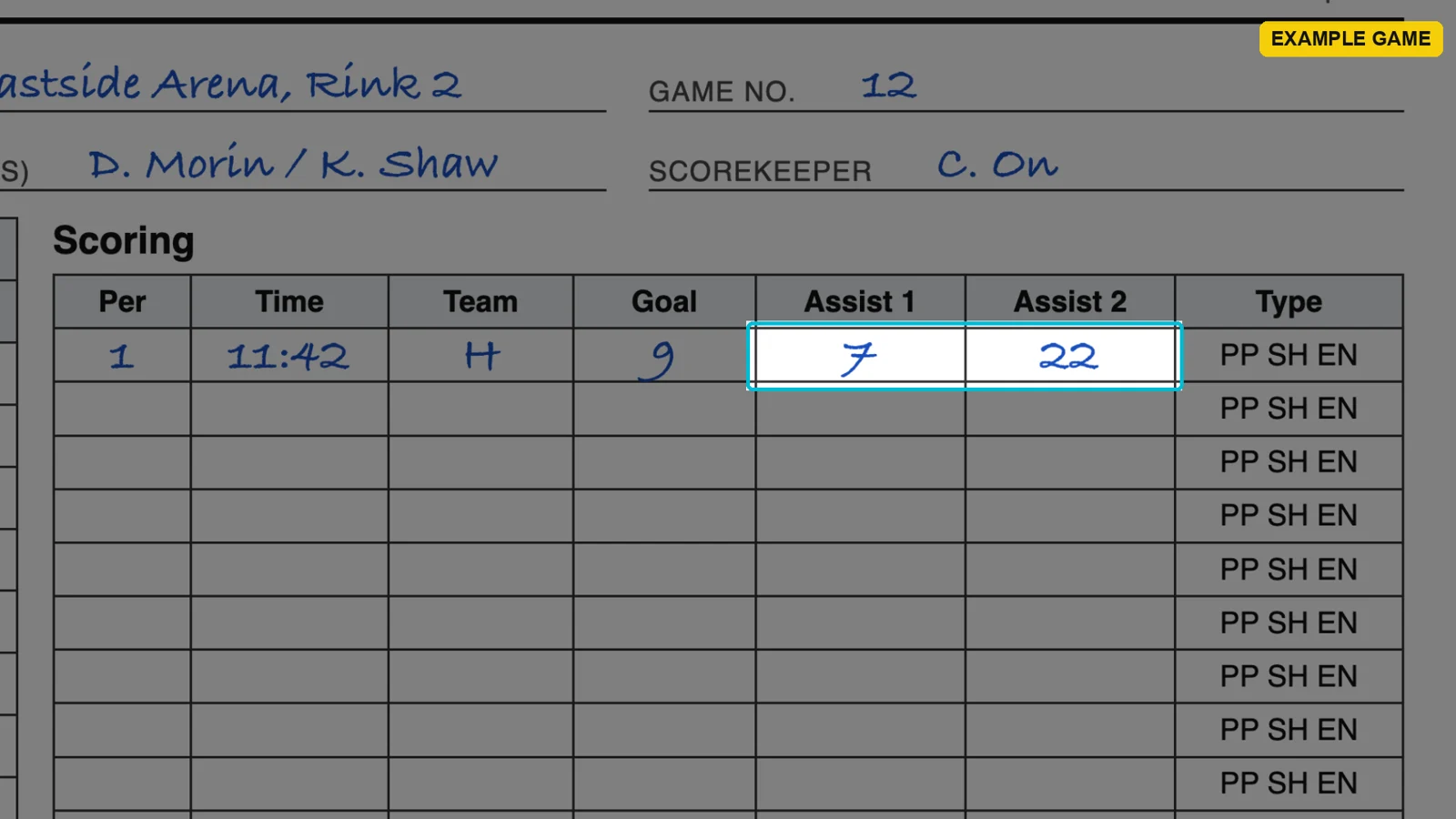
Each goal gets its own row in the scoring table. Fill in, in order:
Per: the period (1, 2, 3, or OT).
Time: the time of the goal.
Team: H for home or V for visitor.
Goal: the scorer's jersey number.
Assist 1 and Assist 2: up to two players, or leave them blank for an unassisted goal.
Period, time, team, scorer, then up to two assists
Never more than two assists. An assist goes to a maximum of two players who touched the puck before the scorer, as long as no defender had possession and control in between. If a defender puts the puck in their own net, no assists are given (Hockey Canada rule 6.6 (g); NHL rule 33 says the same: maximum two).
About the time. Leagues differ on which time goes on the sheet. Some want the time showing on the clock, others the time elapsed in the period. Ask your league once and use the same format for every goal and every penalty. Our example game uses the time showing on the clock.
Power-play, short-handed and empty-net goals
The Type column lets you circle one of three labels when it applies:
Circle
Means
Example
PP
Power-play goal: scored while the other team was short-handed
Visitor scores while a home player sits for tripping
SH
Short-handed goal: scored while your own team was short-handed
Home scores while one of its players is in the box
EN
Empty-net goal: scored with no goalie in the net
The other team pulled its goalie for an extra skater
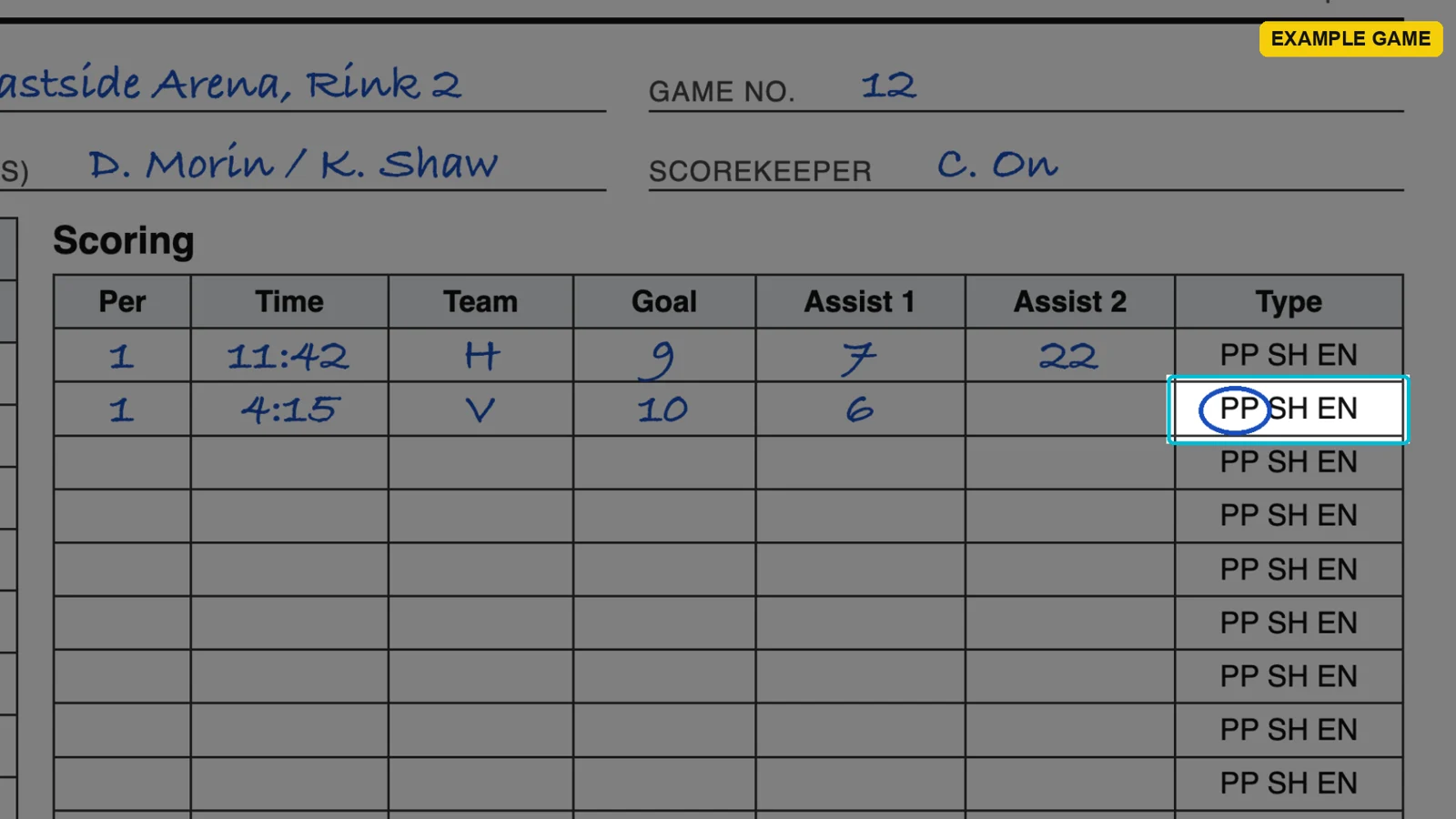
Circle PP when the goal comes on a power play
Most goals are even strength, so most rows have nothing circled. A power-play goal matters twice: it goes in the Type column, and it can end a minor penalty early (see penalties).
Add each goal to the rosters
Right after you write a goal row, add it to the rosters: a 1 in G for the scorer and a 1 in A for each assist. If the player already has one, change the 1 to a 2.
Scoring table first, roster columns second
Doing it as you go is what makes the end-of-game check work. If you leave the rosters until the end, you're copying from your own table and you won't catch anything.
Penalties
Each penalty gets a row in the penalty table: Per, Time, Team, the player's No., the Infraction (tripping, hooking, roughing…), the Minutes, and the Off and On times. The referee tells you the infraction and the length (Hockey Canada rule 5.2 (g)), and the scorer keeps a record of every penalty with the player, the length, the infraction and the time (rule 5.6 (c)).
Penalty lengths scorekeepers need
Penalty
Minutes
What it means for the sheet
Source
Minor
2
Team plays short-handed. Ends early if the other team scores (the minor with the least time left ends).
Off is when the penalty starts. On is when the player can come back. For a minor that runs its full length, that's two minutes of playing time after Off.
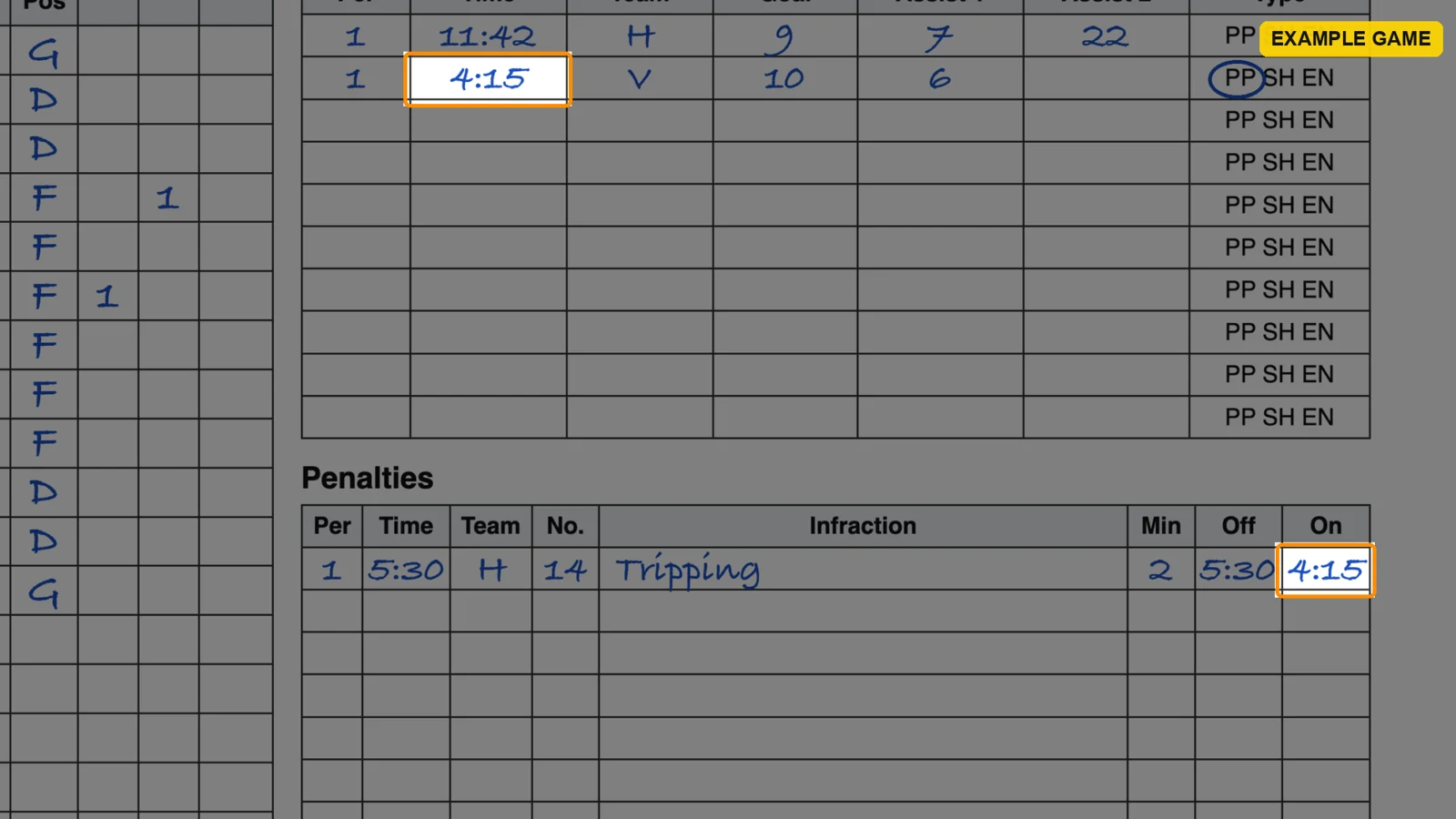
When a power-play goal ends a minor early, write that goal's time in On. In our example, home #14 goes off for tripping at 5:30 of the 1st and the visitors score on the power play at 4:15, so the On time is 4:15, the same as the goal.
The power-play goal at 4:15 ends the minor, so On is 4:15
Then add the minutes to the player's PIM (penalties in minutes) box on the roster.
Period scores, shots and goalies
At the end of each period, write each team's goals for that period in the 1st, 2nd or 3rd box, and keep a running count of shots on goal for the Shots column. Use OT and SO only if the game goes there.
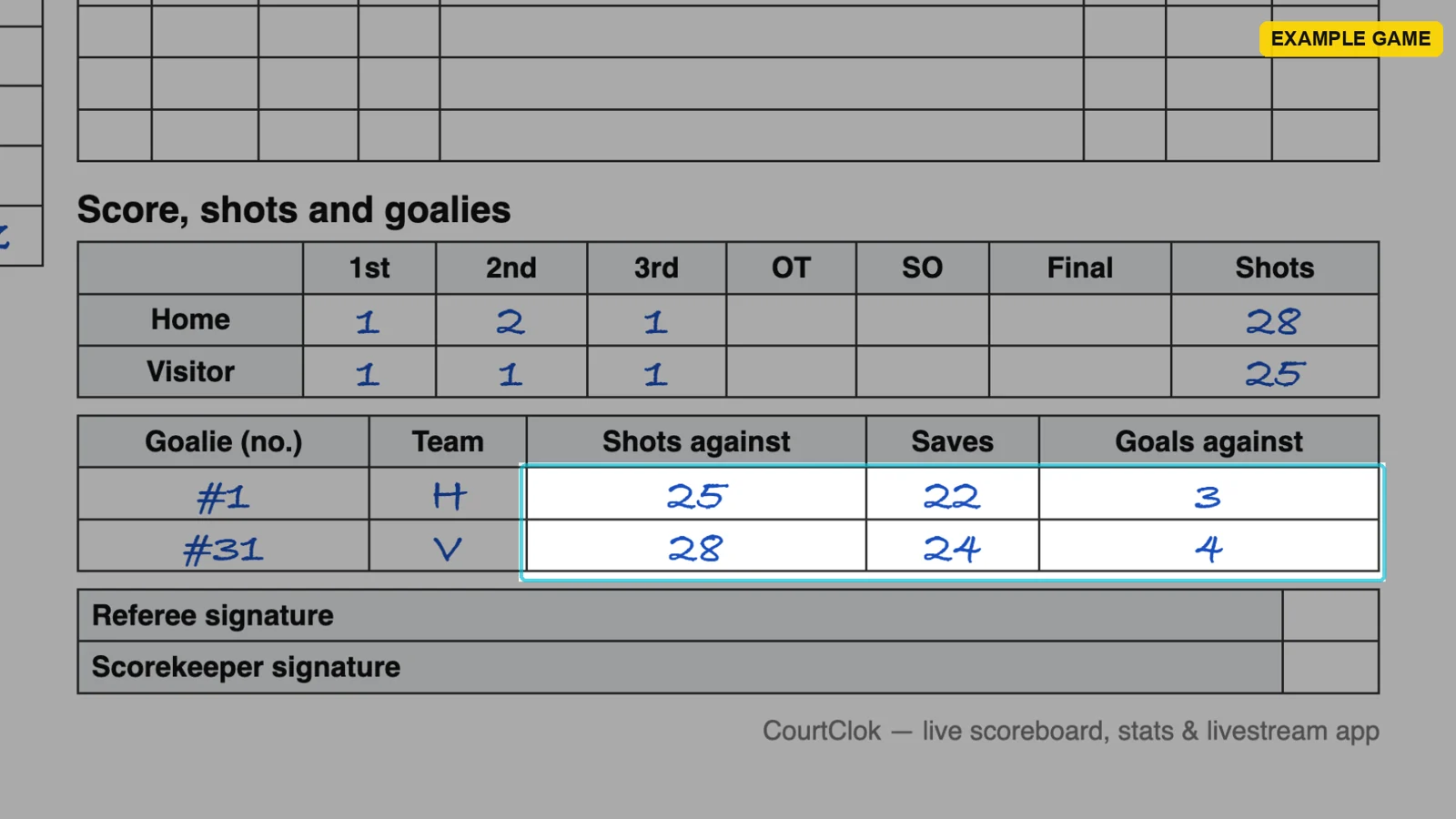
Then the goalie lines. For each goalie write the number, the team, shots against, saves and goals against. One check catches most mistakes: saves plus goals against equals shots against. A goalie's shots against is the other team's shots.
Saves plus goals against should equal shots against
If a goalie is replaced mid-game, give each goalie their own line with only the shots and goals while they were in.
End of the game: final score and signatures
Write the final score for each team. Then check it three ways before anyone signs:
The final matches the number of rows for that team in the scoring table.
The final matches the sum of the period boxes.
The final matches the total of the G column on that team's roster.
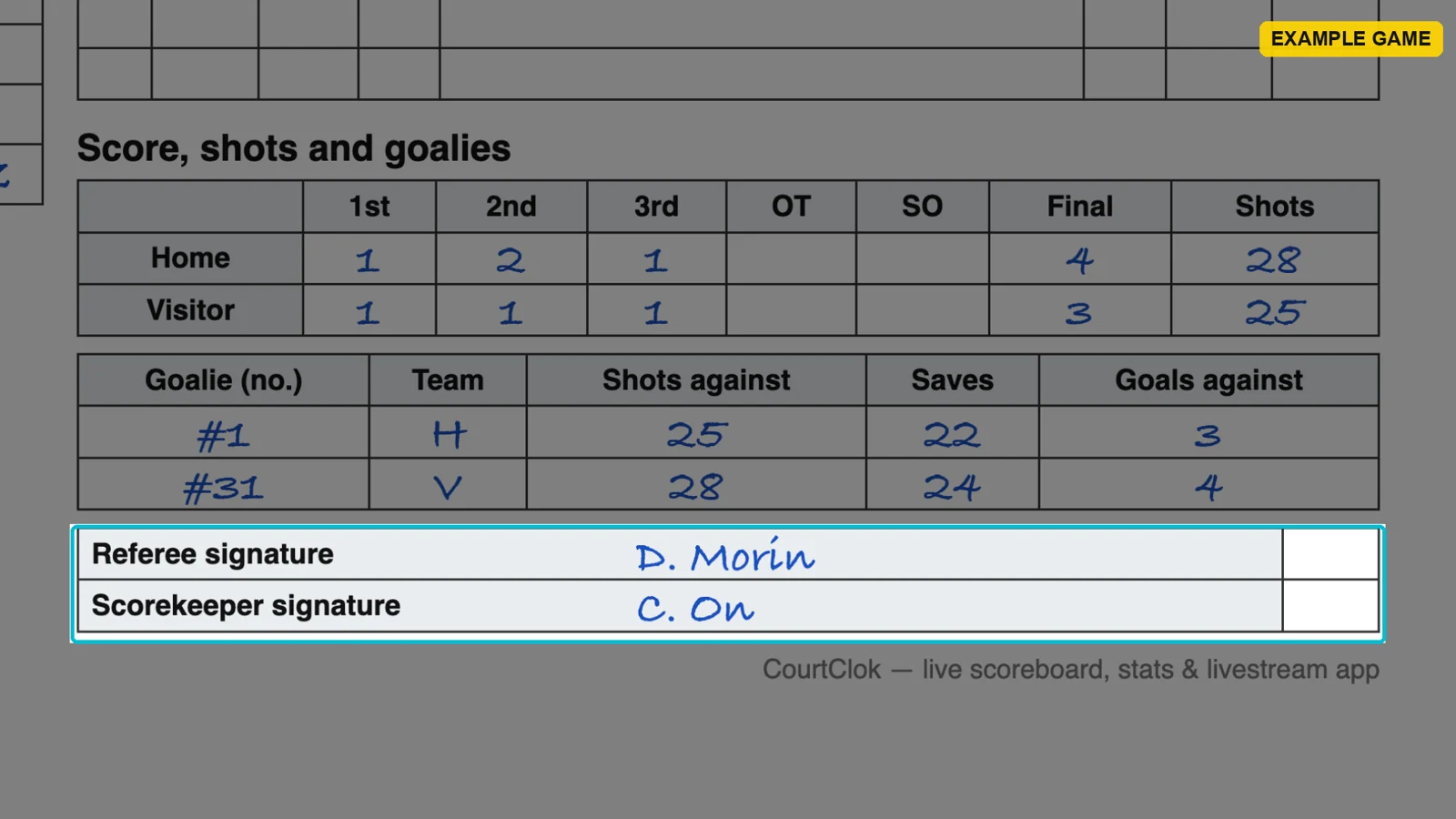
Finals, then both signatures
Then sign. Under Hockey Canada rules the scorer signs the game report and has the referee sign it, and the referee checks it before signing (rules 5.6 (f) and 5.2 (i)). Hand it in the way your league asks.
Common mistakes and how to fix them
Mistake
How to catch it
Fix
Wrong number on a goal or assist
The roster G/A doesn't match what the bench says
Ask the referee at the next stoppage and correct it with a single line, not a scribble
Three assists on one goal
Count the assist boxes
There can only be two. Ask the referee which two
Minor not ended after a power-play goal
A PP goal falls inside a minor's Off–On window
Change On to the goal's time
Final doesn't match
Scoring rows, period boxes and G column disagree
Recount the scoring table first; it's the record the others come from
Goalie numbers don't add up
Saves + goals against ≠ shots against
Recheck the shot count for that team
Corrections should stay readable. Draw one line through the wrong entry and write the right one beside it, so the referee can see what changed.
The easy way: keep score on your phone
Paper works, and many leagues still want a signed sheet. But if you'd rather not do period totals and shot counts by hand, the CourtClok app keeps the hockey score, the period clock, shots on goal and penalties for you, and can show them on a TV scoreboard at the rink.
Many scorekeepers do both: the app for the score everyone sees, and the paper sheet as the signed record. The free hockey score sheet is ready to print.
Watch it filled in
Coach On fills in the whole sheet for a made-up game, Valley Hawks U13 vs Ridge Wolves U13.
Fill in the top before the puck drops, then both rosters with G for the goalies. Ask each coach to check the numbers.
For every goal: period, time, team, scorer, then up to two assists exactly as the referee reports them. Circle PP, SH or EN if it applies.
For every penalty: the minutes, plus Off and On times. A minor ends early on a power-play goal, so that goal’s time goes in On.
Each period, write goals and shots. For each goalie, saves plus goals against should equal shots against. Then you and the referee sign.
Hockey score sheet questions
How many assists can a goal have in hockey?
Up to two. Assists go to a maximum of two players who touched the puck before the scorer, as long as no defender had possession and control in between. A goal can also be unassisted.
Who decides the scorer and the assists?
The referee. Under Hockey Canada rules the referee announces to the official scorer who gets the goal and the assists, and the scorer records it.
How long is a minor penalty in hockey?
Two minutes of playing time. A major is five minutes and a misconduct is ten. A minor ends early if the other team scores while the penalized team is short-handed; a major does not.
What do PP, SH and EN mean on a score sheet?
PP is a power-play goal (scored while the other team is short-handed), SH is a short-handed goal (scored while your team is short-handed) and EN is an empty-net goal (no goalie in the net).
What does PIM mean?
Penalties in minutes: the total penalty minutes for a player. Add each penalty's minutes to the player's PIM box on the roster as you log it.
Do I write the time on the clock or the time elapsed?
It depends on your league. Some record the time showing on the clock, others the time elapsed in the period. Ask once, then use the same format for every goal and penalty.
Is the hockey score sheet free?
Yes. It's a free printable with both rosters, a scoring table, a penalty table, period scores, shots, goalie lines and signatures on one page.
Rather keep score on your phone? CourtClok keeps the hockey score, the period clock, shots on goal and penalties for you.