How to fill out a basketball score sheet (step by step)
By the CourtClok team · Updated October 2026 · 12 min read · 5 sources
From our video. The example game is made up.
The short answer
Fill in the game details and both rosters before tip-off. During the game, the running score comes first: cross off the team's new total and write the scorer's number beside it. Then add the points to that player's box. Mark every foul and timeout as it happens. At the end, player totals must equal the running score.
The mistake almost every new scorekeeper makes
Most people who get handed the book do one thing well: they write down how many points each player scored. Then they forget the running score, the column of numbers that tracks the team total basket by basket.
The running score is the official record of the game. When the scoreboard and the book disagree, the book is what officials go back to. FIBA's rules say that if the scoreboard and the scoresheet can't be reconciled, the scoresheet takes precedence (FIBA Official Basketball Rules 2026, Art. 49). In high school, the official scorebook is accepted in a controversy unless the referee knows otherwise (NFHS scorer guidance).
So the order is always the same. Running score first, player box second. Everything below follows from that.
Tip: Grab our free printable basketball score sheet and follow along. It has the running score, player points per quarter, fouls, team fouls and timeouts on one page.
What you need
A score sheet for every game. Print a few of our free score sheets so you have spares.
Two pencils or pens. Pencil is easier to fix. If your league wants pen, cross out cleanly and initial the change.
Both rosters with jersey numbers. Ask each coach for theirs before warm-ups end.
A seat at the scorer's table next to the clock operator, with a clear view of the court and the officials.
In high school games the scorer should have both rosters and numbers 10 minutes before game time, and the starting lineups 10 minutes before tip-off. If a list is late or changes, tell the referee before the ball goes up (NFHS scorer guidance). Youth leagues are usually more relaxed, but the habit saves you trouble.
Before tip-off: game details and rosters
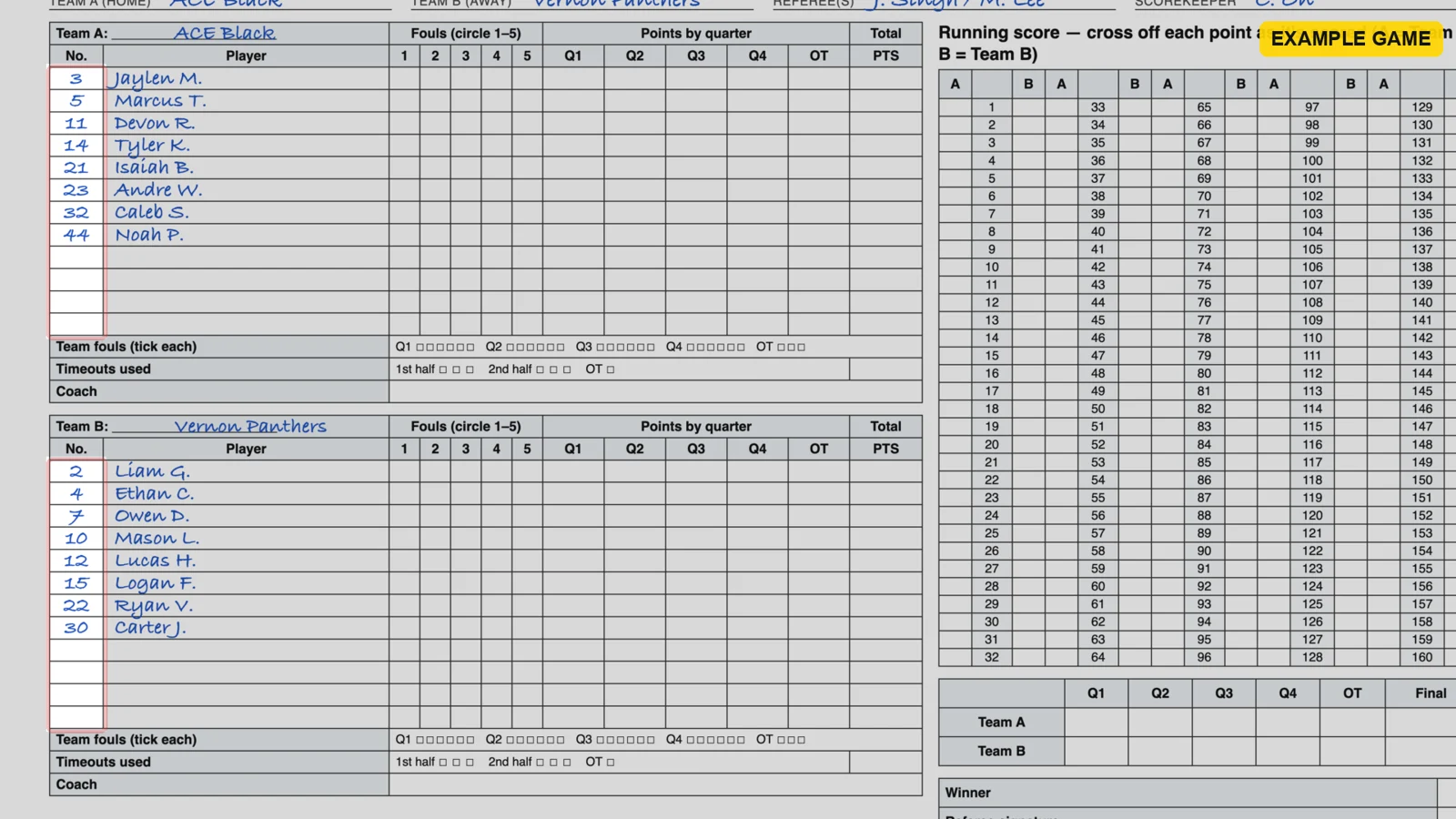
Game details at the top, then both rosters, jersey number first
Fill in the game details
Write the league or event, the date and the court.
Write both team names. On our sheet, Team A is home and Team B is away. In the example, ACE Black is home and Vernon Panthers are away.
Write the referees' names and your own name as scorekeeper.
Fill in both rosters
List each team's players with the jersey number first, then the name. During the game you'll only ever hear or see numbers, so put them where your eye goes.
Mark the five starters if your league asks for it.
Show each coach their roster and ask them to check it. A wrong number found before tip-off takes ten seconds to fix. Found in the third quarter, it can mean points credited to the wrong player.
You should see: every player on both teams listed by number, and both coaches have looked at it.
The running score
The running score is a long column of numbers, 1, 2, 3, 4 and up, one column per team. Team A (home) uses the A column and Team B (away) uses the B column. Each time a team scores, you cross off numbers up to their new total.
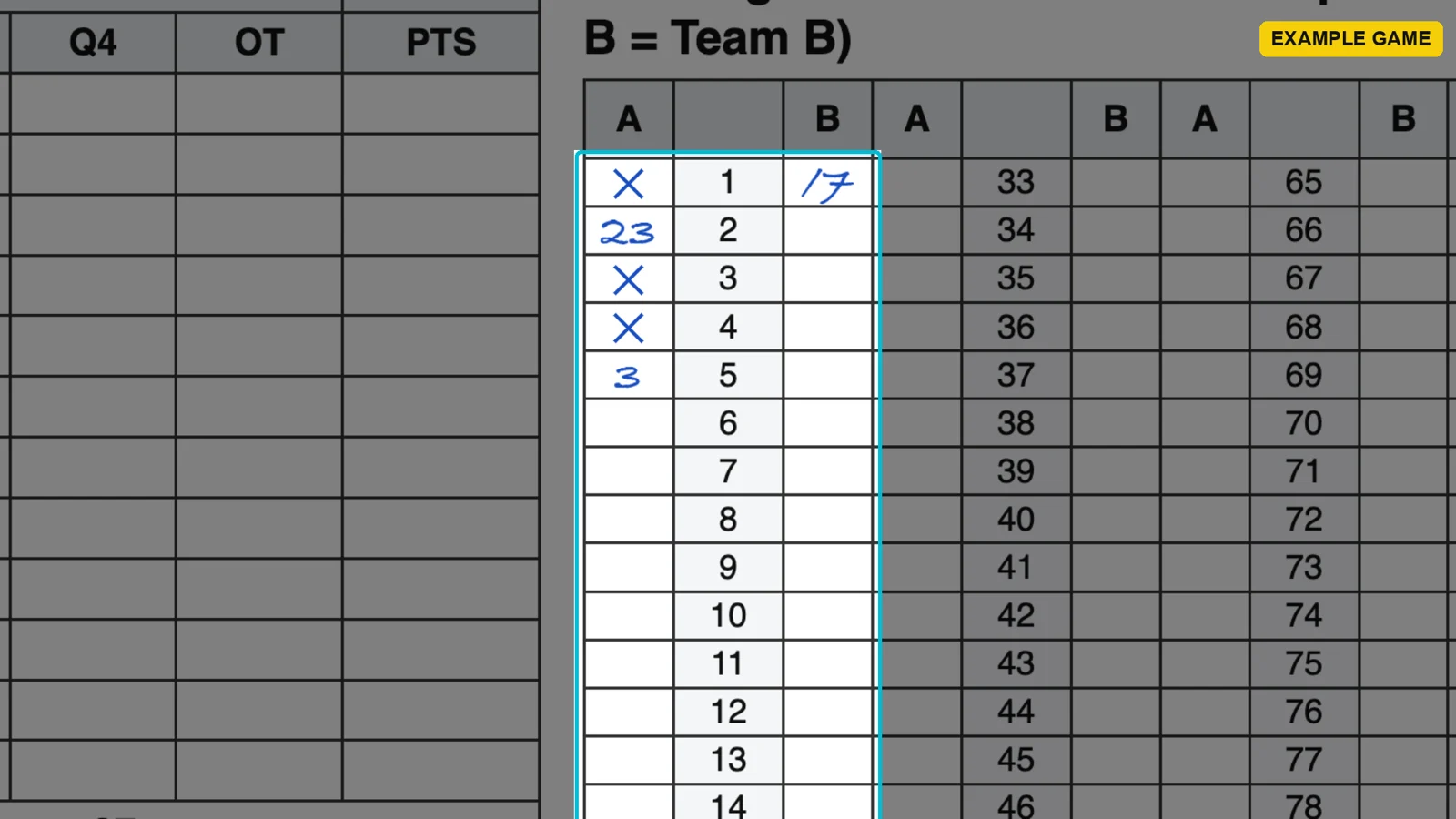
X for a basket, slash for a free throw, and the scorer's number beside the last number crossed off
A team scores. Find their column and the next numbers not yet crossed off.
Cross off the numbers for the points scored. A basket is 2 numbers, a three is 3, a free throw is 1.
Mark the last number: an X for a basket, a slash (/) for a free throw.
Write the scorer's jersey number beside that last number.
Example: ACE Black's #23 hits the first shot of the game, a two. In the A column, cross off 1 and 2, put an X on the 2, and write 23 beside it. Vernon's #4 then makes one of two free throws. In the B column, slash the 1 and write 4 beside it. One look at the column tells you ACE Black 2, Vernon 1, and who scored each point.
Tip: For a three, cross off three numbers and circle the player's number so you can count threes later. FIBA scoresheets use the same circle for a 3-point goal.
Look up at the scoreboard after every basket. If it doesn't match your column, tell the officials at the next dead ball. Don't wait until halftime.
Player points, by quarter
Once the running score is done, add the points to the player. Each player has a box for each quarter.
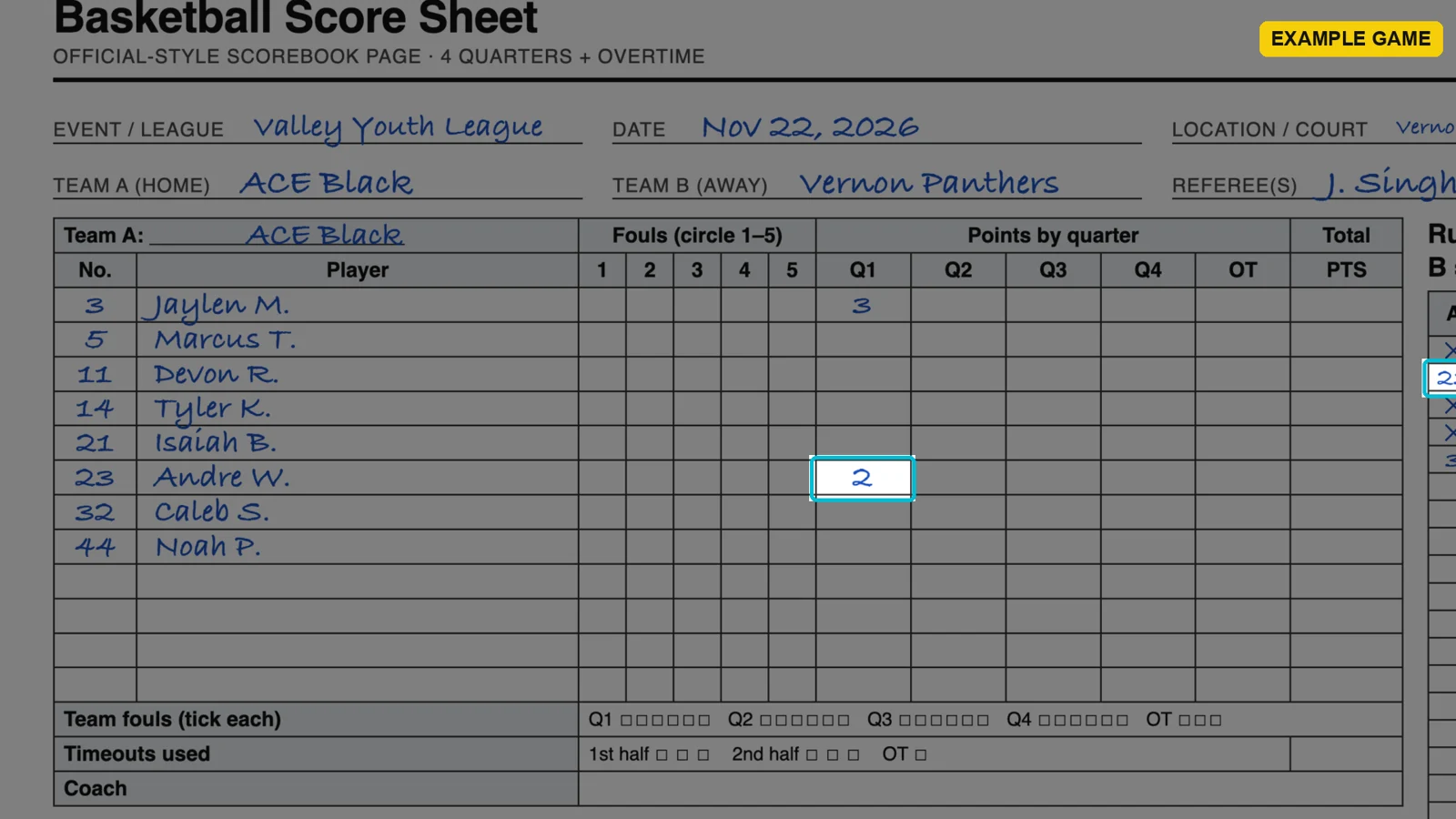
Player points go in that quarter's box, after the running score
Find the player's row and the box for the current quarter.
Write the points they just scored: 2, 3 or 1 for a free throw.
Keep going in the same box until the quarter ends. Add it up at the break.
Writing each score separately (2, 2, 1, 3) instead of a running total makes mistakes easier to find later. If you only write "8", you can't tell which basket went missing.
Fouls: player fouls and team fouls
Every foul gets two marks. One goes on the player who committed it. One goes on their team's foul count for the quarter.
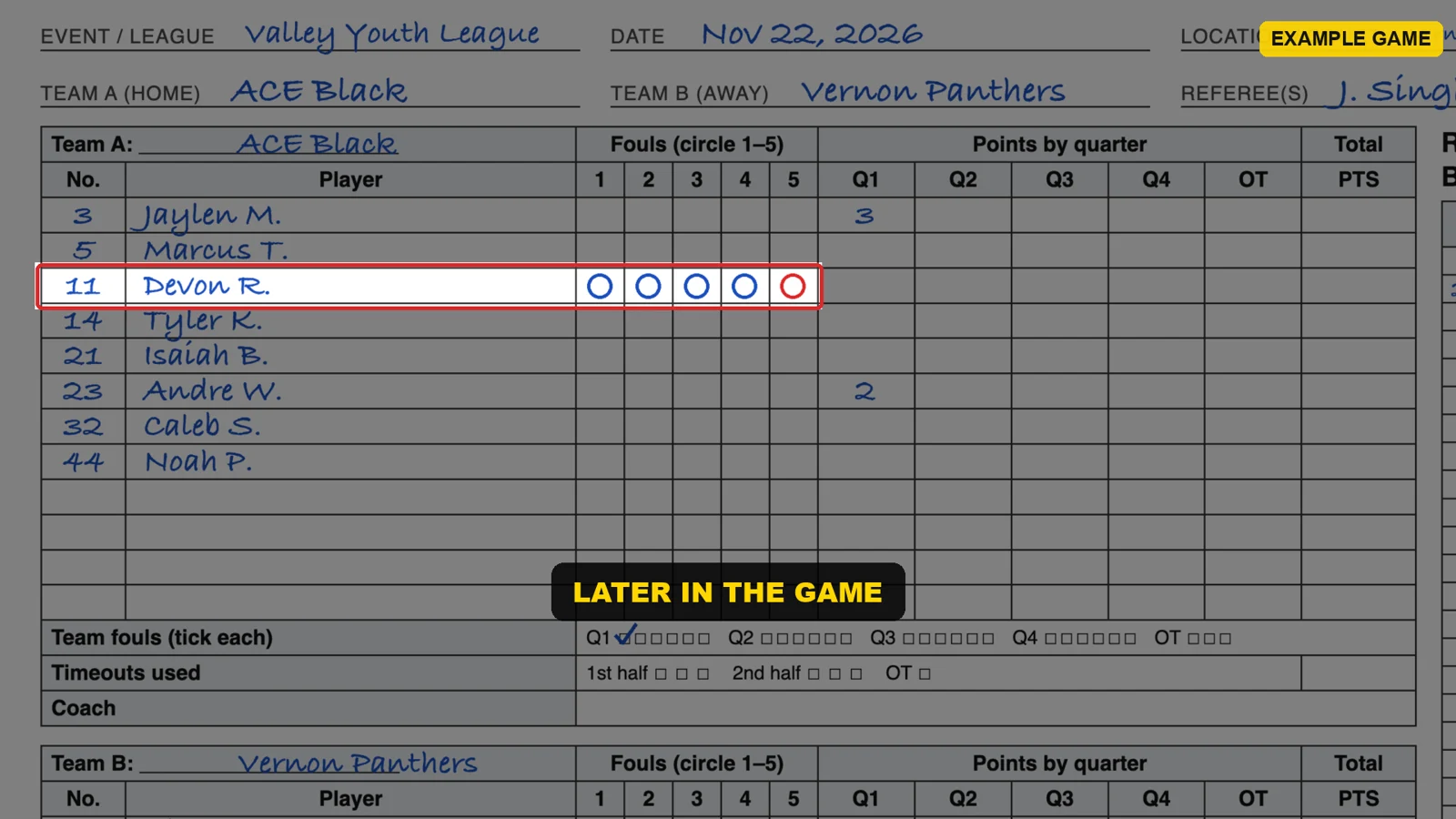
One mark per foul. Five marked means that player is out
Watch the official report the foul to the table: the number of the player and usually the type.
Mark that player's next foul box.
Tick the next team-foul box for that team in the current quarter.
If it's the player's fifth foul, or the team has just reached the bonus, tell the nearest official straight away.
Fouling out
In high school (NFHS) basketball, a player is disqualified on their fifth foul, counting personal and technical fouls (NFHS rules differences). Under FIBA rules, a player who has committed 5 fouls must leave the game (FIBA, Art. 41). Most youth leagues follow one of these two, but check yours. Some house leagues change it.
Telling the official is your job. The NFHS scorer guidance lists "any player is charged with his or her fifth foul" as one of the times the scorer must notify the nearer official (NFHS scorer guidance). Under FIBA, the timer notifies a referee immediately when a player reaches 5 fouls (FIBA, Art. 50). At most youth games, the scorer is also the timer, so that's you.
Team fouls and the bonus
Team fouls tell you when the other team starts shooting free throws on every common foul. That's the bonus (FIBA calls it the team foul penalty). High school rules changed for the 2023-24 season, so older scorebooks and older coaches may still be thinking in halves.
Foul limits and team-foul bonus by rule set
Rule set
Player fouls out on
Team fouls counted
Bonus
High school, NFHS (2023-24 onward)
5th foul (personal + technical)
Per quarter, reset after each quarter
Two free throws for common fouls from the opponent's 5th team foul in the quarter. No more one-and-one (NFHS)
High school, NFHS (before 2023-24)
5th foul
Per half
One-and-one from the 7th team foul, two shots from the 10th (NFHS)
FIBA (2026 rules)
5 fouls
Per quarter. Overtime fouls count as 4th quarter
After 4 team fouls in a quarter, personal fouls on a player not shooting are two free throws (FIBA, Art. 42)
Under current NFHS rules, the bonus doesn't apply to a player-control or team-control foul (NFHS). The scorer notifies the nearer official when the bonus is in effect (NFHS scorer guidance). Youth and club leagues vary, so ask the league or the referee before the game which bonus rule they're using.
Tip: Draw a heavy line in the team-foul row after the foul that puts the other team in the bonus. You'll spot it at a glance when the next whistle goes.
Timeouts
When a team is granted a timeout, tick the next box in their timeout row. Our sheet splits the boxes into 1st half, 2nd half and OT so you can see what's left at a glance.
How many each team gets depends on the rules:
High school (NFHS): three 60-second and two 30-second timeouts per team (NFHS rules differences). The scorer tells the nearer official when a team has used all its timeouts or is granted an extra one (NFHS scorer guidance).
FIBA: 2 timeouts in the first half, 3 in the second half (no more than 2 of them when the clock shows 2:00 or less in the 4th quarter), and 1 in each overtime. Unused timeouts don't carry over (FIBA, Art. 18).
Youth and rec leagues: often fewer. Ask before tip-off and cross out the boxes that don't apply.
Coaches lose track of their timeouts all the time. When one asks "how many do we have?", you should be able to answer in two seconds from your sheet.
End of each quarter, and full time
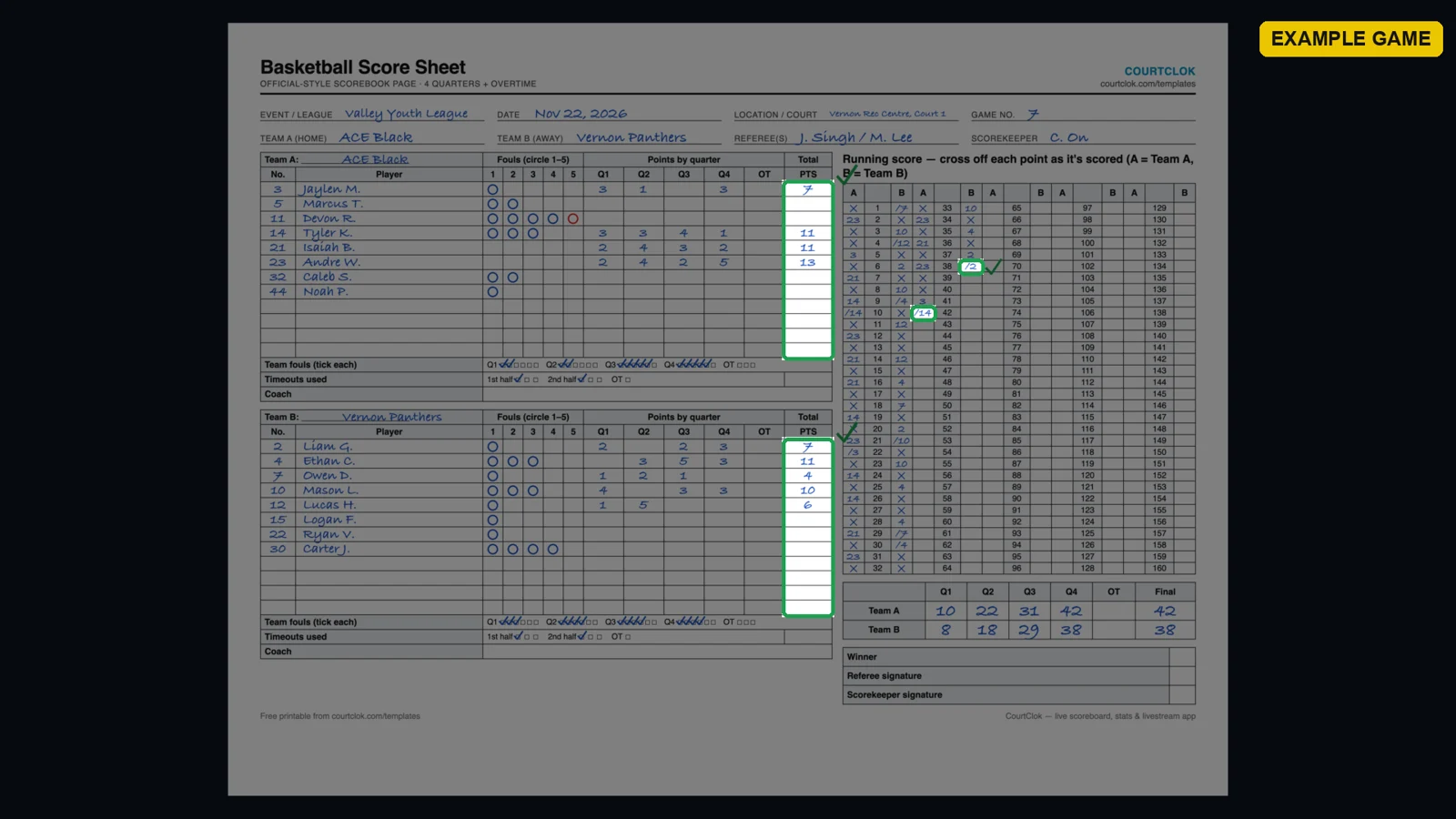
Copy the running score into the summary, then check the player totals match
At the end of every quarter
Draw a line under the last number crossed off in each running score column, so you can see where the quarter ended.
Copy each team's running score into the quarter summary at the bottom of the sheet.
Add up each player's points for that quarter.
At full time
Add each player's quarter boxes into a total for the game.
Add up all the player totals for each team. They must equal that team's final running score.
Write the final score and the winner.
Sign as scorekeeper, and have the referee sign the sheet.
This check isn't just good practice. NFHS guidance tells scorers to compare the summary of individual scores with the total running score at the end of each half, and the scorebook stays at the table until the referee has approved the final score (NFHS scorer guidance). Under FIBA, the scorer enters each quarter's score, the final score and the winning team, the table officials sign, and the crew chief signs last (FIBA, Appendix B).
Common mistakes, and how to fix a scoring error
Mistake
What to do
Player totals don't add up to the running score
The running score is usually right and a player box is missing points. Go down the running score column: every X or slash has a jersey number beside it. Check each one against that player's boxes until you find the missing basket.
Running score and scoreboard disagree
Tell the officials at the next dead ball. Don't fix the scoreboard on your own if the teams dispute it. Under FIBA, the scoresheet wins if it can't be resolved (FIBA, Art. 49).
Points given to the wrong player
Cross out the number beside the running score, write the right one, and move the points between the two player boxes. The team total doesn't change.
Foul marked on the wrong player
Fix it at the next dead ball and tell the official, especially if either player is on 4. A wrong fifth foul takes a player out of the game.
Missed a basket while looking down
Ask the clock operator or the other scorer what the score is, add it to the running score, and find out who scored at the next dead ball.
Writing only player points
Start the running score now from the scoreboard total and tell the officials. Then keep it going properly.
Make corrections at a dead ball, cross out with a single line so the old number is still readable, and let the referee know. Officials can correct scoring errors within the limits of the rules, and under FIBA the crew chief signs the corrections (FIBA, Appendix B). Each league has a limit on how late an error can be fixed, so speak up as soon as you notice.
The easy way: keep score in the CourtClok app
Paper works, and every scorekeeper should know how to do it. But if you're keeping the book by yourself, every basket is three jobs: the running score, the player box and the scoreboard.
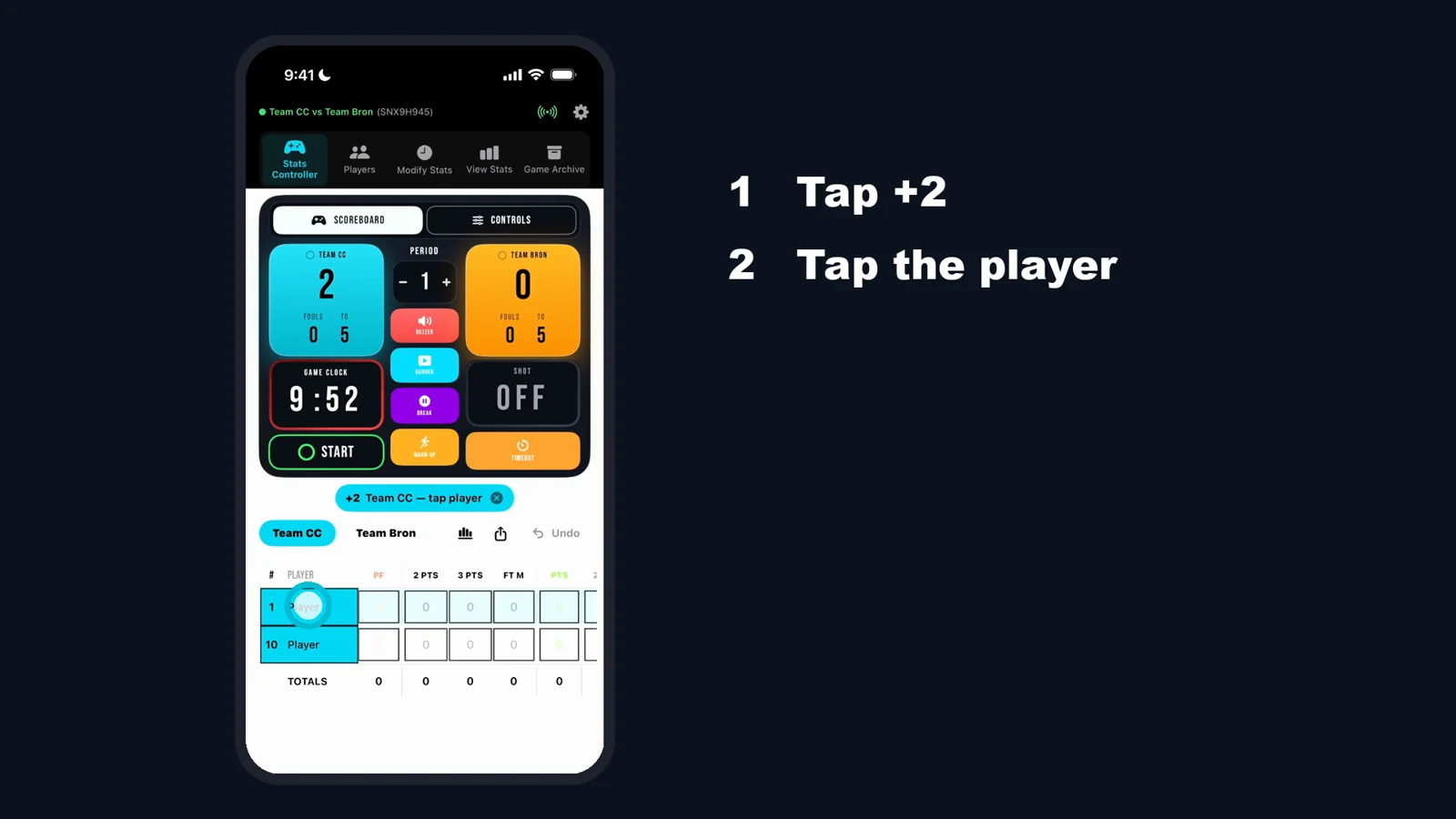
Tap +2, then tap the player. The running score, fouls and box score fill in
Tap +2 (or +1, +3) under the team that scored.
Tap the player who scored.
That's it. The team score, the player's points and the box score update together, so they can't disagree. Record a foul against a player and their foul count and the team foul count go up too. Parents can follow the live box score on their phones, and at full time the box score is already done.
Plenty of leagues still want a signed paper sheet. Keep score in the app and copy the final numbers onto the printable sheet at the end. It takes two minutes because the totals are already checked.
Watch it filled in
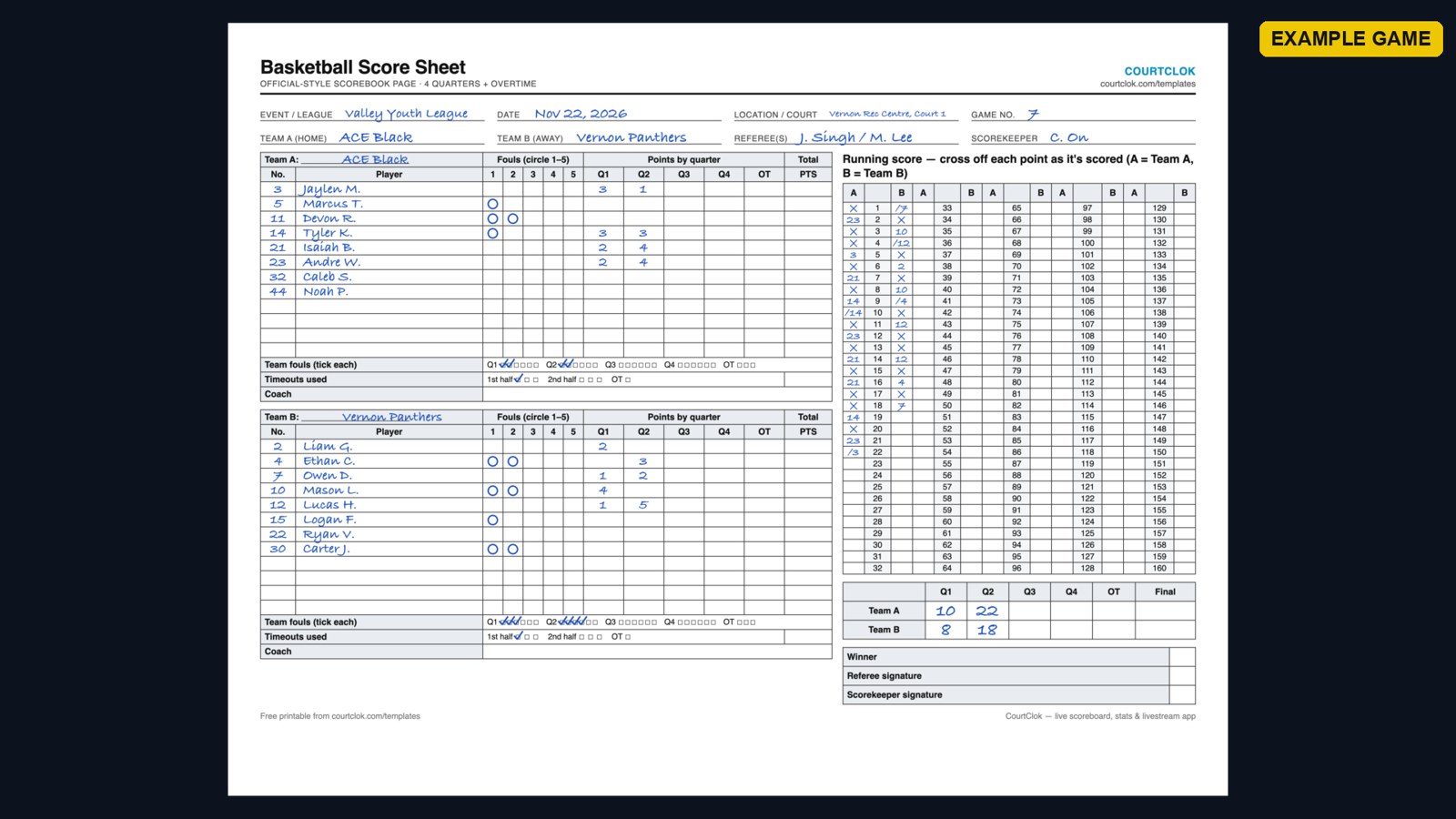
Coach On fills in a whole sheet for a made-up game, ACE Black vs Vernon Panthers, one step at a time.
The running score is the official record. Fill it in first, then the player box.
X for a basket, slash for a free throw, and the scorer's jersey number beside the last number crossed off.
Every foul gets two marks: the player's next foul box and a team-foul box for the quarter.
At full time, player totals must add up to the running score. If they don't, look for a player box that's missing points.
Basketball score sheet questions
What is the running score in basketball?
It's the column of numbers that tracks each team's total, basket by basket. You cross off numbers up to the new total each time a team scores and write the scorer's jersey number beside the last one. It's the official record of the score.
How do you mark a free throw on a score sheet?
Cross off the next single number in the team's running score with a slash, and write the shooter's number beside it. Then add 1 to that player's box for the quarter. A missed free throw isn't marked in the running score.
How many fouls before a player fouls out?
Five in high school (NFHS) and under FIBA rules. Most youth leagues use five as well, but check your league's rules. When a player gets their fifth, tell the official right away.
What if the player points don't add up to the final score?
The running score is usually right. Go down the running score column and check each jersey number against that player's boxes. You'll normally find a basket that never made it into a player box.
Who signs the score sheet?
The scorekeeper signs, and the referee signs to approve the final score. In FIBA games all the table officials sign and the crew chief signs last.
When do team fouls reset?
In high school (NFHS) they reset after every quarter since the 2023-24 season, with two shots from the 5th team foul. Under FIBA they also count per quarter, and overtime counts as part of the 4th quarter. Youth leagues vary, so ask before the game.
Is there a free basketball score sheet I can print?
Yes. Our [free printable basketball score sheet](/templates/basketball-score-sheet) has the running score, player points by quarter, fouls, team fouls and timeouts on one page.
Tired of keeping three things in sync by hand? In CourtClok you tap +2, then tap the player. The score, player points, fouls and box score all fill in at once, and parents can follow along live.