By the CourtClok team · Updated October 2026 · 10 min read · 3 sources
From our video. The example match is made up.
The short answer
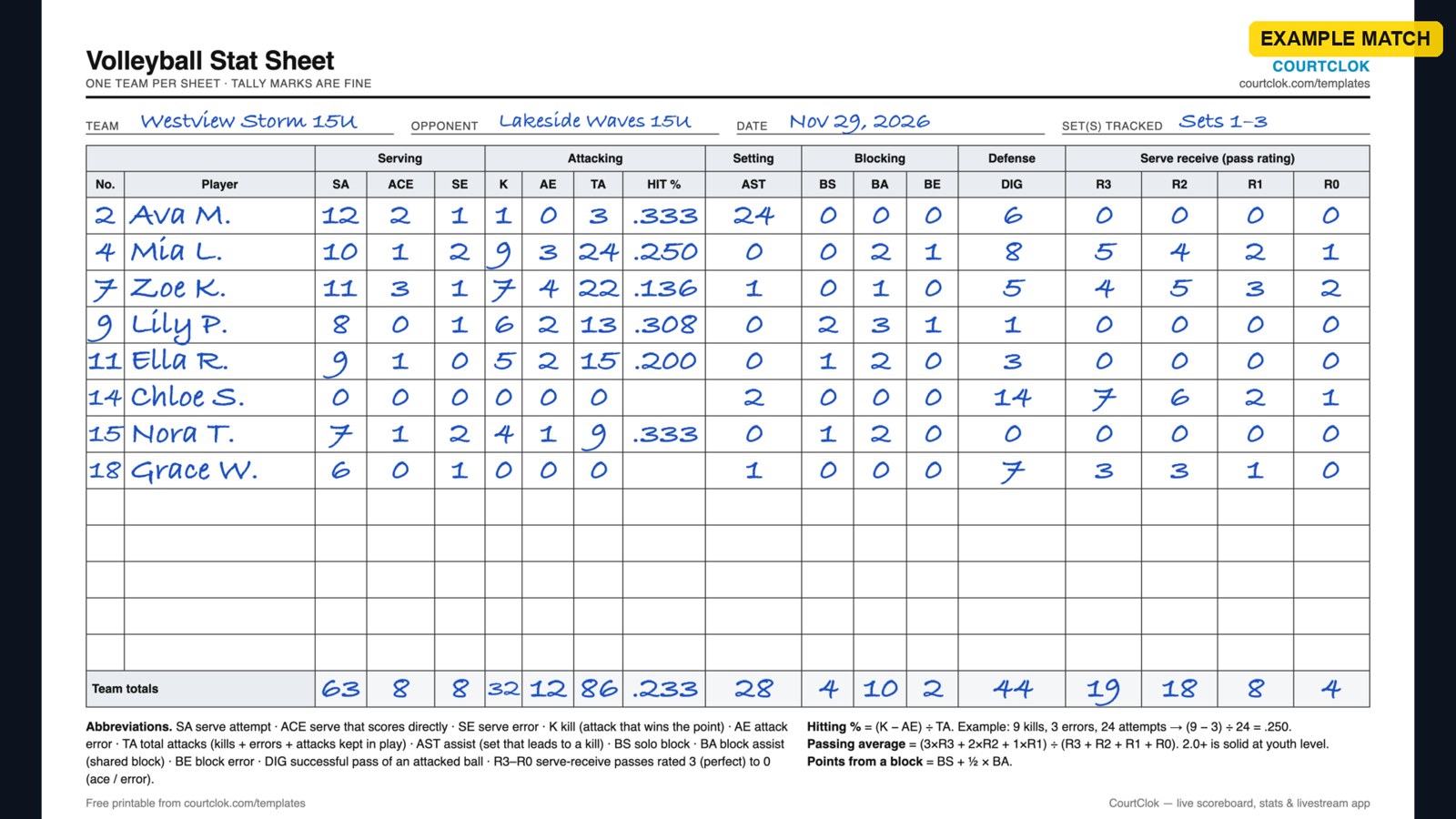
Write your team, the opponent, the date, the sets you're tracking and every player. Mark every serve under SA, and add ACE or SE when it scores or misses. Mark every attack under TA, and add K for a kill or AE for an error. Add assists, blocks, digs and a 0–3 rating for every serve-receive pass. After the match, hitting percentage is (K − AE) ÷ TA.
The most common mistake: hitting percentage without the errors
Ask a new stat keeper for a hitter's percentage and you'll often get kills divided by attacks. That number is always too high, because it ignores every ball the hitter put out, into the net or into a block.
Hitting percentage takes away the errors first: (kills − attack errors) ÷ total attacks. That's the formula on the sheet and the one the NCAA uses (NCAA.com glossary). To work it out, you need all three numbers, so every attack has to be counted, not just the kills.
Tip: [Get the free volleyball stat sheet (PDF)](/templates/volleyball-stat-sheet): 13 player rows with serving, attacking, setting, blocking, defense and serve-receive columns, team totals and the formulas printed at the bottom.
What you need
The sheet, printed before the match. One team per sheet.
A pen or pencil. Tally marks are fine during play; turn them into numbers after each set or at the end.
A seat with a clear view of the whole court, ideally up high and in line with the net.
The roster with jersey numbers, from the coach before warm-ups.
Volleyball rallies are fast. Many teams split the sheet between two people: one takes serving and serve receive, the other takes attacking, setting, blocking and digs. If you're on your own, start with serving and attacking and add the rest when you're comfortable.
Before the match: team, sets and players
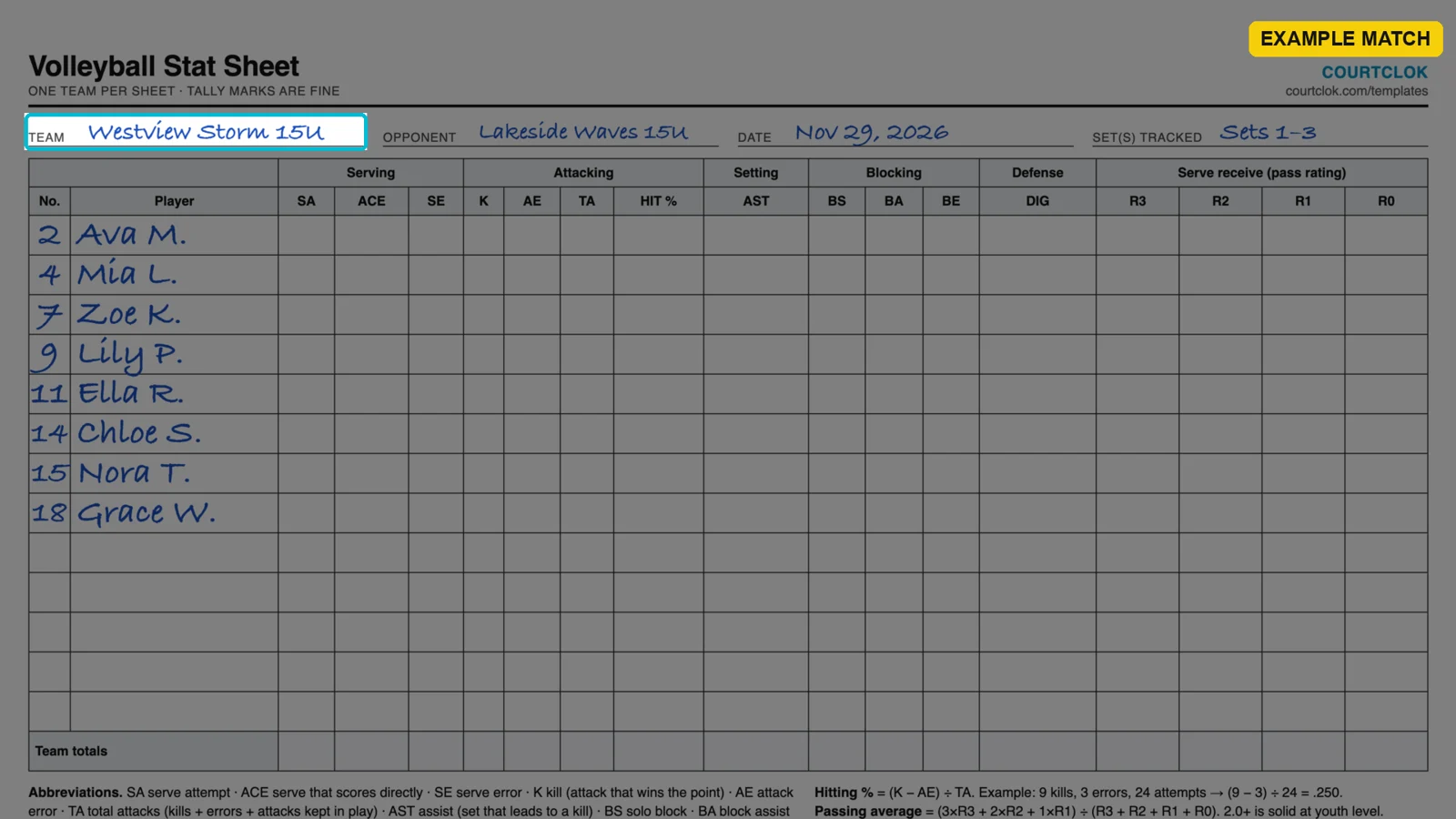
Fill in the top: your team, the opponent, the date and Set(s) tracked. The last one matters: a stat line from sets 1–3 isn't comparable with one from set 2 only.
Then every player: jersey number first, then the name. Ask the coach to check the numbers.
Team, opponent, date, sets, then every player
Serving: SA, ACE and SE
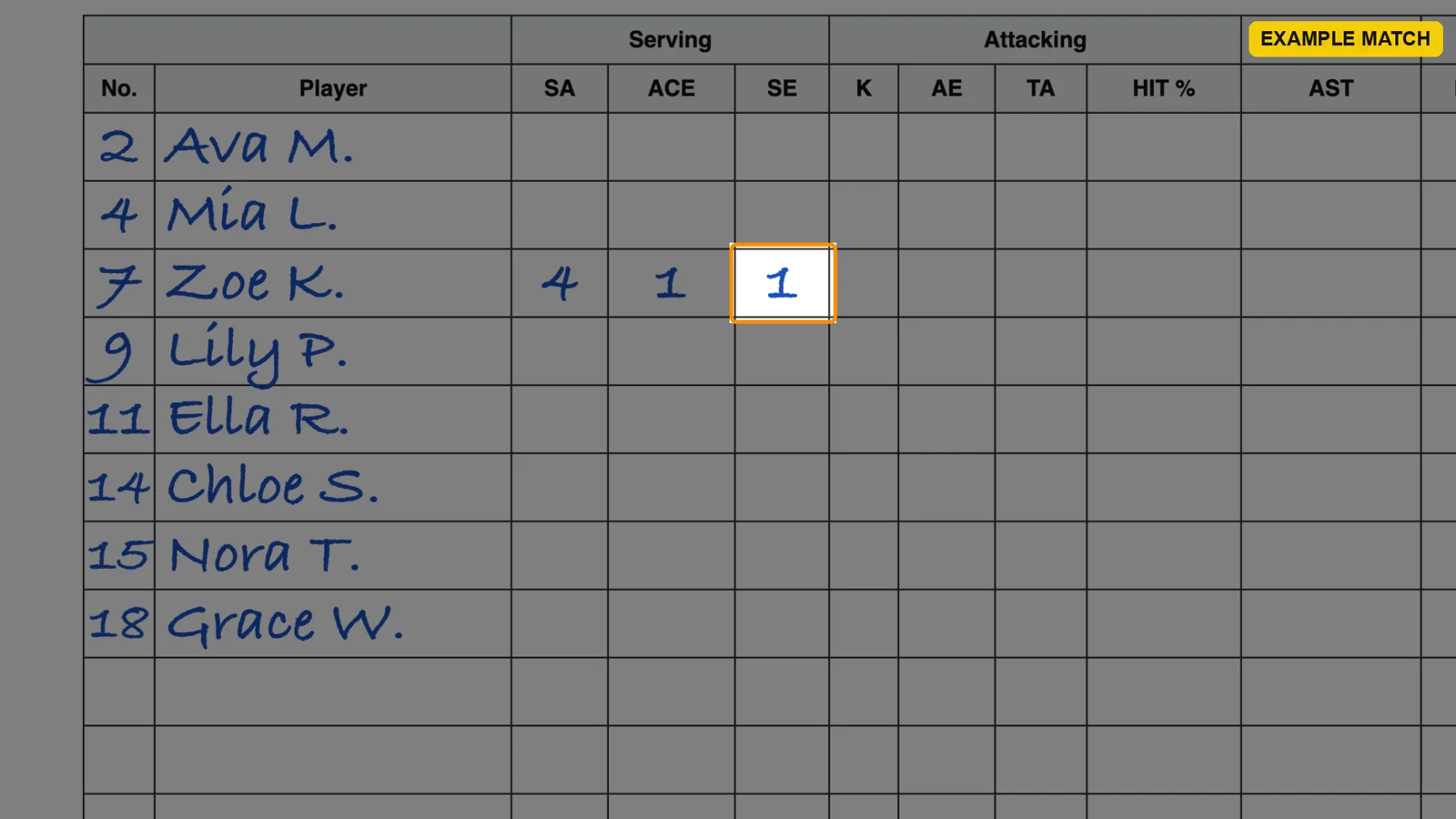
Every serve is one mark under SA (serve attempt) for the server. Then, if it applies:
ACE: the serve scores directly. Add one here as well as under SA.
SE: serve error. It goes out, into the net, or the server commits a fault. Add one here as well as under SA.
Four serves: one ace, one error, two kept in play
ACE + SE can never be bigger than SA. Most serves are neither: the other team passes them and the rally goes on.
Attacking: K, AE and TA
TA is total attacks. Every attack counts, whatever happens to it. Then:
Column
What counts
K (kill)
An attack that wins the point straight away
AE (attack error)
The attack goes out, into the net, gets blocked for a point, or the hitter commits a violation
TA (total attacks)
Kills + errors + attacks the other team keeps in play
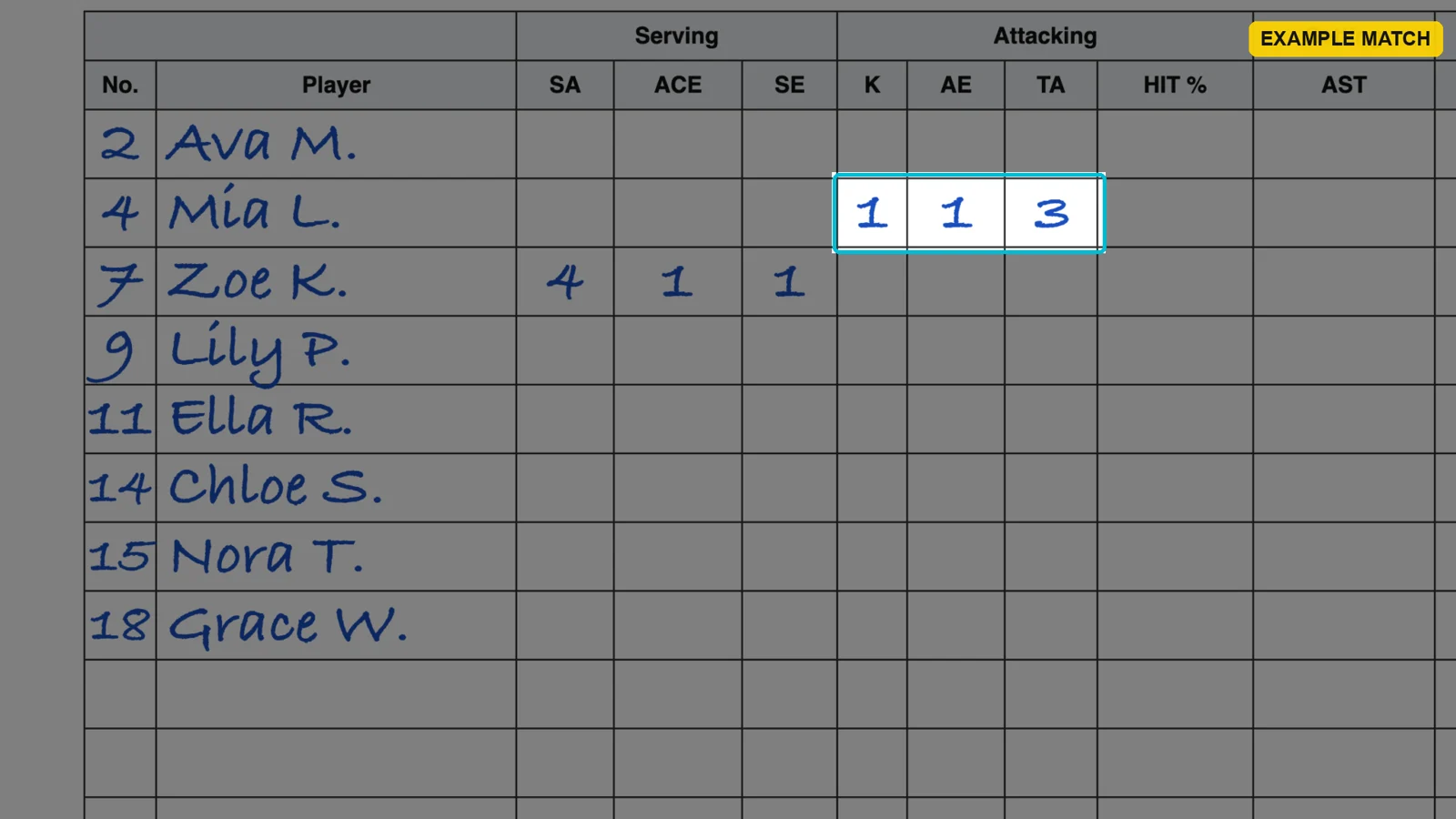
In our example, number 4 attacks three times: a kill, an error, and one the other team digs. That's K 1, AE 1, TA 3. These definitions follow the NCAA statisticians' manual and the WIAA statistics guide.
A kill, an error and a ball the other team dug: K 1, AE 1, TA 3
Assists, blocks and digs
Column
What counts
AST (assist)
The set or pass right before a teammate's kill. No kill, no assist
BS (solo block)
One player blocks the ball and it scores a point
BA (block assist)
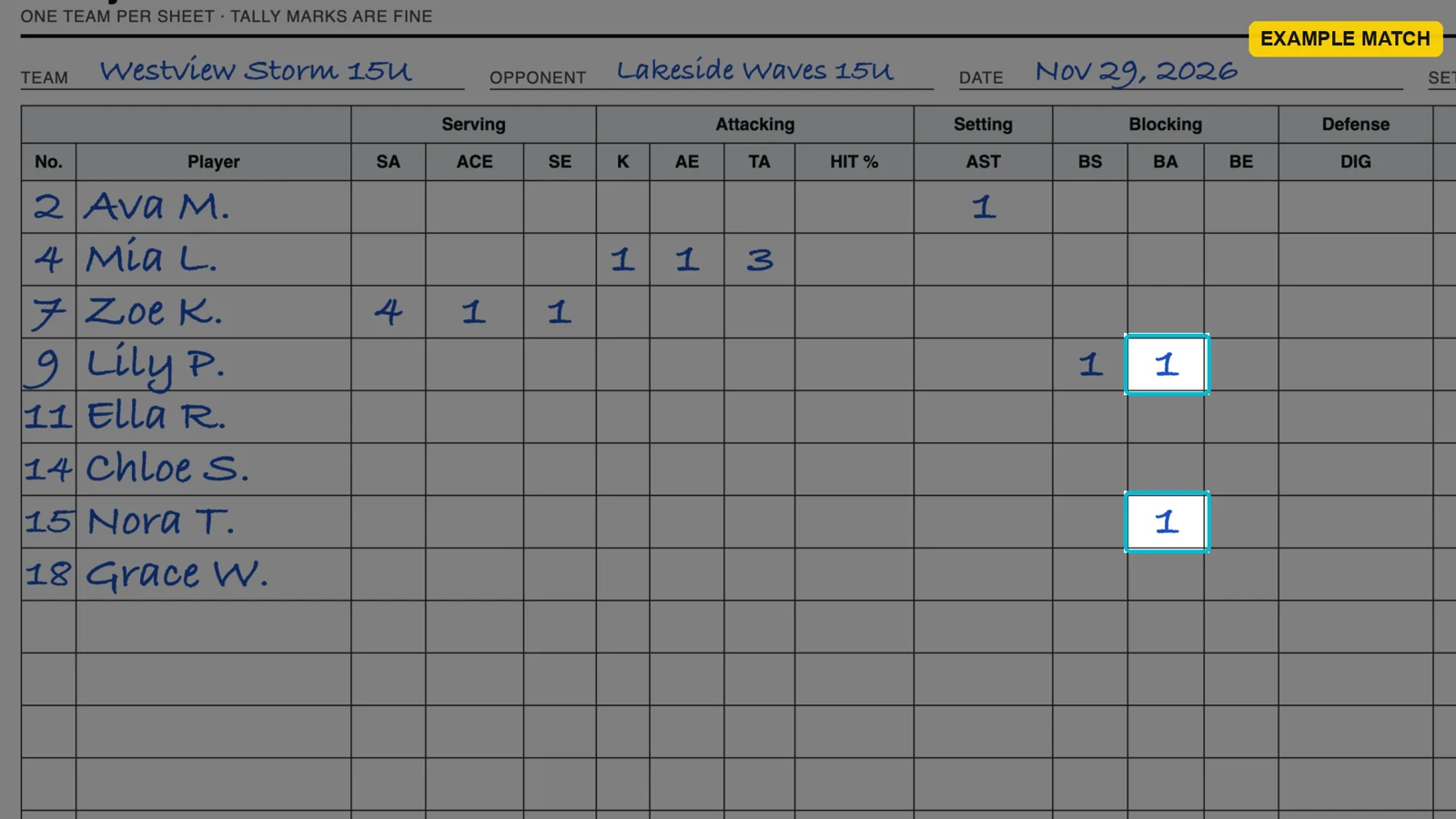
Two or three players block together for a point. Each of them gets one BA
BE (block error)
A blocking fault, like touching the net while blocking
DIG
A player keeps an attacked ball in play with a good pass
A shared block: each player in it gets one BA
Two details trip people up. A block assist goes to every player in the shared block, so two blockers means two BAs on the sheet (WIAA). And a dig only counts on an attacked ball; passing a free ball isn't a dig.
Serve receive: rating every pass
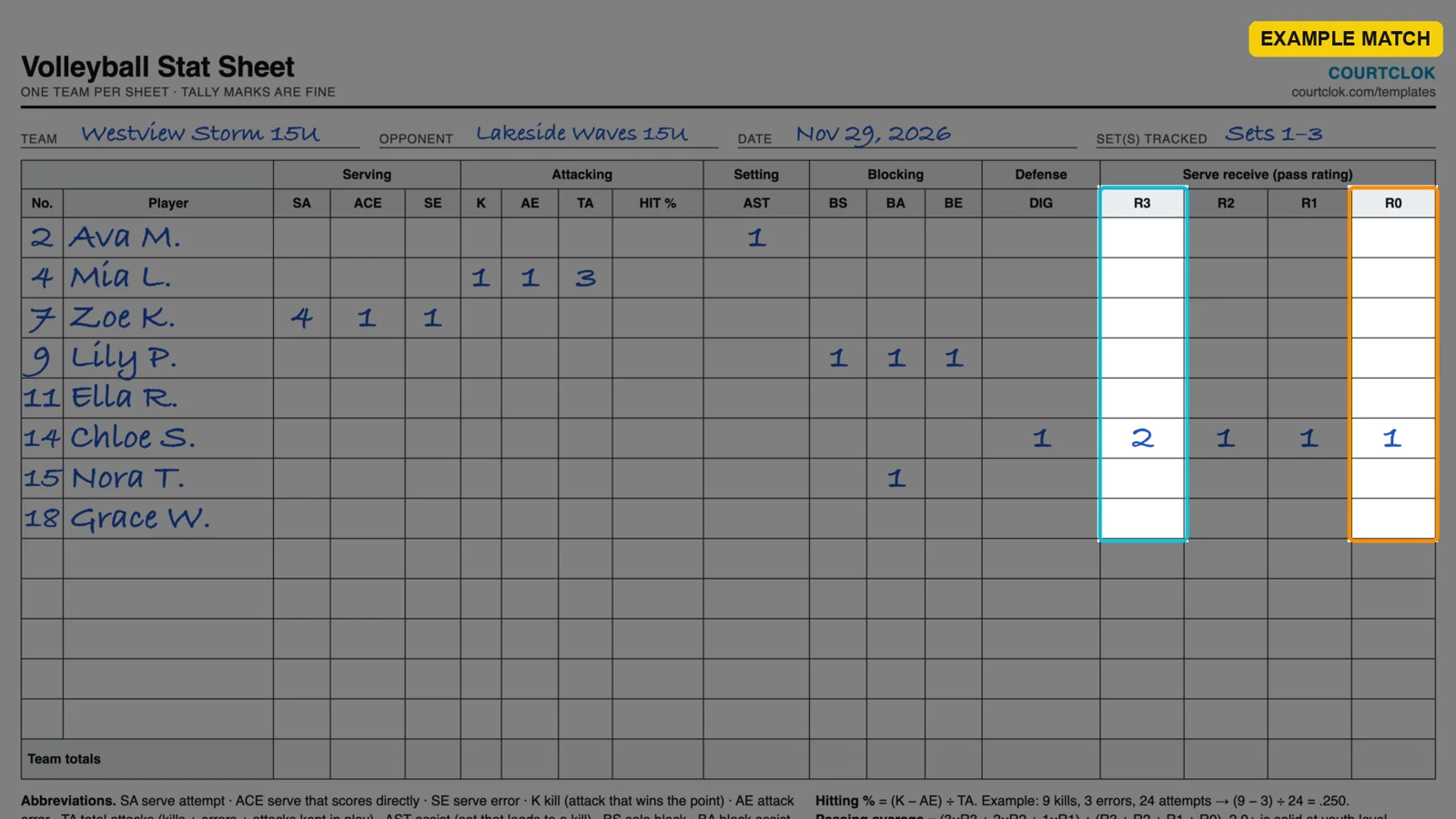
The last four columns rate each pass of the other team's serve on a 3-point scale, the one most coaches use:
Rating
Means
R3
Perfect pass: the setter has every option
R2
Good pass: the setter has to move, but can still set most hitters
R1
Poor pass: the ball is kept up but the attack is limited
R0
The serve was an ace, or the pass was an error
One mark per pass, in the column for its rating
After the match: hitting %, team totals and passing average
Tip: Hitting % = (K − AE) ÷ TA
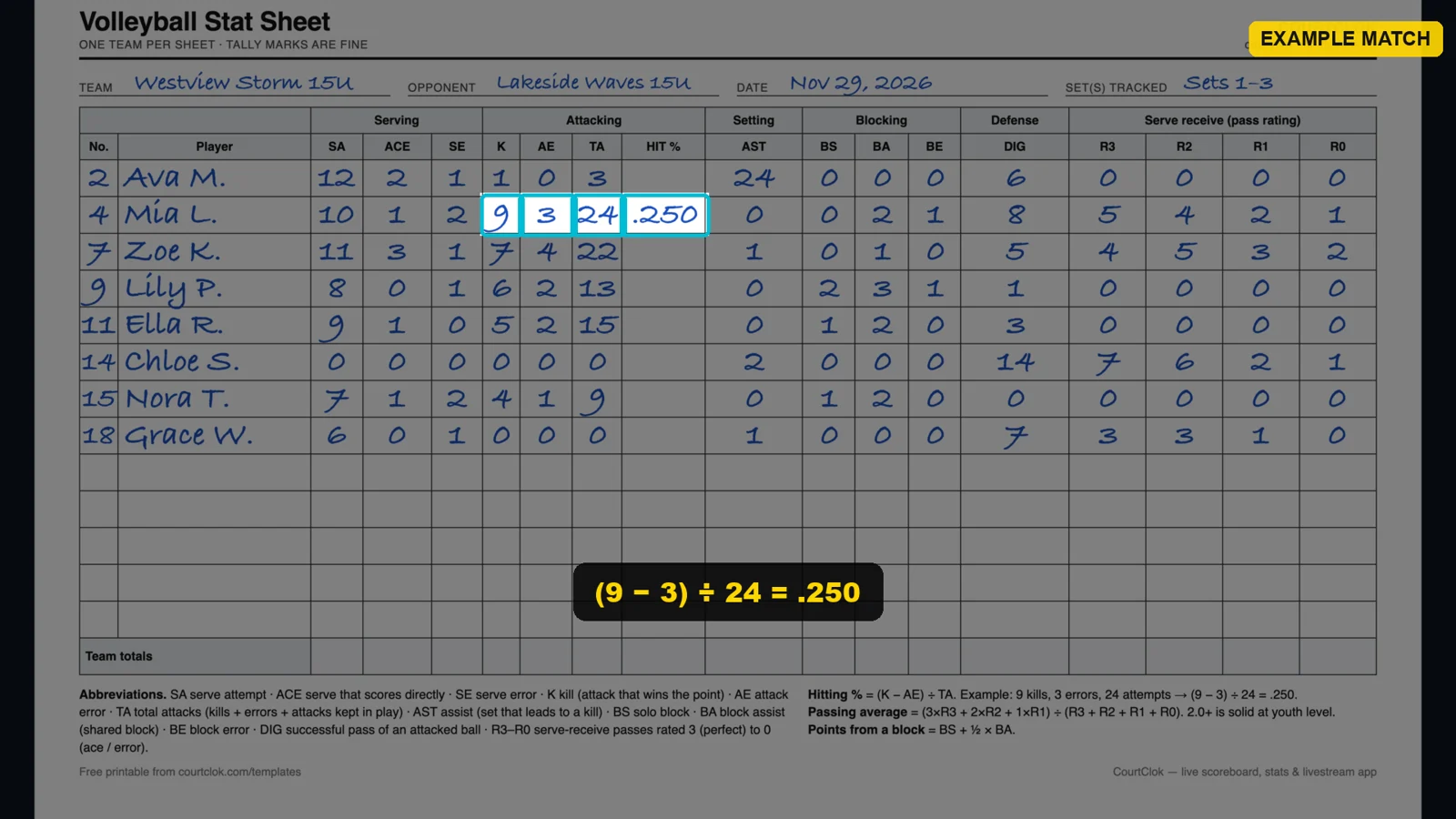
Number 4 has 9 kills, 3 attack errors and 24 total attacks: (9 − 3) ÷ 24 = .250. Hitting percentage is written as a three-digit decimal, and it can be negative if a player has more errors than kills.
(9 − 3) ÷ 24 = .250
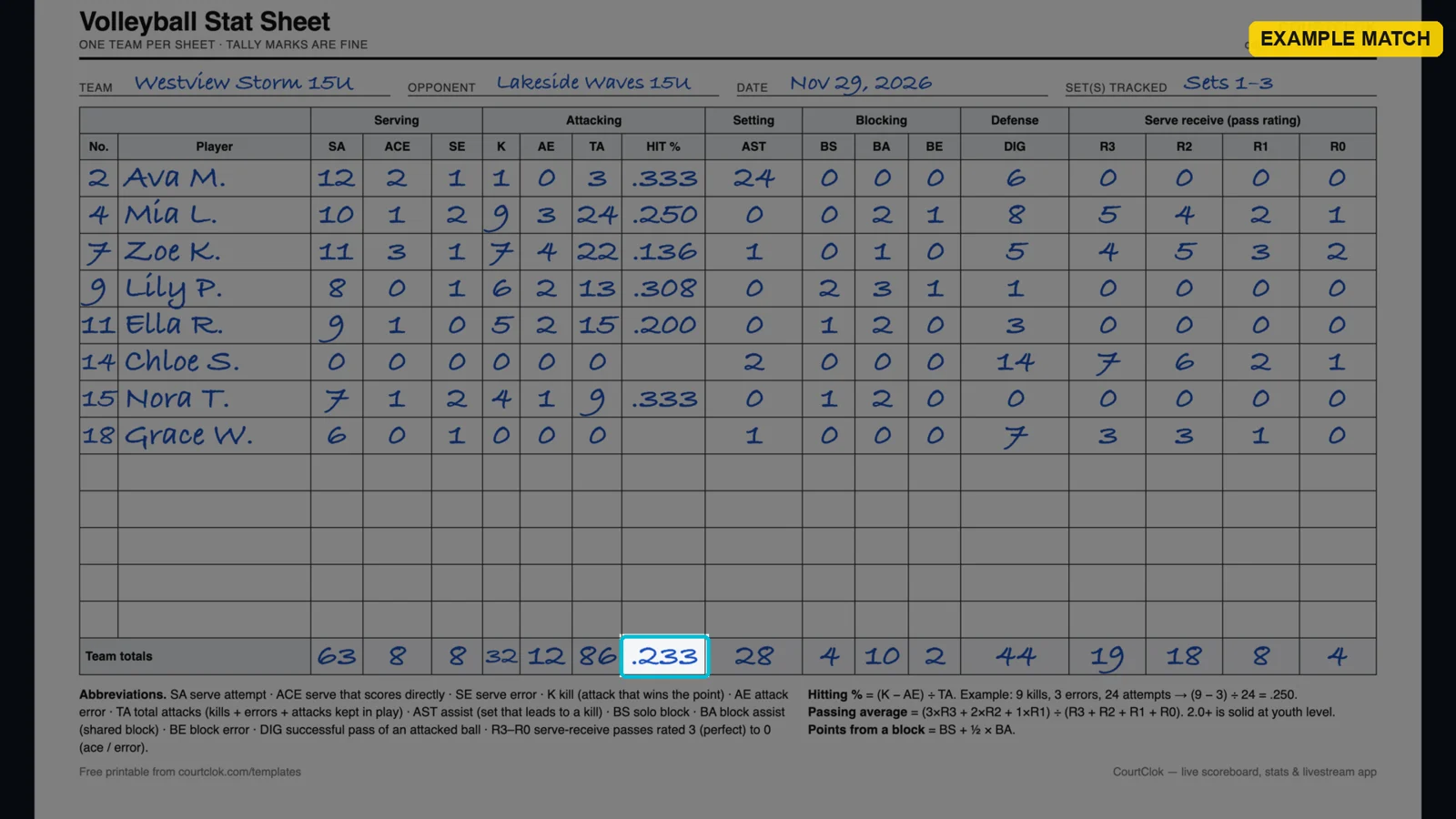
Then add every column into Team totals, and work out the team's hitting percentage the same way from the team's K, AE and TA. Don't average the players' percentages; it gives the wrong answer.
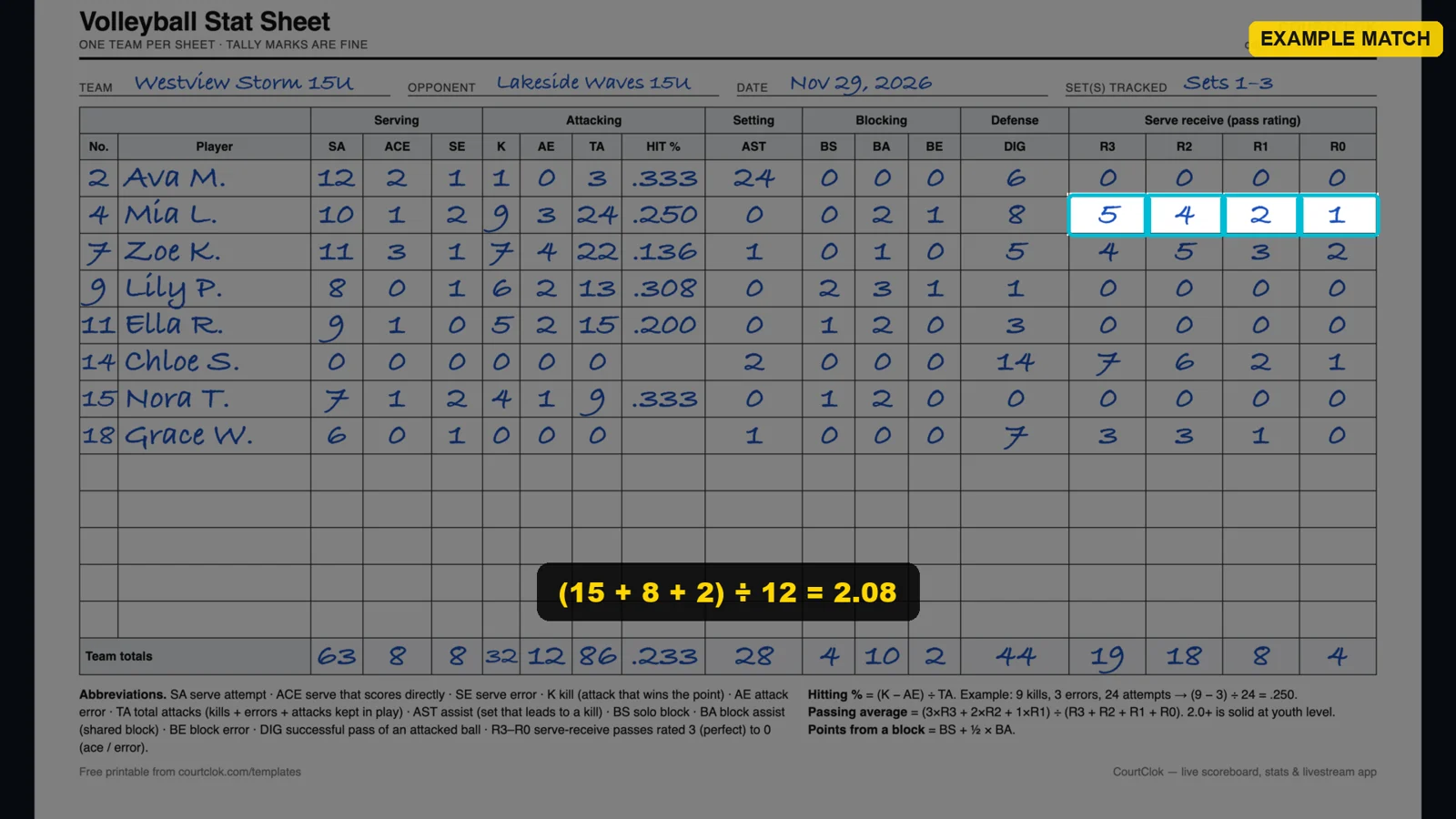
Number 4 has 5 threes, 4 twos, 2 ones and 1 zero: (15 + 8 + 2) ÷ 12 = 2.08. The sheet notes that 2.0 or better is solid at youth level.
(15 + 8 + 2) ÷ 12 = 2.08
Points from blocks are counted as BS + ½ × BA, because a shared block is one point split between the players (WIAA).
Common mistakes and how to fix them
Mistake
How to catch it
Fix
Hitting % = kills ÷ attacks
Percentages look too good
Take away attack errors first: (K − AE) ÷ TA
Only counting kills and errors
K + AE equals TA for everyone
Mark every attack under TA, including ones kept in play
Averaging players for the team %
Team % doesn't match (K − AE) ÷ TA from the totals row
Use the team totals, not an average
One BA for a shared block
Odd block assists with only double blocks
Every blocker in a shared block gets a BA
Mixing up which sets you tracked
Stats don't match the match length
Fill in Set(s) tracked before the first serve
The easy way: track stats on your phone
Paper works. If you'd rather tap than tally, CourtClok's Stats Controller keeps each player's kills, aces, blocks, digs, attack errors and serve errors during the match.
Some coaches use both: the app for the main stats and the free volleyball stat sheet for serve-receive ratings.
Watch it filled in
Coach On fills in the whole sheet for a made-up match, Westview Storm 15U vs Lakeside Waves 15U.
Every serve is a serve attempt. An ace or a serve error is marked as well.
Every attack counts in TA, whether it’s a kill, an error or kept in play.
Hitting percentage is kills minus attack errors, divided by total attacks: 9 kills, 3 errors, 24 attacks is .250.
Rate every serve-receive pass from 3 to 0, then work out the passing average.
Volleyball stat sheet questions
How do you calculate hitting percentage in volleyball?
Kills minus attack errors, divided by total attacks. 9 kills, 3 errors and 24 attacks is (9 − 3) ÷ 24 = .250.
What counts as an attack error?
An attack that goes out, into the net, is blocked for a point, or where the hitter commits a violation.
What's the difference between a block solo and a block assist?
A block solo (BS) is one player blocking for a point. A block assist (BA) is two or three players blocking together for a point; each of them gets one BA.
What counts as a dig?
Keeping an attacked ball in play with a successful pass. Passing a free ball or a serve isn't a dig.
How do you rate serve-receive passes?
On a 0 to 3 scale: 3 is a perfect pass, 2 is good, 1 is poor but kept up, and 0 is an ace or a passing error. Passing average is (3 × R3 + 2 × R2 + R1) ÷ all passes.
Can hitting percentage be negative?
Yes. If a player has more attack errors than kills, the result is below zero.
Is the volleyball stat sheet free?
Yes. It's a free printable with 13 player rows, team totals and the formulas on one Letter page.
Rather track stats on your phone? CourtClok's Stats Controller keeps each player's kills, aces, blocks, digs, attack errors and serve errors.