How to use a soccer stat sheet (shots on target, fouls, saves)
By the CourtClok team · Updated October 2026 · 8 min read · 3 sources
From our video. The example match is made up.
The short answer
Use one sheet per team. Write the roster before kick-off and note the minute of every substitution. Add goals and assists as they happen. Tally every shot in SH and only the shots that would have gone in without a save in SOT. Tally fouls committed and suffered, offsides and cards, fill in the goalkeeper line, then work out minutes and total every column after the game.
The common mistake: every shot counted as on target
The two shot columns look alike, and that's where most stat sheets go wrong. SH is every shot. SOT is only shots on target. If a shot goes wide, over the bar or gets blocked, it goes in SH and not in SOT.
Get this right and the numbers mean something: shot accuracy, your goalkeeper's save percentage and who's actually testing the keeper all come from these two columns.
Tip: [Get the free soccer stat sheet (PDF)](/templates/soccer-stat-sheet): 14 player rows with MIN, G, A, SH, SOT, FC, FS, OFF, Y and R, a team totals row and two goalkeeper lines on one Letter page.
Before the game: one team per sheet
A stat sheet is for your team. Fill in the top: your team, the opponent and the date. Leave the final score for the end.
Then the roster: jersey number first, then the name. Tally marks are fine during the game; you'll turn them into numbers afterwards.
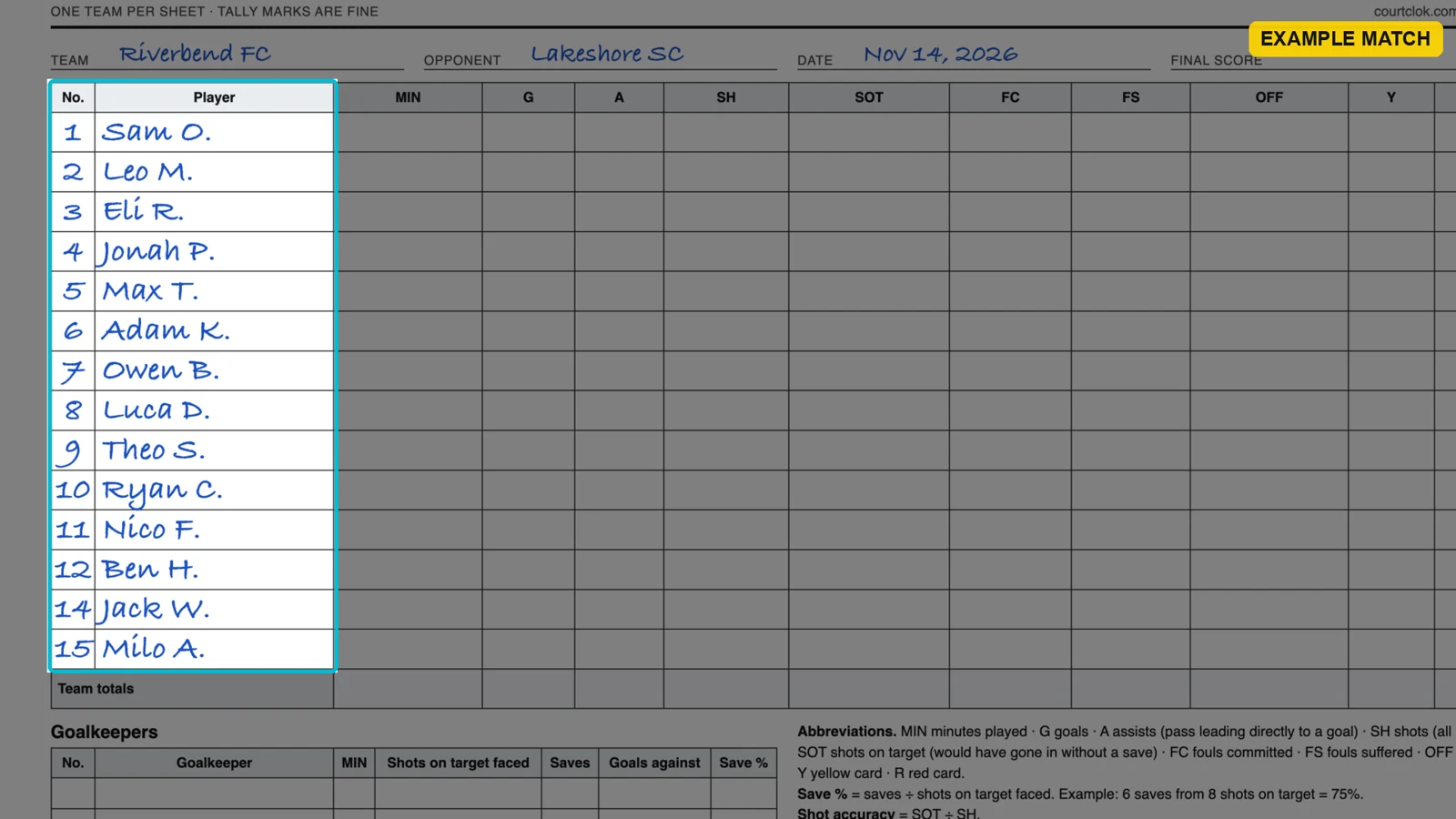
Number first, then the name
Minutes, goals and assists
MIN is minutes played. Don't try to keep it live. Write down the minute of every substitution (who came on, who went off) and work the minutes out after the game.
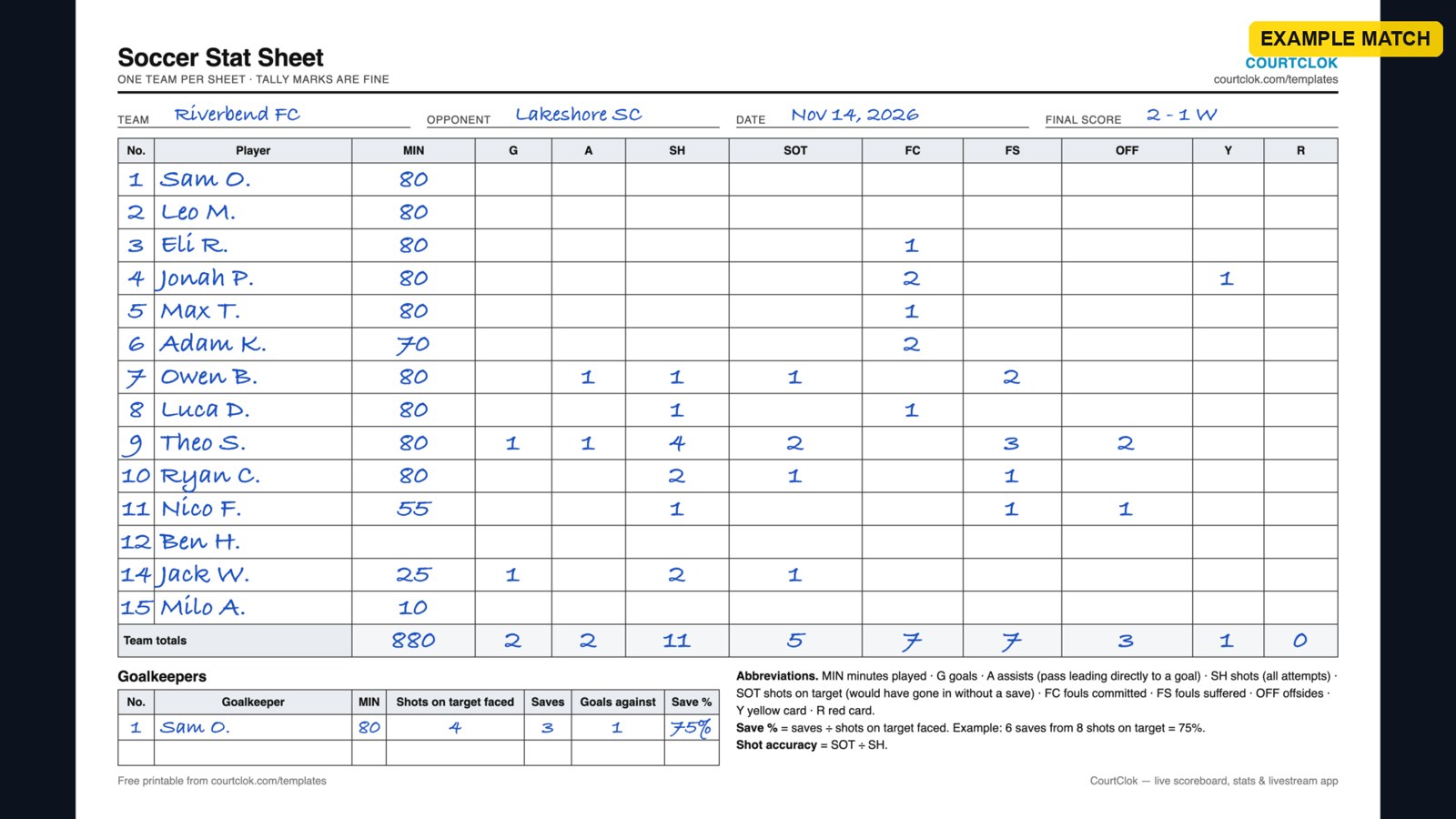
In our example the match is 2 × 40 minutes. #14 comes on for #11 in the 55th minute, so #11 played 55 and #14 played 25. #15 comes on for #6 in the 70th, so #6 played 70 and #15 played 10. Starters who stayed on played all 80. Use your league's match length: the Laws of the Game set two halves of 45 minutes, and youth competitions often play shorter halves (IFAB Law 7).
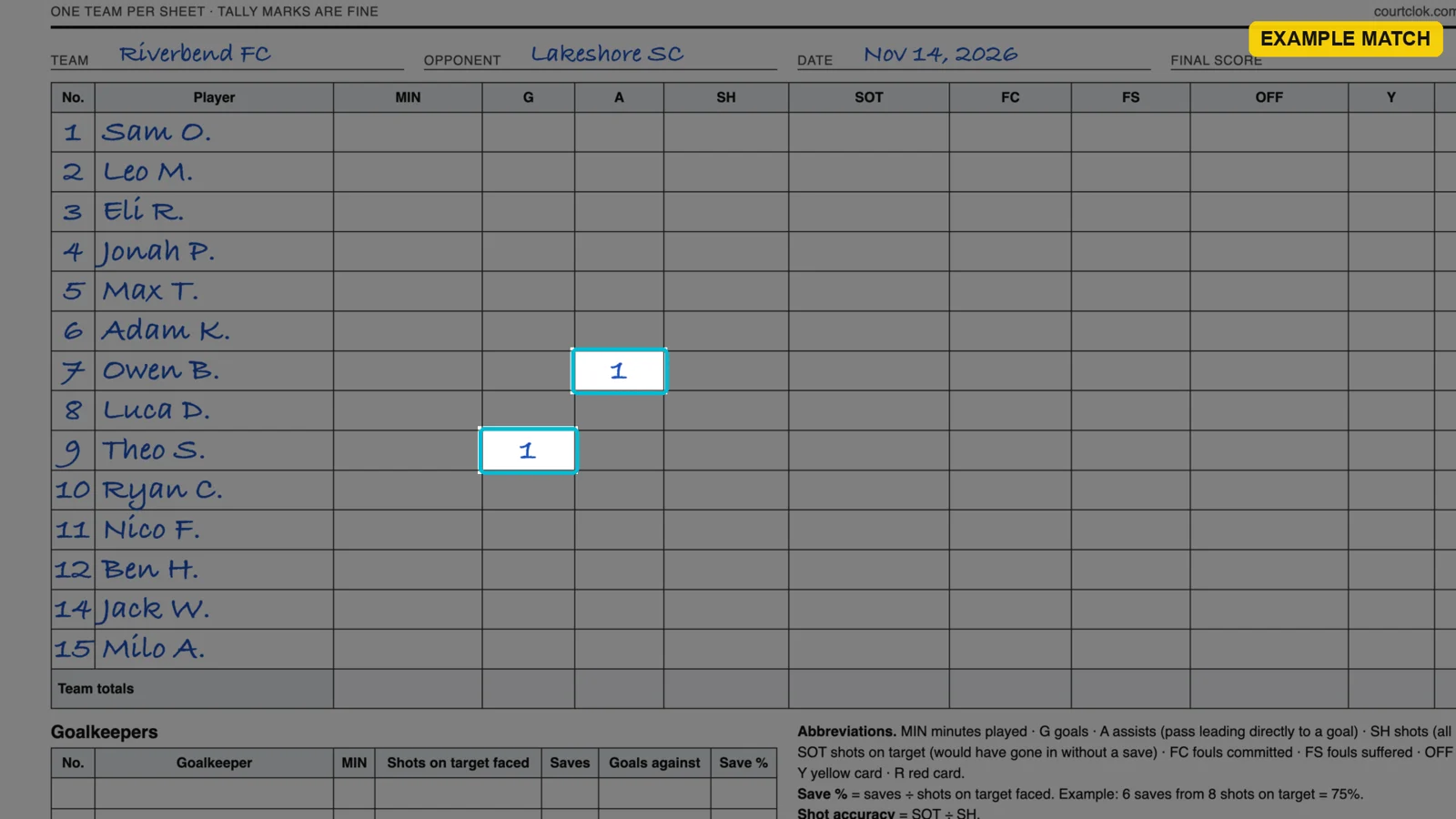
When your team scores, add 1 to G for the scorer and 1 to A for the player whose pass led directly to the goal, as the sheet defines it.
#9 scores from #7's pass
Shots (SH) and shots on target (SOT)
Which column a shot goes in
What happened
SH
SOT
Goal
+1
+1
Goalkeeper saves it
+1
+1
Wide or over the bar
+1
—
Blocked by a defender before it reaches the goal
+1
—
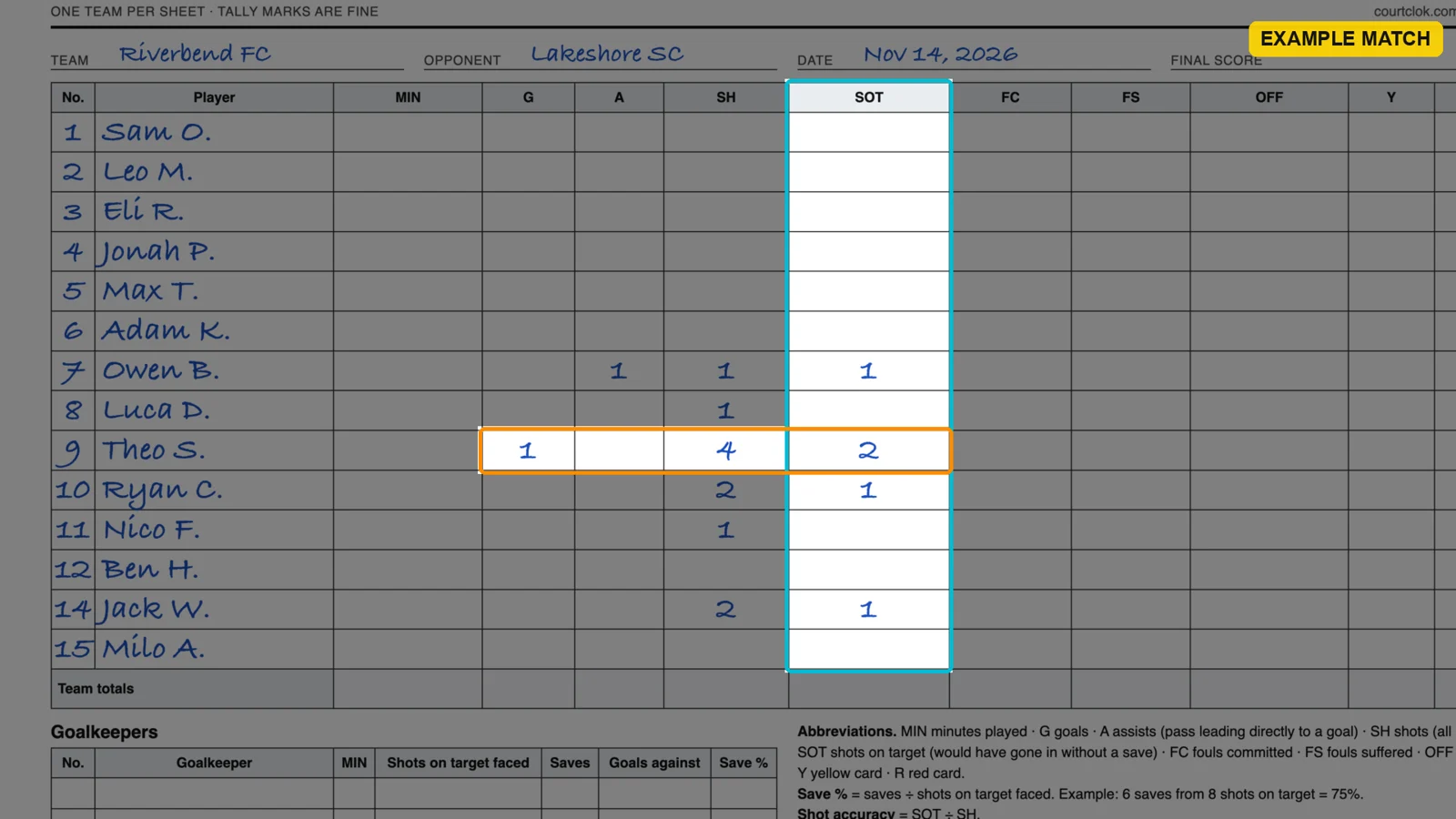
On this sheet, a shot on target is one that would have gone in without a save. Every goal is a shot on target too. That gives you two checks: SOT can never be bigger than SH, and every player's SOT is at least their goals.
#9: 4 shots, 2 on target, 1 goal
Shot accuracy = SOT ÷ SH. In our example Riverbend took 11 shots with 5 on target: 5 ÷ 11 = 45%.
Fouls, offsides and cards
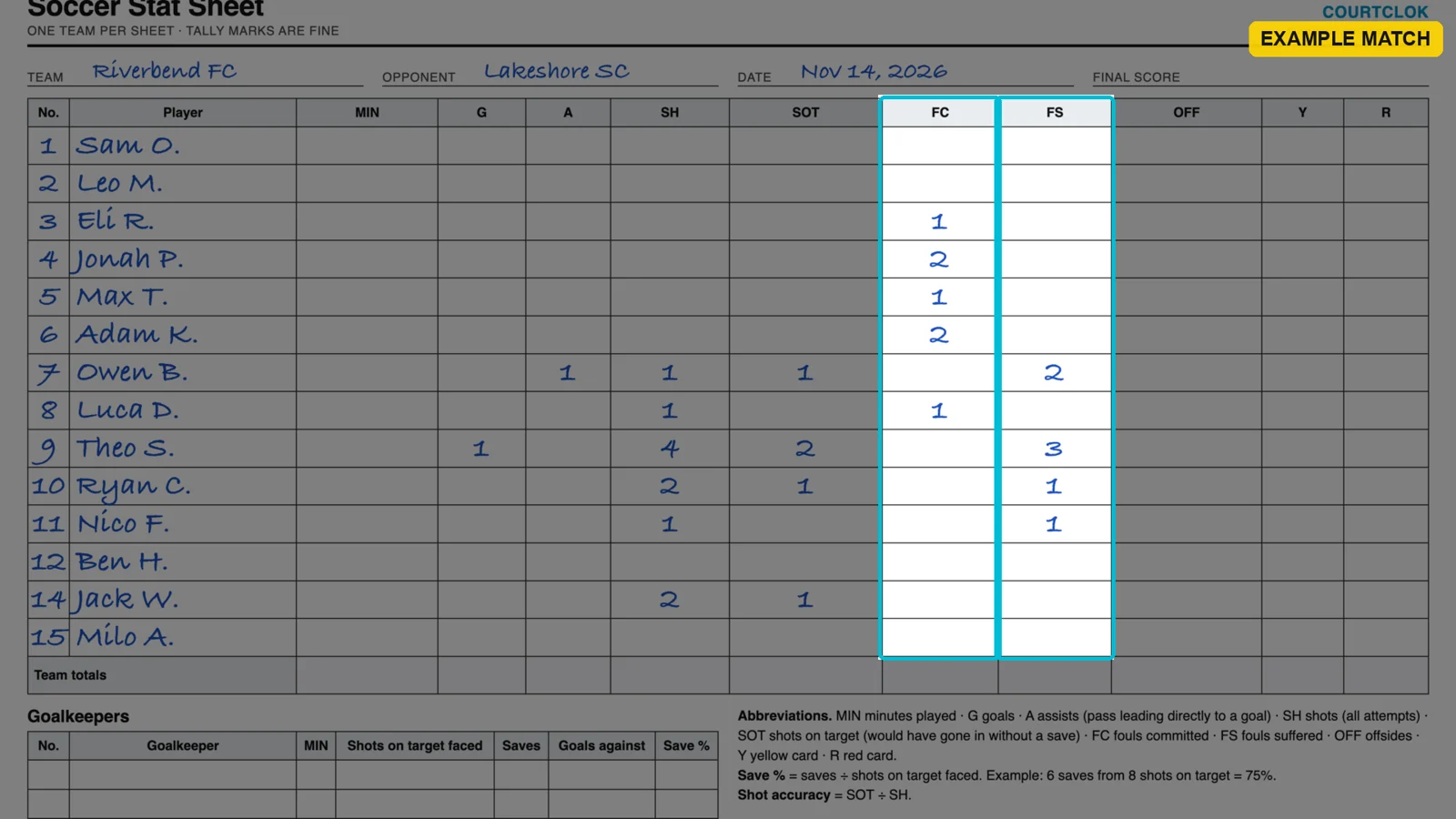
FC is fouls committed and FS is fouls suffered. Put one tally each time the referee gives a foul: FC for your player who made it, FS for your player who was fouled. Count what the referee calls, not what the bench shouts.
Fouls committed and fouls suffered
OFF is a tally each time the player is penalised for offside. Being in an offside position isn't an offence by itself; it only counts when the referee penalises it because the player became involved in play (IFAB Law 11). So only tally the ones the referee whistles.
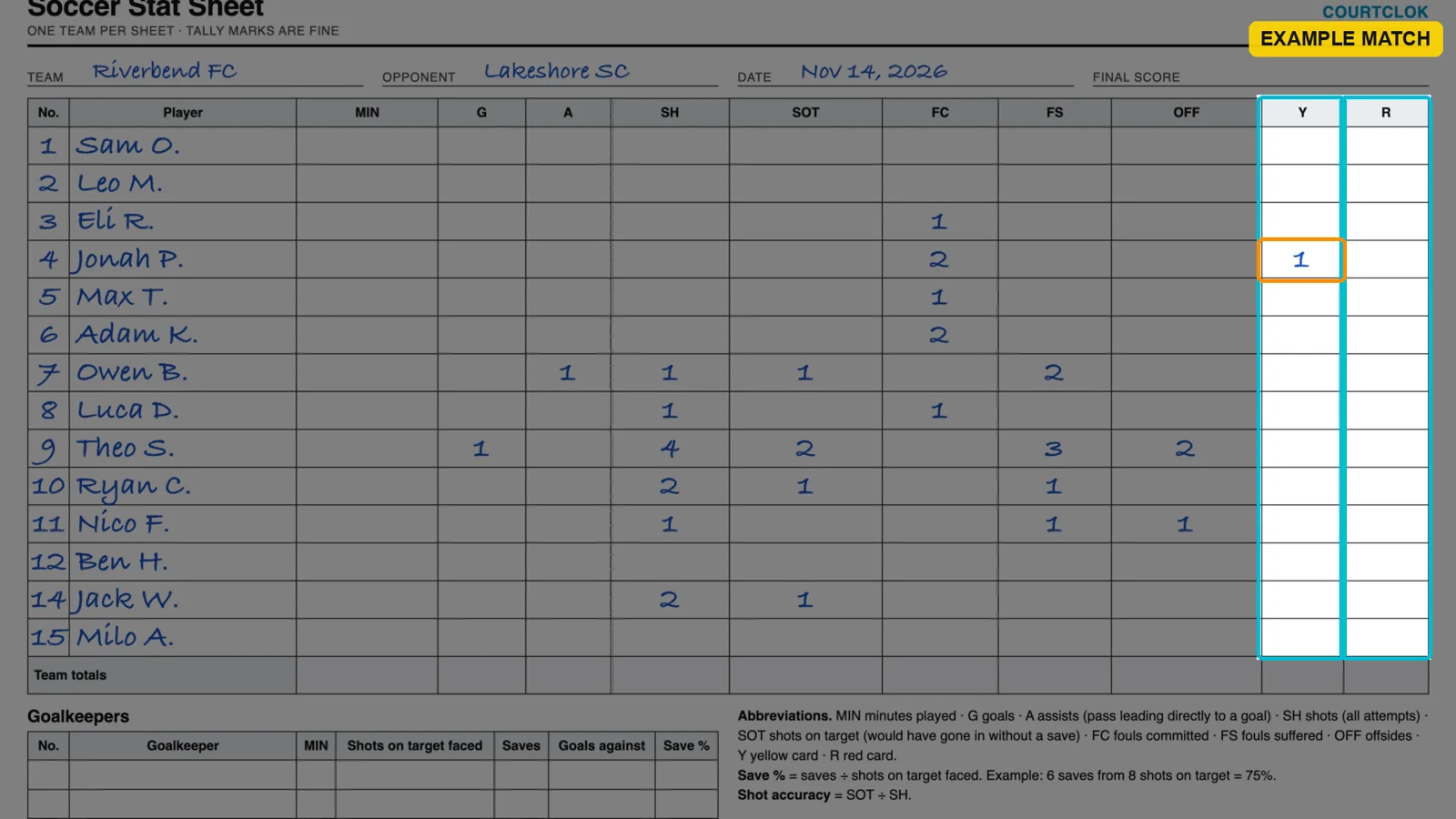
Y and R are cards. A player who gets a second caution in the same match is sent off (IFAB Law 12), so check the Y column before you write a yellow. If there's already one there, the second yellow means a red.
Check the Y column before you write a yellow
Goalkeeper and save percentage
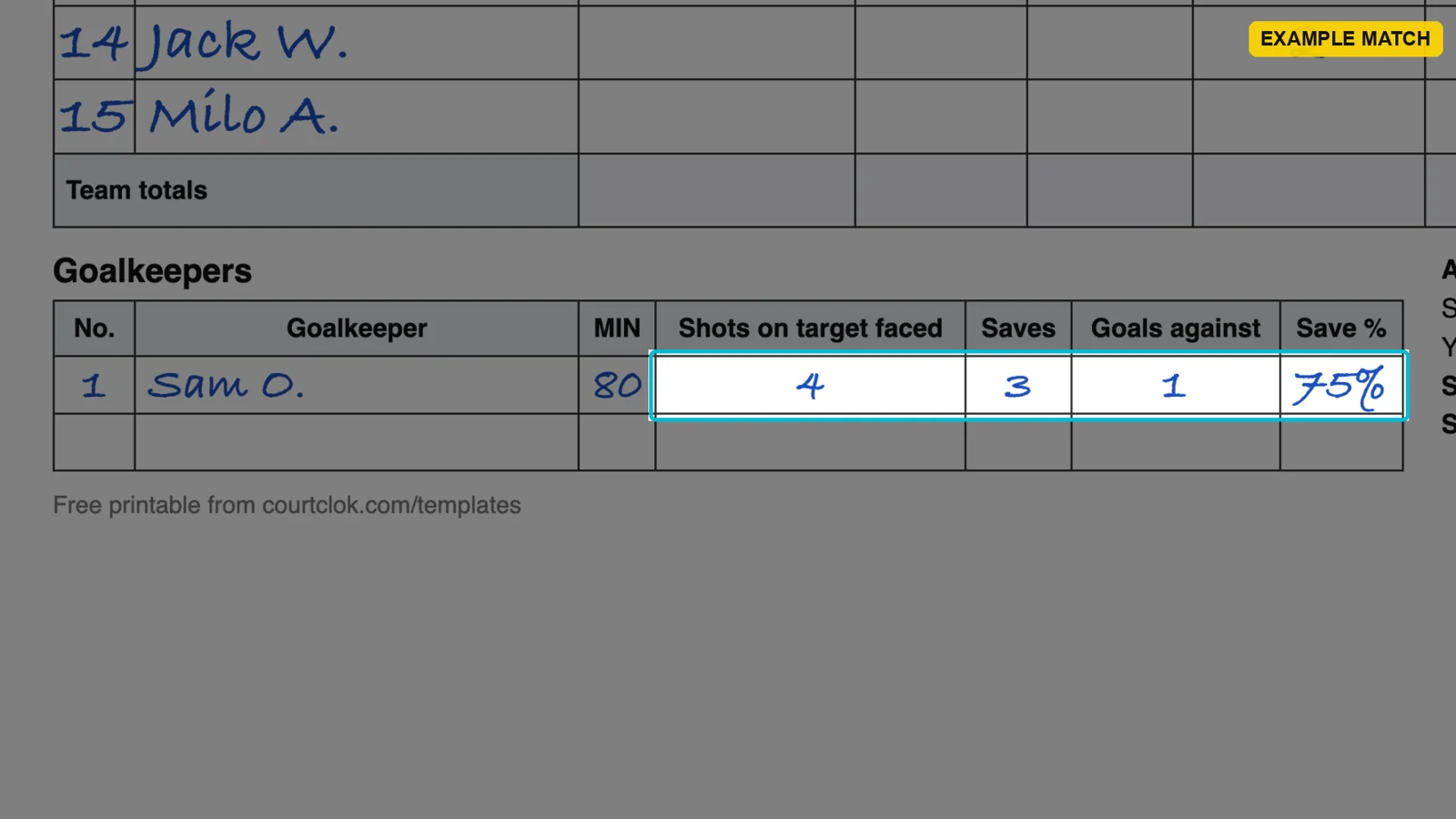
On the goalkeeper line write the number, name and minutes, then shots on target faced, saves and goals against. The check: saves plus goals against equals shots on target faced.
Save percentage = saves ÷ shots on target faced. In our example the keeper faced 4 shots on target, made 3 saves and let in 1: 3 ÷ 4 = 75%.
3 saves from 4 shots on target: 75%
If the keeper changes, use the second line and give each one only the shots and goals while they were in goal.
After the game: minutes and team totals
Work out each player's minutes from your substitution notes, turn tallies into numbers, then fill in the Team totals row. Before you hand it in, check:
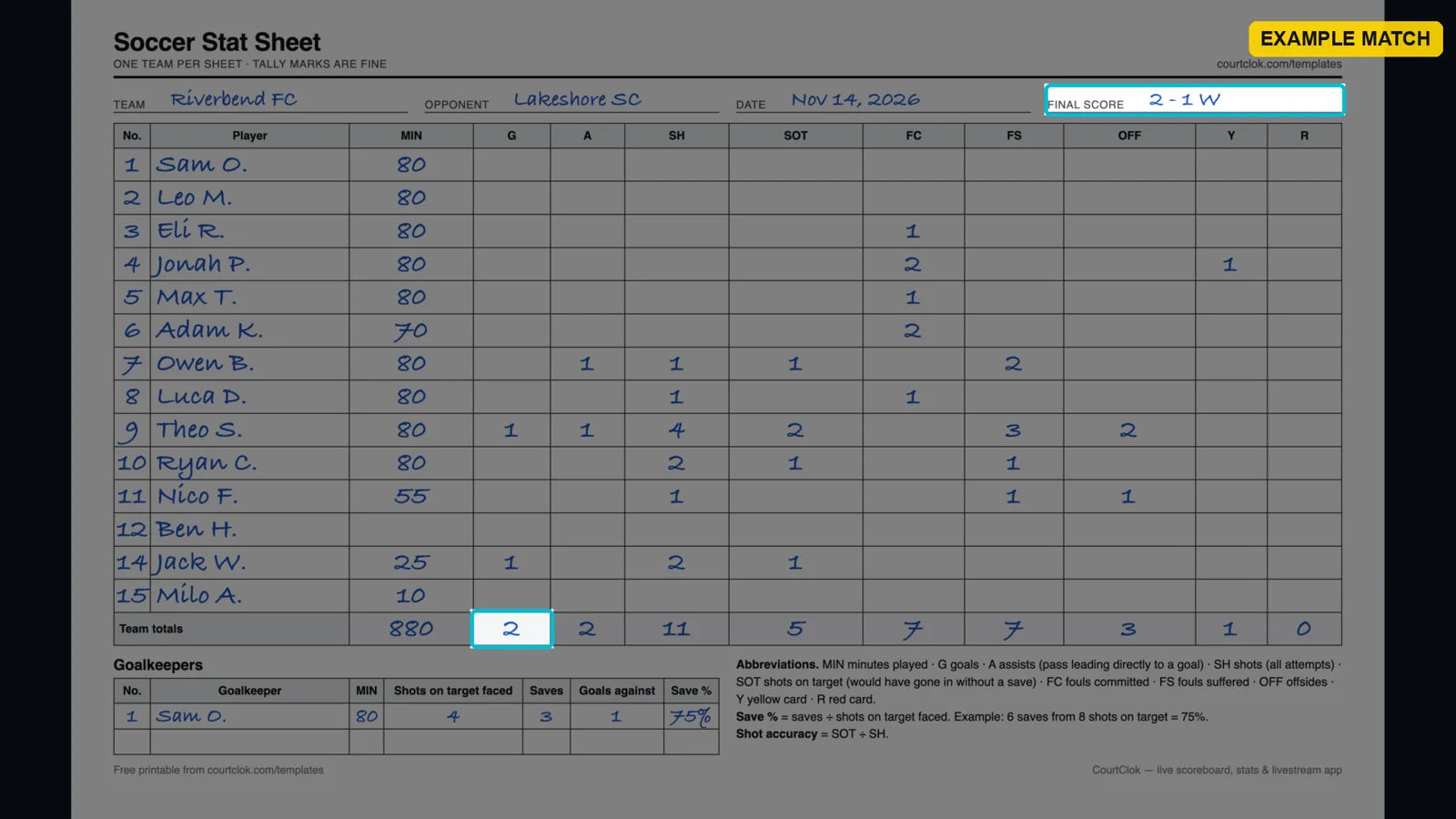
Team G equals your team's final score.
Team SOT is no bigger than team SH, and at least team G.
No player has A for their own goal.
Nobody has two yellows without a red.
Your keeper's saves plus goals against equals shots on target faced.
Team goals match the final score
Common mistakes and how to fix them
Mistake
How to catch it
Fix
Wide shots counted in SOT
SOT close to SH, keeper's saves don't match
SOT is only shots that would have gone in without a save
A goal left out of SOT
A player's SOT is smaller than their G
Every goal is a shot on target
Minutes kept live and lost
Team minutes don't equal players on the field × the match length
Work them out after the game from the substitution minutes
Offside position tallied without a whistle
More OFF than the referee called
Only tally offsides the referee penalises
Team G doesn't match the score
Totals row vs final score
Find the goal that's missing or doubled on the player rows
With 11 players on the field the whole match and no red cards, team minutes equal 11 × the match length: 11 × 80 = 880 in our example.
The easy way: keep score on your phone
Paper is fine for a stat keeper on the touchline. If you'd rather not keep the score and the clock by hand, the CourtClok app keeps the soccer score and the match clock for you.
SH is every shot. SOT is only shots that would have gone in without a save, so SOT can never be bigger than SH.
Write the minute of every substitution so you can work out minutes played after the game.
A second yellow in the same game is a red, so check the Y column before you write a yellow.
For the keeper, saves plus goals against should equal shots on target faced: 3 saves from 4 is 75%.
Soccer stat sheet questions
What's the difference between a shot and a shot on target?
A shot is any attempt at goal: on target, wide, high or blocked. A shot on target is one that would have gone in without a save. Every goal counts as a shot on target too.
How do you work out shot accuracy?
Shots on target divided by all shots. 5 on target from 11 shots is 45%.
How do you work out a goalkeeper's save percentage?
Saves divided by shots on target faced. 3 saves from 4 shots on target is 75%.
What do FC and FS mean on a soccer stat sheet?
FC is fouls committed by the player and FS is fouls suffered, meaning the player was fouled. Tally them each time the referee gives a foul.
Is two yellow cards a red card?
Yes. Under the Laws of the Game a player who receives a second caution in the same match is sent off.
How do I track minutes played?
Write down the minute of every substitution, then work out minutes after the game. A starter who comes off in the 55th minute played 55; the player who replaced them played the rest.
Is the soccer stat sheet free?
Yes. It's a free printable with 14 player rows, a team totals row and two goalkeeper lines on one page.
Rather keep score on your phone? CourtClok keeps the soccer score and the match clock for you.