
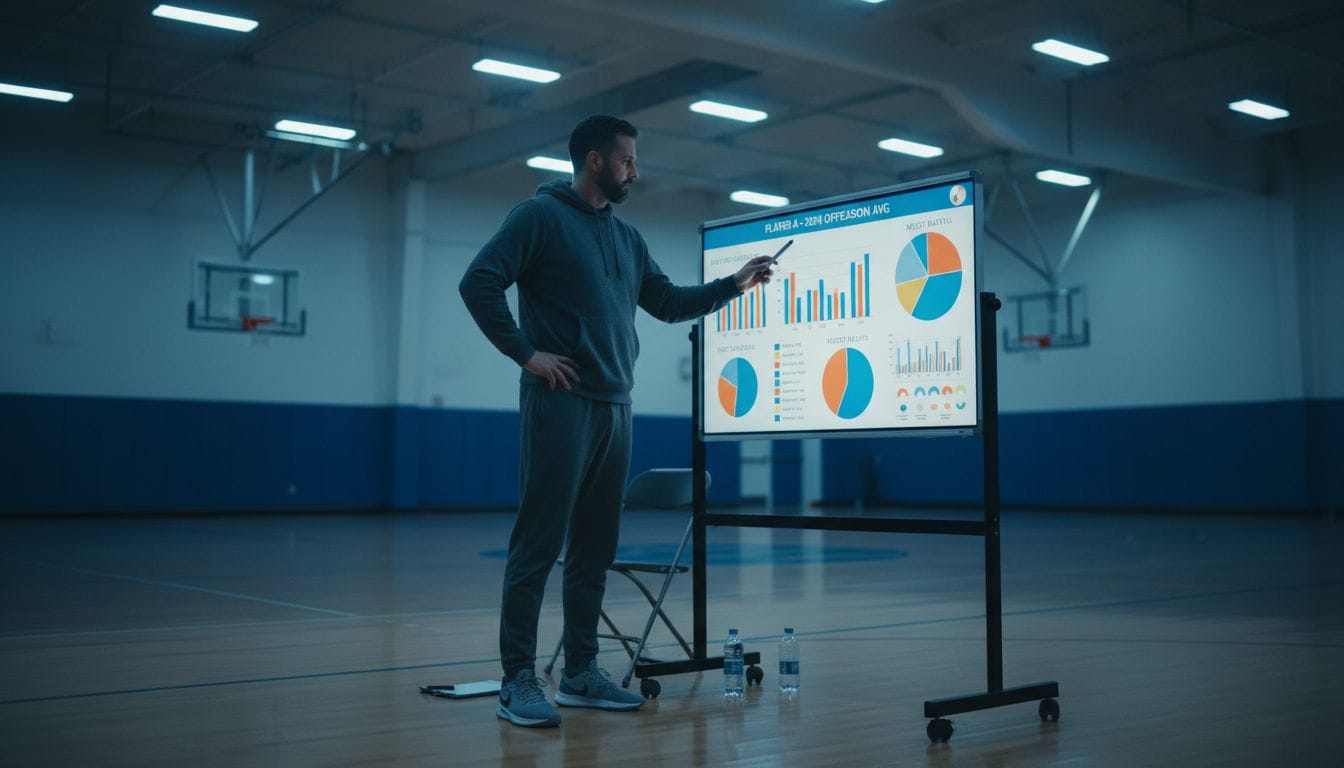
Why the Offseason Is Where Coaches Actually Get Better — And How to Make Yours Count
Most coaches finish their season, take a breath, and immediately start sprinting in whatever direction their frustration is pointing them. I get it. I've been there. You know exactly what went wrong — or at least you think you do. And that certainty feels so real, so urgent, that you just start running. But here's the thing that stopped me cold when I heard this discussed recently: that certainty? It might be your biggest obstacle.
There's a story about an Olympic endurance runner — one of the best in the world — who just missed the podium. He was convinced it was his interval training. Absolutely sure of it. So he was ready to overhaul his entire program based on that assumption. Except when he actually got tested by a high-performance trainer, the real limitation had nothing to do with his intervals at all. It was his psychological ceiling — his belief about what he was capable of. In one day, with no additional training, no rest, nothing different physically, he went from 22 minutes to 28 minutes and 12 seconds. Just by having a clear, laser-focused target. And then when the clock was taken away? Right back to 22 minutes. That story hit me like a freight train. Because it's not just about runners. It's about every coach who assumes they already know what the problem is.
The Off Season Is Where You Actually Get Better — If You're Honest About It
I've heard a lot of coaches talk about the offseason like it's a recovery period. A time to decompress, maybe run a few open gyms, start thinking about next year's roster. And sure, rest matters. But when I heard the framing that great coaches are masters of the offseason, I immediately thought — that's exactly right, and most coaches I know are leaving an enormous amount of growth on the table.
What struck me most was the idea that the offseason should be geared primarily toward individual player development, not team concepts. Weight room. Skill development. Things that are measurable. Tangible. Things you can actually see change. This is something I think about a lot, especially when watching teams that looked completely different from one November to the next. The leap didn't happen during the season. It happened in the months nobody was watching.
And that idea connects directly to something broader — the whole science of basketball athletic performance, from strength and conditioning to movement training, which is often the first thing coaches talk about wanting to improve but the last thing they actually structure properly in the offseason. It's easy to say "we need to get stronger." It's harder to build a real system around it.
The Three Phases Every Coach Goes Through — And Why You Need to Skip to Phase Three
Here's something that resonated with me deeply. There are basically three emotional phases coaches cycle through every year.
First, there's optimism. Pure, intoxicating optimism. Culture problems are going to fix themselves because a difficult player graduated. The sophomore who showed flashes is going to explode this year. You're more veteran, more experienced, more prepared. Everything feels possible.
Then reality hits. Practice starts. Games start. And you realize — maybe we're not quite what I thought we were.
Then, usually around December or January, you hit phase three. Clarity. This is who we are. This is what we actually need to do to win.
The question that I think every serious coach should be sitting with right now is: why are we waiting until December to get there? Why does it take half a season of live games to arrive at the clarity we could have reached in July with honest evaluation?
I don't fully agree that this is inevitable, because I've seen coaches who are genuinely self-aware skip phase one almost entirely and go straight to disciplined, eyes-open planning. But I'll admit — that takes a specific kind of psychological discipline that most of us, myself included, have to actively work at. The pull toward optimism is real. It feels good. It protects you from hard questions.
Which is exactly why the concept of an offseason postmortem is so valuable. Not a vibe check. Not a feeling. A structured, honest autopsy of your season. There are coaches who've made this kind of reflective shift the turning point of their entire career — not because they discovered some magical new drill, but because they finally got honest about what wasn't working and why.
The Problem With "Just Do Everything a Little Bit Better"
Going back to that Olympic runner story — the part that really gets me is the final iteration. Take away the clock, take away the specific target, tell him to just go past his previous best? Back to 22 minutes. Every time.
That's the coaching equivalent of saying "we just need to execute better" or "we need to be more disciplined." It sounds like a plan. It isn't one. It's a direction without a destination.
What actually works is identifying the precise, specific thing that is the highest-leverage change you can make — and then locking onto it with total clarity. That's the four-minute mile principle. Roger Bannister didn't just train harder in general. He targeted that number. Everything else organized around it.
I've seen this play out personally when watching teams that made dramatic jumps between seasons. The coaches who drove those improvements weren't trying to improve everything. They picked one or two things — maybe it was how quickly their players made decisions under pressure, or maybe it was their ability to generate consistent offense without relying on plays — and they attacked those things with precision. The coaches who tried to fix everything? They usually looked pretty similar to the year before.
There's a concept I keep coming back to here: what got you here won't get you there. It sounds like a motivational poster. But it's actually a call to do the uncomfortable work of admitting that your current ceiling isn't a talent ceiling — it might be a thinking ceiling. A planning ceiling. A willingness-to-question-your-own-assumptions ceiling.
And the only way to break through it is to start the offseason not with answers, but with the right questions. Which means slowing down before you speed up. Doing the postmortem before you write the plan. Understanding why modern basketball is increasingly demanding that coaches shift from system-first thinking to player development-first thinking — and honestly asking yourself where your program sits on that spectrum.
The 1% Better Principle and Why Coaches Overlook It
When I heard the reference to the British cycling team and James Clear's Atomic Habits, I immediately thought — yes, this is exactly the conversation basketball coaches need to be having. Most people know the story. Dave Brailsford took over a British cycling program that had won almost nothing for over a century, and his entire philosophy was simple: find every single thing that contributes to performance, and improve each one by just 1%. Not 10%. Not a dramatic overhaul. One percent. And they went on to dominate the Tour de France.
The reason this hits so differently in a basketball context is because coaches are conditioned to think in big swings. Big offensive schemes. Big recruiting wins. Big halftime speeches. But what about the pillow your player is sleeping on in a hotel room? What about the room temperature? These aren't soft ideas — there's real science behind sleep quality and recovery, and if you care about basketball athletic performance, including the strength, conditioning, and recovery habits that actually move the needle, you already know that marginal gains in rest and environment compound fast. This is something I think about a lot. The little things are not little. That line stuck with me.
What I also appreciated was the honesty here — most coaches don't have a written postseason checklist. The live poll confirmed it. Majority said no. And honestly? I'd bet that holds true at almost every level outside of high-major programs. We autopsy our game film. We rarely autopsy our process. That's a massive blind spot.

Standards Are the Foundation — And Most Teams Are Faking It
Mark's first draft pick from the postseason checklist was standards, and I don't think anyone should be surprised by that. What struck me most was how he framed it — standards drive behavior, and you can't build anything sustainable on top of shaky culture. That's not a new idea, but the way he made it immediately practical is what separated this from the usual motivational talk.
Three standards for a team meeting. That's it. Everyone on time. No cell phones. Sitting up, engaged. Simple. Enforceable. And the moment he described redirecting a player by asking them to recall the standard themselves — rather than just scolding them — I felt that. That's peer accountability without the coach becoming the bad guy every single time. It's also a much more sustainable model because the players start owning it. I've seen this play out personally in team environments where the coach tries to enforce everything themselves, and it always collapses under its own weight by February.
There's a broader coaching philosophy underneath this that connects to how punishing players as a primary enforcement tool tends to backfire — and replacing that with standards-based accountability is a genuinely better system. Not softer. Better. The distinction matters.
I also loved the 1-to-3 scale suggestion for staff meetings. Yes or no is useful for a quick audience poll, but inside a coaching room, binary thinking kills nuance. A two on enforcing your meeting standards opens a real conversation. A yes or no closes it. That's a small coaching adjustment with a real ripple effect on how honest your staff evaluations actually get.
Postmortems Only Work If You're Asking the Right Questions
Here's where I want to push back a little — not on the content, but on how most coaches will actually use a checklist like this. The danger with any structured postseason review is that it becomes a formality. You go through the list, you check boxes, you feel productive, and then you do mostly the same things next year. I've seen this happen. The checklist isn't the thing — the honesty you bring to it is the thing.
The self-scouting piece is what makes or breaks it. If you're genuinely asking "did we actually uphold our standards this season or did we let it slide by January?" — that's uncomfortable. Most coaching staffs aren't set up to have that conversation without it feeling like blame. And that's a real problem. Because if you're running a postseason review and everyone's being diplomatic, you're not doing an autopsy. You're doing a PR session.
This connects to something I've thought about a lot around how coaches present themselves and their programs — there's often a gap between the story a coach tells about their culture and the reality their players experience day to day. The postseason checklist, done honestly, is one of the few tools that can actually close that gap.
And frankly, the coaches who are willing to sit in that discomfort — to look at their meeting standards, their sleep protocols, their player development systems, all of it — those are the ones who actually improve year over year. Not because they had better talent. Because they had better self-awareness. That's the real aggregate gain. And sometimes it only takes one honest evaluation to completely change the direction of a coaching career.
Player Development Is More Than Skills — It's the Whole Human
When I heard the argument that player development beats skill development, I immediately thought — yes, finally someone is saying this out loud. There's a version of coaching that obsesses over jump shots and ball-handling drills while completely ignoring the person holding the ball. And I think that's a serious problem.
What struck me most was the distinction between developing a skill and developing a player. Skills are tools. But a player is a person with habits, a mindset, social needs, emotional wiring — and if you're only sharpening the tool while ignoring everything else, you're leaving most of your influence on the table. As coaches, we're often the loudest voice in a young person's life. That's not a small thing. Using that influence purely to improve someone's three-point percentage feels, honestly, like a missed opportunity at best and negligence at worst.
The IQ piece hit me hard too. I've seen this play out personally — players who become technically polished but have no idea when to use what they've learned. A player who struggles with decision-making under pressure isn't just missing a skill. They're missing the contextual understanding that turns skill into performance. Drilling moves without teaching reads is like handing someone a dictionary and calling them a writer.
And then there's the social development angle, which I don't think gets nearly enough attention. The bond-before-battle versus battle-before-bond dynamic between genders? That's real. I've seen teams with genuinely talented rosters fall apart because the social fabric was never built. You can have five skilled individuals and still have nothing. Cohesion isn't automatic — it's developed. And that's a coaching responsibility too.
This connects to something much bigger in how we think about basketball athletic performance and the full development of a player — it's never just physical. Strength, conditioning, movement, IQ, mindset, and social trust are all part of the same picture. Coaches who treat those as separate categories are always going to be working with an incomplete puzzle.
Standards, Scales, and the Courage to Draw a Line
The four-point scale conversation genuinely changed how I think about evaluation. Here's why it works — it forces a verdict. Above the line or below. No hiding in the middle. No comfortable seven out of ten. You're either performing at standard or you're not, and that clarity matters more than most coaches realize.
I don't fully agree with removing all middle ground in every context, because nuance has its place. But for standards? For culture? Yeah. Vague feedback breeds vague improvement. If everyone defaults to the middle number, the scale is useless. The recruiting anecdote — can't say seven or eight — is brilliant precisely because it makes you commit. It forces honest evaluation instead of diplomatic fuzziness.
The distinction between rules and standards landed hard for me too. A rule is rigid and punishes context. A standard is a value you're always measuring yourself against. The example of Jimmy being late because his mom had a hard day — that's exactly where rules collapse. A rigid rule in that situation punishes loyalty, punishes empathy, punishes real life. A standard says we value showing up early, we know Jimmy lives that standard, and we handle this like adults with judgment. If you've ever read about the real problem behind punishing players, you'll recognize this tension immediately — punishment-based systems often destroy the very culture they're trying to protect.
And the phone policy for coaches is something I think about a lot. You can't give away what you don't possess. That sentence alone is worth the entire conversation. If we're asking players to be present, locked in, phones away — and then a coach is sitting there scrolling — the standard is already dead. It doesn't matter what you wrote on the whiteboard. Culture is what people see you do, not what you tell them to do.
What this whole conversation reinforced for me is that the best offseasons aren't built around new plays or new drills — they're built around honest reflection. Where are we actually on that four-point scale? Are we developing whole players or just training skills? Are our standards real values or are they just rules wearing a nicer outfit? Those are uncomfortable questions. But they're the right ones. And the coaches willing to sit with that discomfort — to move from set plays to genuine player development and build something with real depth — those are the ones whose programs last.
That's what I took from this conversation more than anything. Not a system. Not a strategy. A mindset. Build the person. Uphold the standard. Draw the line. And have the courage to mean it.
Test Your Basketball IQ!
Beat the clock! 5 questions, 14 seconds per answer, 2:00 game clock. Can you get a perfect score before time runs out?

Put your knowledge to use
CourtClok keeps score, tracks player stats, and lets your fans follow along live — all from your phone. Free for any league or pickup game.