
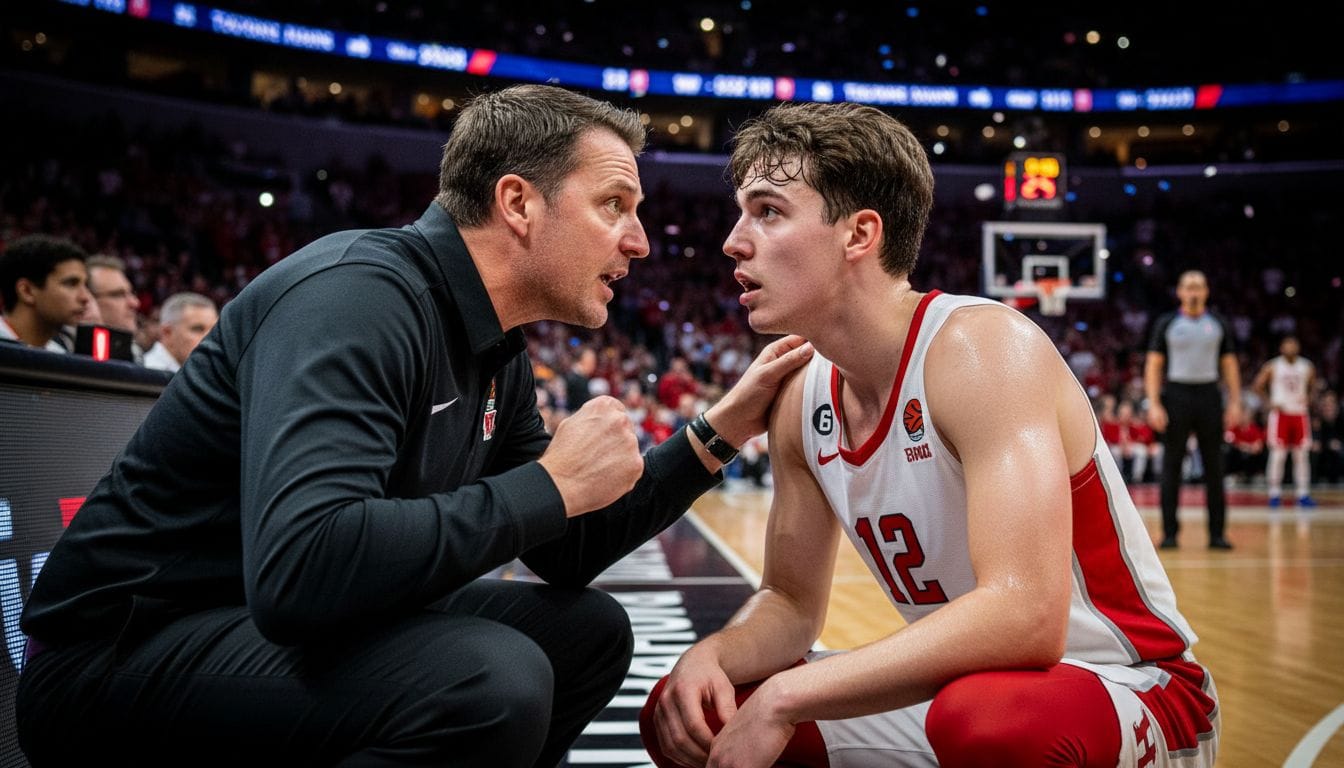
When in Doubt, Zoom Out: What Identity-Based Coaching Really Means for Basketball Leaders
Most coaches I know are obsessed with performance. Win percentage. Points per game. Shooting splits. And I get it — those numbers feel real, feel concrete. But here's what struck me when I sat with this podcast: what if your obsession with performance is actually the thing holding you back as a leader? What if the scoreboard isn't just measuring your players — it's measuring you, in ways that are quietly undermining everything you're trying to build?
This session is week four of a teaching tools cohort built around something called the SAVVY framework. The first three weeks covered simplicity, adversity, and victory tools. Week four is all about identity. And honestly? I think this might be the most important piece of the whole thing.
The Question Every Coach Needs to Sit With Right Now
The coach running this session opens with a question that I immediately wrote down: Is your identity rooted in your performance or your purpose?
Simple question. Genuinely hard to answer honestly.
Think about the last time your team lost badly. Or the last time a player you believed in completely fell apart in a big moment. How did that make you feel about yourself? Not about the game. About you. If the answer is "terrible" or "like a failure" — that's performance-based identity talking. And the argument here is that it's not just emotionally damaging, it makes you genuinely harder to follow as a coach.
When I heard this, I immediately thought about all the coaches I've watched get tight in big moments. Not because they didn't know the X's and O's — they absolutely did — but because you could see them needing the win for themselves. Players feel that. Kids especially feel that. And it changes the entire atmosphere of a team. This is something I think about a lot, especially watching youth and rec league coaches who pour everything into their teams but quietly tie their self-worth to every result.
The idea being presented here is clear: if your sense of value fluctuates with your win-loss record, your identity will always be unstable. And unstable leaders produce unstable teams.
The ID Camp Story That Reframes Everything
Here's where it gets really personal — and really good.
The coach shares a story from his own playing career. He's at an ID camp after college, trying to earn a professional contract. Scouts everywhere. Everything riding on performance. He plays day one completely zoomed in — if I play well, I get my shot. Then he approaches a Toronto Raptors scout he knows slightly and asks the obvious question: what do I need to do to make it?
The scout's answer? "Do you have your identity written down somewhere you see every day?"
He said no. The scout told him flat out: then you don't have a chance.
I've seen this play out personally. Not at the professional level, but I've watched players who were technically talented just never quite get there — and when you looked closely, they were chasing outcomes instead of living out an identity. They wanted to be good rather than actually being the thing they wanted to become. There's a massive difference.
So he goes back to the hotel. Writes down: I am a pro basketball player. Comes back day two. Plays better. Goes back to the scout. Scout asks if he has a plan — how a pro prepares, thinks, eats, trains. He doesn't. Scout says again: then you're not actually a pro yet.
Back to the hotel. Writes the plan. Shows up day three. Performs his best. And eventually — not from that camp directly, but as a consequence of that mindset shift — he does play professionally.
What struck me most was how gradual the shift was. Day one to day three. It wasn't an overnight transformation, it was a progressive movement from performance focus to purpose focus. And that mirrors what the best player development thinking suggests — that the ecological learning approach in basketball coaching is built on exactly this principle: create the right environment and identity, and performance emerges from it naturally rather than being forced.
When in Doubt, Zoom Out — and Why This Principle Is So Powerful
This is the first major principle introduced in this session, and I don't fully disagree with anything about it — which, if you know me, is saying something.
"When in doubt, zoom out."
Short. Memorable. And actually pretty profound when you sit with it.
The logic goes like this: doubt is almost always a product of zooming in on a moment. A loss. A missed shot. A practice that went sideways. You zoom in on the moment, and the moment looks like failure, and failure makes you question everything. But doubt lives at the performance level. Purpose, on the other hand, doesn't fluctuate the same way. If your purpose is to develop young players into confident, capable people — that purpose doesn't disappear when you lose by 20 on a Tuesday night.
I've seen this play out personally with coaches who went through rough stretches. The ones who survived and thrived were always the ones who could articulate why they were doing what they were doing beyond wins and losses. They had something to come back to. Something stable. The coaches who crumbled were often the more technically gifted ones — but their identity lived entirely in outcomes, and when outcomes turned bad, they had nothing underneath them.
This connects directly to some of the broader thinking around coaching tools and how to build a complete coaching philosophy — because tools without identity behind them are just tricks. They work until they don't. But when your tools are rooted in a clear sense of purpose, they're expressions of who you actually are as a coach, and that's when they carry real weight.
There's also something here about how this principle applies to players, not just coaches. How many times have you watched a player get one bad call, miss two shots in a row, and then completely fall apart mentally for the rest of the game? That's performance-based identity in a 14-year-old. They don't have a "zoom out" mechanism yet. Part of our job as coaches is building that in them — and you can't teach what you haven't learned yourself. If punishing players for mistakes is part of your coaching approach, you're almost certainly reinforcing performance-based identity rather than helping them build anything stable.
What I find genuinely interesting about this framework is that it's not soft or touchy-feely in the way some "identity coaching" conversations can feel. It's practical. Write it down. Build a plan. Live it out. There's rigor here. And the argument isn't that performance doesn't matter — it's that purpose is the foundation performance has to be built on, or the whole thing is structurally unsound.
Can you build a winning team on performance-based identity alone? Sure. Maybe. For a while. But the coaches who build programs — not just teams — seem to consistently be the ones operating from something deeper than a box score.
When I Heard "Zoom Out" — I Finally Understood Why So Many Coaches Self-Destruct
There's a stat I keep coming back to: research consistently shows that coaches make their worst decisions during the moments they feel the most pressure. Not because they're bad coaches. Because they're too zoomed in.
This section of the podcast hit me hard. The cryptocurrency analogy? Honestly, it's one of the best coaching metaphors I've ever heard. The investor who sold when things dropped and bought when things rose — he wasn't irrational. He was just reacting to the moment instead of trusting the bigger belief. And coaches do this constantly. A bad loss happens and suddenly we're scrapping the whole system. A parent complains and we start second-guessing our philosophy. A player struggles and we panic-switch their role. That's all performance-based thinking. That's all being too zoomed in.
When I heard this, I immediately thought about how many coaches I've seen torch genuinely good long-term processes because of one bad weekend. They didn't have a written purpose they could return to. They had nothing to zoom out to. So the noise won.
What struck me most was the challenge to actually write your purpose down — and the point that if you can't say it off the top of your head, you probably haven't clarified it enough. That's blunt. But it's true. I've had conversations with coaches who've been doing this for fifteen years and still can't articulate why in one or two sentences. And you can feel it in how they coach. They drift. They chase results. They contradict themselves between sessions because there's no north star pulling everything together.
This is something I think about a lot — especially in the context of the broader set of coaching tools that actually build sustainable programs. Purpose isn't soft. It's structural. Without it, every other tool you pick up is just noise.

I don't fully agree with everything here, though. There's a version of "zoom out" thinking that becomes an excuse to never adjust. Some coaches hide behind their philosophy when real-time feedback is genuinely telling them something important. The key — and I think this is what was being said — is that you zoom out to clarify, not to avoid. Big difference.
The "You Me We" Framework — And Why Most Coaches Are Getting the Order Backwards
This is the part that genuinely surprised me.
The framework is simple: You. Me. We. And the argument is that elite coaches — the Coach K's, the Phil Jacksons — spend a disproportionate amount of their coaching time on the You. The individual. Not the team. Not the system. The person standing in front of them.
I've seen this play out personally. The coaches who had the biggest impact on me weren't the ones who ran the best drills or drew up the cleanest plays. They were the ones who saw me specifically. Who said something that made me feel like they'd actually thought about me before practice started. That's You coaching. And it's rarer than it should be.
The numbers people were dropping into the chat — 20%, 30% of coaching directed at individuals — honestly track with what I observe too. Most coaching is corporate. It's directed at the group because it's easier, faster, and feels more efficient. But it isn't more efficient. It's just louder.
Phil Jackson's Sacred Hoops gets referenced here and it's the perfect example. That entire book is about identity work. How do you coach Dennis Rodman? How do you make Michael Jordan a better leader? Those aren't team problems. Those are You problems. And Jackson obsessed over them. That's why those Bulls teams were what they were.
The index card idea — strength, stretch, and Roar for every single player — is something I want to steal immediately. It forces you to think about each person as an individual before they ever step on the floor. It's the kind of preparation that separates coaches who build real relationships from coaches who just manage rosters. And once a player knows their Roar — their identity, their role, their purpose within your system — everything else clicks faster.
What I find interesting is how this connects to the broader argument about ecological learning in basketball — the idea that players develop better when the environment itself teaches them, when constraints are designed around the individual. The You Me We framework is almost the coaching philosophy version of that same idea. Start with the person. Build outward.
The Trainer Conflict Nobody Talks About — And Why It Reveals Everything About Identity Coaching
The transcript cuts off right as a genuinely fascinating problem gets introduced: a coach dealing with a new individual trainer who has entered one of his player's development picture. And honestly? This is one of the most real, messy, under-discussed challenges in basketball coaching right now.
It's a You coaching problem wearing a team problem's clothes.
When a player has a personal trainer outside the program — especially one with a strong personality or a different philosophy — the coach loses some of that You connection. The player starts getting identity signals from two places. And if those signals conflict, the player doesn't become confused about their game. They become confused about who they are as a player. That's deeper. That's harder to fix.
I've seen this create real fractures. Not because the trainer was bad. Not because the coach was bad. But because nobody sat down and aligned on the player's identity first. Nobody did the index card conversation. Nobody agreed on what the Strength, Stretch, and Roar actually were for that specific person.
This is also why the shift some coaches make away from traditional individual skill work toward more game-connected development matters so much. When training is disconnected from identity — when it's just moves and mechanics in a vacuum — it's easy for outside voices to pull a player in a different direction. But when a player knows why they're working on something, when it connects to their role and their purpose inside the team, outside noise has less room to take hold.
The question the podcast is building toward — how do you handle this specific conflict — is one I genuinely don't have a clean answer to. But I think the framework being set up here is the right starting point. You coaching first. Identity clarity first. Then, whatever conflict exists on the outside has less power over what happens on the inside.
When Someone Else Defines Your Players Before You Do
There's a story in this conversation that stopped me cold. A coach — good team, legitimate state title contender — has a private trainer move into his area. His players start working with that trainer individually. Great, right? Extra reps, extra development. Except the trainer starts telling these players who they are. What kind of player they should be. And that identity directly conflicts with the roles the coach needs them to play for the team to win.
When I heard this, I immediately thought — how many coaches are silently dealing with this exact problem right now? Probably more than we realize. And here's the thing: the coach isn't the villain for being frustrated. The trainer isn't necessarily wrong either. The real issue is a vacuum. Nobody filled that identity space first.
The line that hit hardest: "If you don't define the identity for your players, someone else will do it for you." That's not just true in basketball. That's just true. And the fix being proposed is deceptively simple — a note card. Within the first two weeks of the season, every player gets a note card with three things written on it from you, their coach.
Strength. What they genuinely bring to the team. Their highest value. What gets them on the floor.
Stretch. What you need them to grow into this season.
Roar. The deeper personal challenge — the fear they need to run toward.
I've seen this play out personally — players grinding at skills their coach never valued, completely confused about why they're not getting minutes. They thought scoring was the answer. The coach wanted rebounding and defense. Nobody ever said it plainly. The result? Frustration on both sides for months. A season half-wasted on a miscommunication that a single honest conversation could have prevented.
What struck me most was the reaction coaches described when players actually receive this note card. Shock. Genuine shock. "You think I'm good at this? I didn't even know that's what you valued." That moment of shock isn't cute — it's a red flag. It means a player has been operating without a compass, guessing what matters, probably for years. This is something I think about a lot when I consider how much potential gets lost not through lack of talent, but through lack of clarity. If you're still relying on instinct and hoping players pick up on your expectations, understanding the full range of modern coaching tools available to you might be the single biggest shift you can make this offseason.
The Roar — Why Running Toward Fear Is the Whole Point
Okay. The lion story. I'll be honest — when this came up, I expected it to be one of those motivational metaphors that sounds great in a gym but evaporates the moment practice ends. I was wrong.
Here's the image: a pride of lions hunting antelope stations their oldest, arthritic lion at one edge of a clearing. The young, fast lions surround the opposite side. The old lion roars. The antelope panic and run away from the sound — straight into the claws of the waiting hunters. The only way an antelope survives is to run toward the roar. Toward the danger that isn't actually there.
Basketball, they said, is a game of opposites. And so is growth.
The Roar is whatever your player is genuinely afraid of. Holding teammates accountable. Communicating loudly. Being different from the crowd. Getting in the weight room when their body is begging them to stop. It's personal. It's specific. And it has nothing to do with performance metrics — it has everything to do with who they're becoming. This connects directly to ideas I've been thinking about since reading about the ecological learning approach in basketball coaching, which similarly argues that development isn't just skill acquisition — it's building the whole person inside real, pressured environments.
What I don't fully agree with is the assumption that every coach knows their players deeply enough to assign a genuine Roar within two weeks. Some do. Many don't — not because they don't care, but because they haven't built the kind of relationship where a player would even reveal what they're actually afraid of. The note card is a powerful idea, but it only works if the relationship underneath it is real. Otherwise you're just guessing, and you might assign someone a Roar that misses entirely.
That said — the underlying principle is undeniable. Purpose-based coaching versus performance coaching. The example they gave is simple but clarifying: instead of saying "you're turning the ball over," you say "remember your strength is your passing — when you peek at the rim, you're actually using what makes you valuable." Same correction. Completely different meaning. One is criticism. The other is identity reinforcement. The problem behind punishing players has always been that it tells them what not to do without giving them anything to run toward. Purpose-based coaching flips that entirely.
And that moment at the end of this conversation — Jennifer getting goosebumps thinking about what her career could have been if someone had coached her purpose instead of just her performance — that got me. It's not abstract. It's real. Every player sitting in a gym right now has a Roar they're running away from. Most of them don't even know it. And most coaches have never thought to ask.
Final Thought
What this whole conversation kept returning to — underneath the frameworks, the note cards, the lion metaphors — is something embarrassingly simple: players need to know that you see them. Not just as a role, not just as a piece of a rotation, but as a person trying to figure out who they are. The strength-stretch-Roar framework is really just a structure for delivering that message consistently and clearly. Done right, it doesn't just improve performance — it changes the entire emotional texture of a season. Feedback lands differently. Conflict drops. Players stop guessing and start committing. I genuinely think if more coaches walked into their first team meeting this fall with a note card for every single player, prepared and specific, we'd see fewer mid-season meltdowns, fewer confused bench players, and fewer kids who quietly quit on a team they were never fully included in. Listening to your players during timeouts matters — but this is the step that comes first. Know who they are. Tell them. Then everything else gets easier.
Test Your Basketball IQ!
Beat the clock! 5 questions, 14 seconds per answer, 2:00 game clock. Can you get a perfect score before time runs out?

Put your knowledge to use
CourtClok keeps score, tracks player stats, and lets your fans follow along live — all from your phone. Free for any league or pickup game.